


Advertisement|Remove ads.
Procept BioRobotics Stock Surges After Strong Q3 Earnings, Outlook Boost: Retail Cheers On



Shares of Procept BioRobotics Corp. ($PRCT) soared 27% on Monday after the company reported a narrower-than-expected loss for the third quarter and raised its fiscal year revenue outlook.
The surgical robotics firm posted Q3 revenue of $58.4 million, exceeding analyst expectations of $53.18 million, while earnings per share came in at a loss of $0.40, compared to the consensus estimate of a $0.49 loss.
Notably, U.S. handpiece and consumables revenue jumped 74% to $29.6 million, and international revenue more than doubled to $6.2 million.
Procept raised its fiscal year 2024 revenue guidance to a range of $222.5 million to $223 million, up from the previous estimate of $217 million, above the consensus of $217.06 million.
The company also projects a full-year gross margin of approximately 61%, an increase from earlier guidance of 59%.
“After receiving HYDROS FDA clearance in August, we successfully converted the third quarter capital pipeline, manufactured sufficient quantities of commercial product, trained our clinical teams while mitigating downside pressure on procedures, and effectively managed customer relationships during this critical phase of our Company's growth,” said CEO Reza Zadno.
“As a result, we delivered another successful quarter with annual revenue growth of 66% and record gross margins of 63.2%."
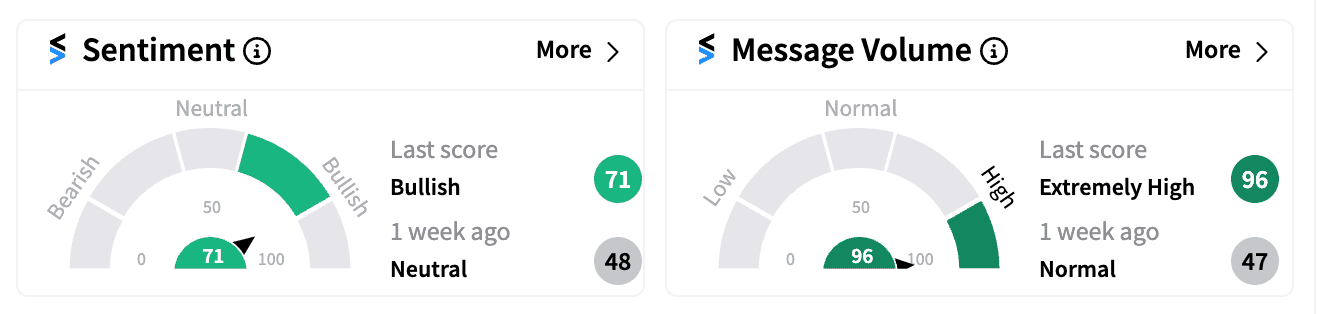
On Stocktwits, retail sentiment for PRCT shifted to a ‘bullish’ stance, coinciding with a significant increase in message volume.
Trading volume reached 3.6 million shares by 2 p.m. ET, more than six times the daily average.
The HYDROS Robotic System, designed for treating benign prostatic hyperplasia, is a key component of the company’s offerings and is powered by AI to enhance surgical precision while preserving critical functions.
PRCT shares have more than doubled this year, reflecting growing investor confidence in the company’s innovative technology and strong market performance.
For updates and corrections, email newsroom@stocktwits.com
Read next: Tesla Stock Ticks Up After Price-Target Hikes, But Retail Wary Of Key Resistance Level

Latest News
/filters:format(webp)https://news.stocktwits-cdn.com/large_Getty_Images_2249184989_jpg_2f36d82a30.webp)
/filters:format(webp)https://news.stocktwits-cdn.com/Anushka_Basu_make_me_smile_in_the_picture_b92832aa_af59_4141_aacc_4180d2241ba8_1_2_png_1086e0ed8c.webp) Anushka Basu·59m ago
Anushka Basu·59m ago/filters:format(webp)https://news.stocktwits-cdn.com/large_Getty_Images_950698324_jpg_d6201b2562.webp) Anushka Basu·2h ago
Anushka Basu·2h ago/filters:format(webp)https://news.stocktwits-cdn.com/large_Getty_Images_951165788_jpg_24c6559b2b.webp) Anushka Basu·4h ago
Anushka Basu·4h ago/filters:format(webp)https://news.stocktwits-cdn.com/large_Getty_Images_1368998806_2_jpg_e532306557.webp) Anushka Basu·5h ago
Anushka Basu·5h ago/filters:format(webp)https://news.stocktwits-cdn.com/large_Getty_Images_1163013566_jpg_dc3a81571d.webp) Anushka Basu·7h ago
Anushka Basu·7h ago/filters:format(webp)https://news.stocktwits-cdn.com/large_Getty_Images_2229273884_jpg_b009b52b81.webp) Anushka Basu·7h ago
Anushka Basu·7h ago