


Advertisement|Remove ads.
Saks Fifth Avenue Owner’s Collapse Signals A Reckoning For US Department Store Chains — Who’s Still Holding On?
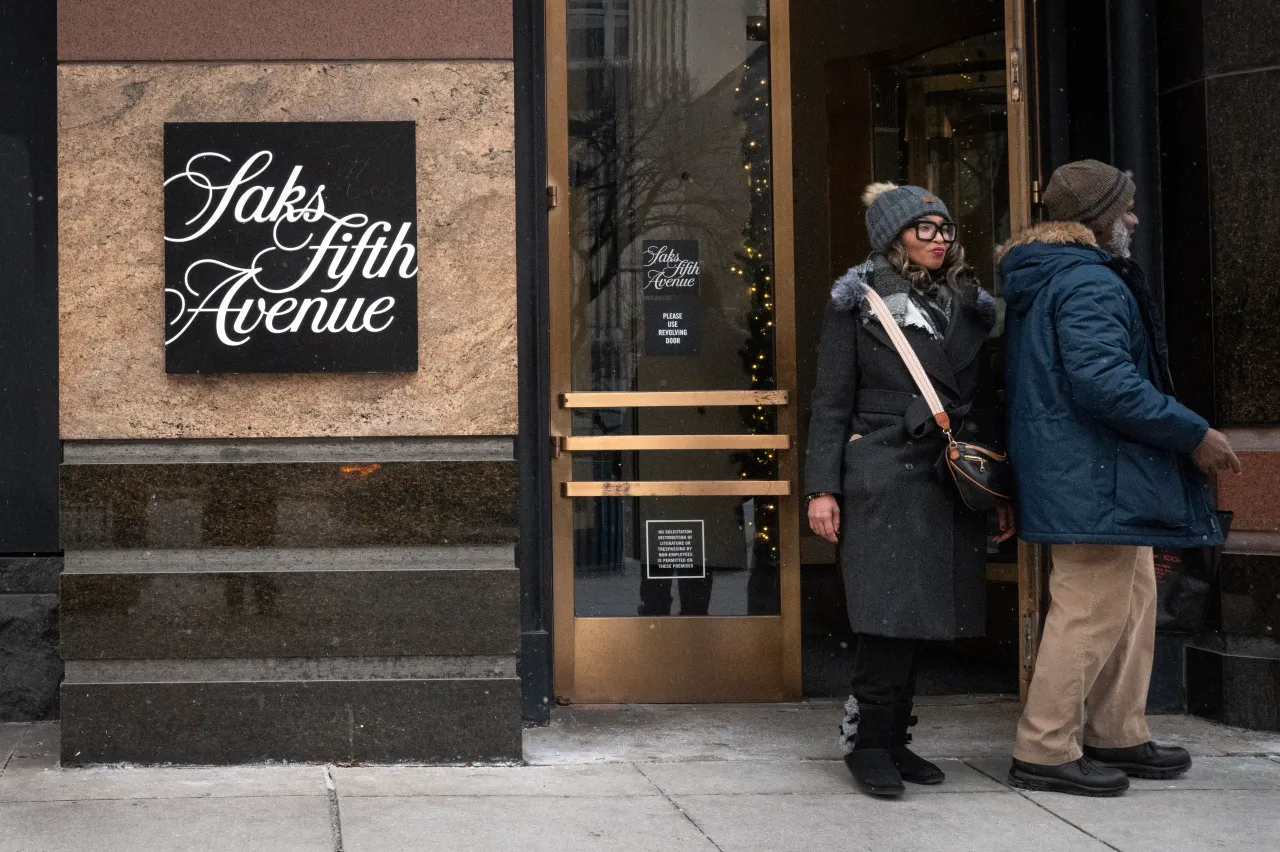


- Saks also named Geoffroy van Raemdonck as its new CEO, effective immediately following the bankruptcy.
- The company’s acquisition of Neiman Marcus in 2024, which gave it strong negotiating power with Vendors, put the former in further debt.
- Shares of Kohl’s closed down nearly 6% on Wednesday, and Macy’s traded 4% lower following the Saks bankruptcy.
Advertisement|Remove ads.
The retail landscape has been anything but rosy for big department stores, and one of the latest to succumb to the uncertainty is Saks Global. The upscale chain has struggled to recover from the COVID-19 pandemic, mounting competition, and an increasingly cautious American consumer.
Saks is not alone. Department store peers such as Macy’s and Kohl’s have also faced intense pressure as shoppers trade down to cheaper private-label brands and flock to ultra-low-cost online rivals like Shein and Temu, which have surged in popularity as e-commerce becomes the norm.
Saks Bankruptcy
Saks fought to stay afloat, but its 2024 acquisition of Neiman Marcus — intended to boost scale and strengthen its negotiating power with vendors — ultimately increased its debt burden. Neiman Marcus itself struggled to regain momentum after emerging from bankruptcy in 2020, following widespread store closures during the pandemic that battered sales and growth.
Advertisement|Remove ads.
Saks Global’s portfolio includes Saks Fifth Avenue, Neiman Marcus, Bergdorf Goodman, Saks OFF 5TH, Last Call, and Horchow. The company said it has secured a financing commitment of approximately $1.75 billion and confirmed that its stores will remain open. Saks also announced that Geoffroy van Raemdonck will take over as CEO effective immediately. Van Raemdonck, who previously led Neiman Marcus Group, succeeds Richard Baker following the acquisition.
Long a symbol of luxury, the flagship Saks Fifth Avenue store remains a high-end shopping destination, housing exclusive collections from brands such as Chanel and Burberry.
The Story Of Macy’s And Kohl’s
Even Macy’s and Kohl’s, which have fought long and hard to remain relevant, are now closing underperforming stores, boosting more private-label brands, and changing top leadership in an attempt to revive their business.
Advertisement|Remove ads.
Macy’s CEO Tony Spring noted last year that uncertainty about the impact of tariffs on demand has made consumers more cautious. Macy’s has been focusing on profitable locations and newer product launches at its high-end departmental store, Bloomingdale’s, and the beauty chain, Bluemercury, which have shown promising growth.
In November, Kohl’s named Michael Bender as its full-time CEO to oversee a turnaround at the department store, which is now trying to recapture its lost glory. Under Bender, the company has course-corrected over the past couple of quarters and has been emphasizing on its exclusive brands.
Shares of Kohl’s closed down nearly 6% on Wednesday, and Macy’s traded 4% lower following news of the Saks bankruptcy.
Advertisement|Remove ads.
How Are Stocktwits Users Reacting?
Retail sentiment on Macy’s was in the ‘bearish’ territory compared to ‘bullish’ a week ago, with message volumes at ‘high’ levels, according to data from Stocktwits.
While sentiment on Kohl’s dipped to ‘bearish’ from ‘neutral’ a week ago, with volumes of messages at ‘high’ levels.
Shares of Macy’s have gained more than 52% in the last 12 months, while Kohl’s has gained 50% for the same period.
Advertisement|Remove ads.
For updates and corrections, email newsroom[at]stocktwits[dot]com.
Comments posted here will also appear on symbol pages.

Latest News
/filters:format(webp)https://news.stocktwits-cdn.com/large_Getty_Images_2294264991_a1d08b075d.jpg)
/filters:format(webp)https://news.stocktwits-cdn.com/Anushka_Basu_make_me_smile_in_the_picture_b92832aa_af59_4141_aacc_4180d2241ba8_1_2_png_1086e0ed8c.webp) Anushka Basu·9h ago
Anushka Basu·9h ago/filters:format(webp)https://news.stocktwits-cdn.com/large_Getty_Images_1925090359_f160f05588.jpg) Anushka Basu·9h ago
Anushka Basu·9h ago/filters:format(webp)https://news.stocktwits-cdn.com/large_Getty_Images_2213700296_87303c323b.jpg) Anushka Basu·10h ago
Anushka Basu·10h ago/filters:format(webp)https://news.stocktwits-cdn.com/large_franklin_templeton_OG_jpg_4b3a7330d9.webp) Anushka Basu·12h ago
Anushka Basu·12h ago/filters:format(webp)https://news.stocktwits-cdn.com/large_Getty_Images_1445160636_5780a5fdde.jpg) Anushka Basu·13h ago
Anushka Basu·13h ago/filters:format(webp)https://news.stocktwits-cdn.com/Getty_Images_540198451_jpg_3e5f3d8ee7.webp) Anushka Basu·14h ago
Anushka Basu·14h ago