


Advertisement|Remove ads.
Cathie Wood, Robinhood CFO Agree Current IPO System Has Failed Retail — And Point To SpaceX As Proof


- According to Wood and Robinhood's Shiv Verma, breakout tech companies no longer go public early, allowing institutional investors to buy the steepest growth before retail investors.
- SpaceX, worth $1.5 trillion to $2 trillion, is the most notorious example of non-accredited investors being excluded from its rise.
- Both executives called the SEC's accredited-investor rule "antiquated," with Robinhood advocating a knowledge-based wealth test.
Advertisement|Remove ads.
Ark Investment Management CEO Cathie Wood and Robinhood Markets, Inc. finance chief Shiv Verma agree that the traditional IPO structure has completely failed, and SpaceX, valued at nearly $2 trillion before it even went public, proves it.
In an interview with Wood earlier this week, Verma argued that once massive wealth was generated for early investors in Amazon.com Inc., Alphabet, Inc., and Meta (formerly Facebook), leading tech companies remain privately held for long periods, institutional investors seize the highest growth gains ahead of time, and retail investors bear losses as a result.
"If you go back in history, Amazon, Google, and Facebook went public at hundreds of millions or single-digit billions. Today, you don't see that anymore," Verma said. "The early growth accrues to a small group of institutional investors."
Advertisement|Remove ads.
The most obvious example, Wood said, is SpaceX, which is valued at between $1.5 trillion and $2 trillion and may go public this year. She pointed out that over the past 25 to 30 years, the number of publicly listed U.S. companies has roughly halved, as founders avoid the bureaucracy and disclosure burden of being public.
According to media reports, Elon Musk’s space exploration company aims to make its market debut as early as June 12 and has selected Nasdaq as its listing exchange.
Both executives blamed the SEC’s recognized investor rule, which generally restricts access to private markets to those with a net worth of $1 million or annual income of $250,000. Verma called the wealth test “antiquated” and said Robinhood is pushing for a knowledge-based alternative that would let investors take a test to prove they understand the risks, regardless of income.
Advertisement|Remove ads.
Wood also pointed to the emergence of multi-layer special-purpose vehicles, or SPVs, in which preferred companies receive private allocations and then resell stakes, with fees piled three layers deep. "These fees upon fees are something that many investors, accredited or non-accredited, are not aware of," she said. In one case, Wood said, the company's management did not know that its equity had been rolled up into an SPV that was part of a public fund.
Among the most closely watched retail vehicles for indirect exposure to SpaceX include Destiny Tech100 (DXYZ), Tema Space Innovators ETF (NASA) and ERShares Private-Public Crossover ETF (XOVR).
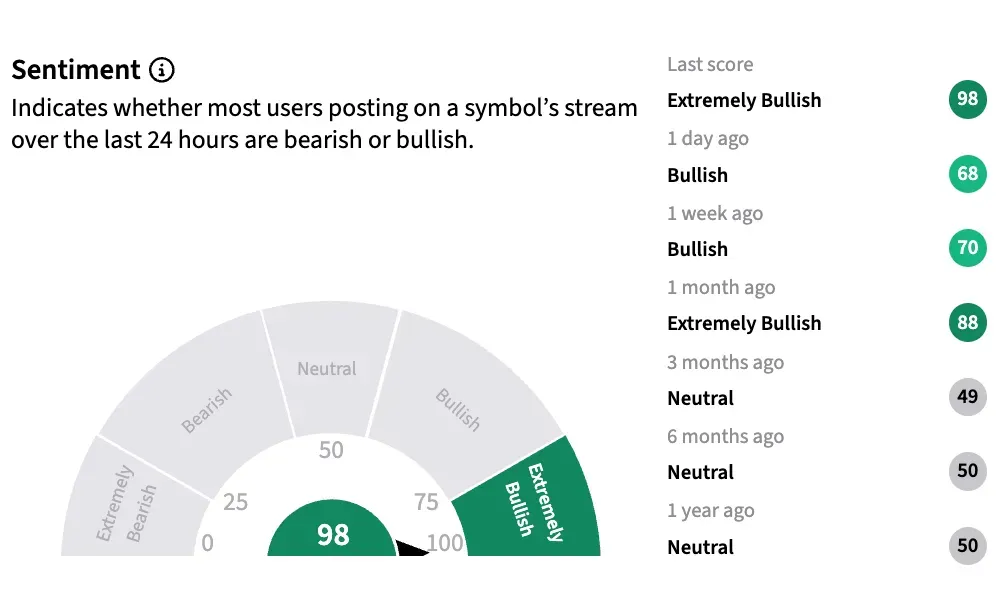
SpaceX (SPACEX) was the top trending ticker on Stocktwits, with retail sentiment improving to ‘extremely bullish’ from ‘bullish’ a day earlier. Message volume also improved to ‘extremely high’ from ‘high’ levels over the past day.
Advertisement|Remove ads.
Structural Fixes Already In Motion
Ark has a $750 million interval fund, ARKVX, which trades at net asset value and allows quarterly redemptions to fill the access void. Robinhood’s newly launched RV1 is a closed-end fund listed on the New York Stock Exchange with daily liquidity and no accreditation requirement.
Wood and Verma also challenged the notion of “dumb money,” citing data showing that retail investors held onto IPOs longer than institutional investors. But without a change in the rules, warned Wood, the next Amazon will be built and owned without them.
On April 14 of this year, the SEC approved FINRA’s proposed amendments to Rule 4210, which formally eliminated the $25,000 minimum equity requirement and the “pattern day trader” designation itself. A few days later, FINRA issued a notice stating that the new rule would take effect on June 4, 2026, giving brokerages up to 18 months to fully implement the changes.
Advertisement|Remove ads.
Among the other big IPOs this year are AI startups Anthropic and OpenAI, which make the immensely popular Claude and ChatGPT chatbots, both reportedly targeting trillion-dollar valuations.
For updates and corrections, email newsroom[at]stocktwits[dot]com.
Advertisement|Remove ads.
Comments posted here will also appear on symbol pages.

Latest News
/filters:format(webp)https://news.stocktwits-cdn.com/large_Getty_Images_2295831097_b515d94e2b.jpg)
/filters:format(webp)https://news.stocktwits-cdn.com/1707726834303_jpg_11f20a9aa9.webp) Shashank Nayar·45m ago
Shashank Nayar·45m ago/filters:format(webp)https://news.stocktwits-cdn.com/large_rocket_lab_peter_beck_jpg_4d8fc790a1.webp)
/filters:format(webp)https://news.stocktwits-cdn.com/unnamed_jpg_9dff551b50.webp) Anan Ashraf·1h ago
Anan Ashraf·1h ago/filters:format(webp)https://news.stocktwits-cdn.com/large_Federal_Reserve_a31f9e5606.jpg) Shashank Nayar·1h ago
Shashank Nayar·1h ago/filters:format(webp)https://news.stocktwits-cdn.com/gettyimages_2296214136_594x594_1_ed9bb6d607.jpg) Anan Ashraf·2h ago
Anan Ashraf·2h ago/filters:format(webp)https://news.stocktwits-cdn.com/large_Getty_Images_2169449321_719241c1ea.jpg) Anan Ashraf·3h ago
Anan Ashraf·3h ago/filters:format(webp)https://news.stocktwits-cdn.com/large_Getty_Images_1688507143_jpg_27b19431c5.webp) Shashank Nayar·3h ago
Shashank Nayar·3h ago