


Advertisement|Remove ads.
SPCE Stock Bucks Space Sector Selloff Ahead Of SpaceX IPO — Richard Branson's Virgin Galactic Torches $64M In Short Bets


- SPCE outperformed the broader space sector as stocks including RDW, RKLB, LUNR and ASTS declined ahead of SpaceX's IPO.
- Short interest stands at 23.2% of float, the highest since April 14, while trading volume hit 286.1 million shares, which is 12x normal levels.
- Virgin Galactic remains on track for Q3 glide-flight testing and Q4 rocket-powered testing of its Delta-class spacecraft.
Advertisement|Remove ads.
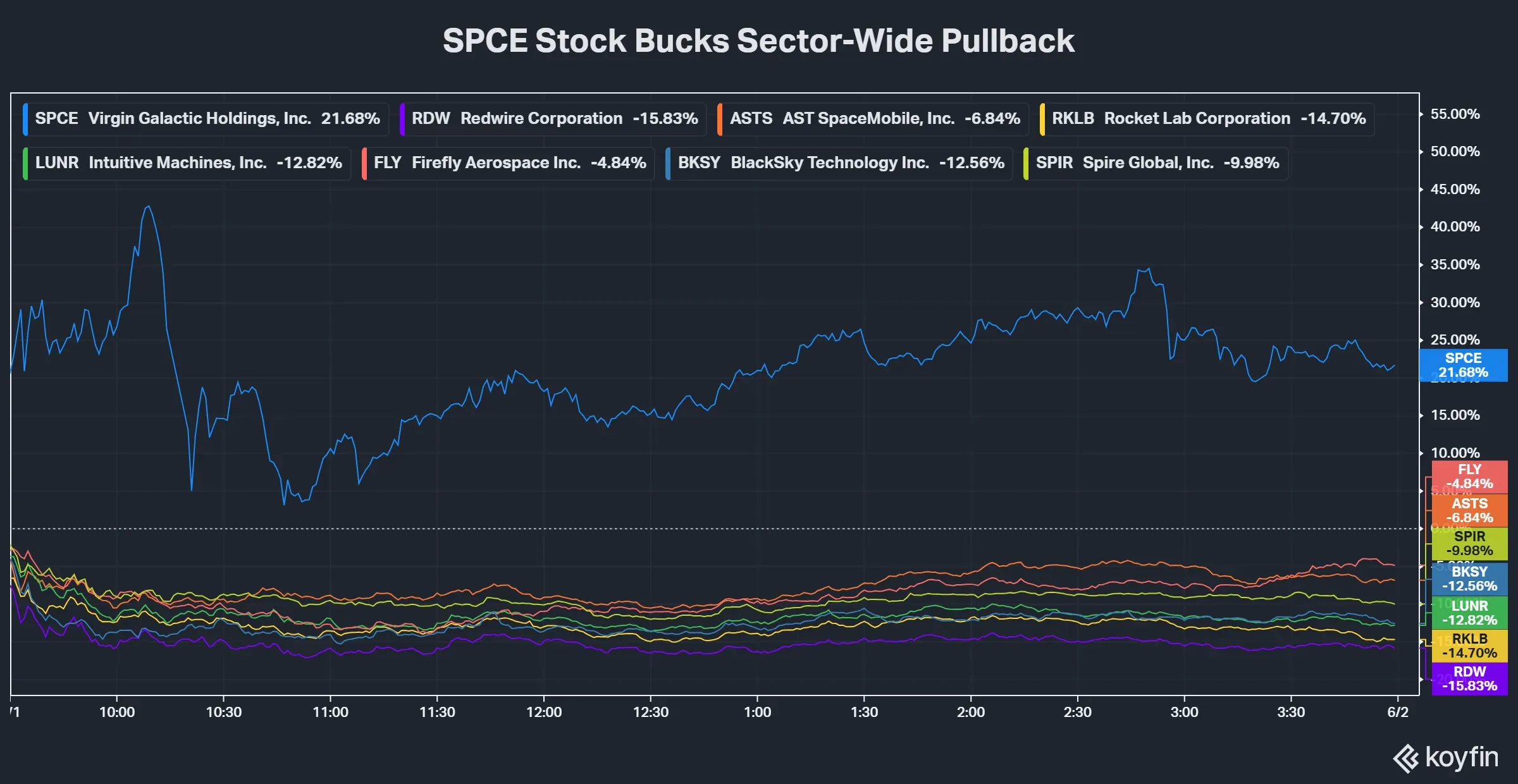
Shares of Virgin Galactic Holdings, Inc. (SPCE) surged nearly 22% on Monday to their highest level in nearly two years, defying a broad selloff across space stocks ahead of SpaceX's blockbuster IPO as short sellers absorbed an estimated $64 million in losses so far this year.
SPCE stock closed at $7.52 on Monday, extending gains after a record-setting May that saw shares soar 160%.

Space Stocks Pull Back As SpaceX IPO Nears
While excitement around SpaceX's long-awaited public debut has driven a massive rally in space stocks in recent weeks, several of the sector's biggest winners have come under pressure as investors reassess valuations ahead of the offering.
Advertisement|Remove ads.
Redwire (RDW), the sector’s biggest loser on Monday, plunged nearly 16% after Jefferies downgraded the stock to 'Hold' from 'Buy', citing limited near-term upside after its 223% year-to-date jump. However, the brokerage raised its price target to $24 from $13, implying a 16% upside from current levels.
The weakness spread across the sector. Rocket Lab USA (RKLB) fell 15%, Intuitive Machines (LUNR) dropped 13%, BlackSky Technology (BKSY) lost 13%, Spire Global (SPIR) declined 10%, AST SpaceMobile (ASTS) fell nearly 7%, and Firefly Aerospace (FLY) slipped 5%.
Advertisement|Remove ads.
The pullback comes amid the anticipation of potentially the largest public offering in Wall Street history. SpaceX is reportedly preparing to begin formal marketing as early as June and could seek to raise up to $75 billion at a $2 trillion valuation. In its IPO prospectus, SpaceX identified a $370 billion market for space services, including rocket launches and satellite operations, and a $1.6 trillion opportunity in global connectivity through Starlink's broadband and communications network.
Short Squeeze Fuels SPCE Rally
Analytics firm S3 Partners estimates short exposure in SPCE at $118.3 million, exceeding the combined active institutional long exposure of $44.9 million and passive long ownership of $58.2 million. The firm said that short sellers have lost $64 million on a mark-to-market basis so far this year as the stock's rally accelerated. Short interest currently stands at 23.2% of float, its highest level since April 14, according to Koyfin data. SPCE also attracted unusually heavy trading volume, with 286.1 million shares traded, 12x its average daily volume of 23.9 million shares.
Even after recent covering activity, about 19.1 million shares remain sold short. Passive institutional ownership has climbed to a one-year high of 9.4 million shares, but remains well below the number of shares held short, the analytics firm said.
Advertisement|Remove ads.
“Momentum and retail flows chased the news ahead of the SpaceX IPO, and the crowded short cut both ways: a rallying cry for retail longs and a direct accelerant as shorts bought to cover,” S3 Partners said in a statement.
The squeeze setup remains notable, with utilization at 88.5% and borrow fees elevated at 9.12%, while S3's proprietary Squeeze Score is at a maximum of 100 out of 100. Short interest had climbed above 22% of float by mid-May while the stock traded sideways, creating a crowded bearish position.
As positive catalysts emerged and momentum traders entered the stock, shorts were increasingly forced into buying, helping fuel the rally. Short interest has since fallen to a one-month low, but S3 noted that bearish positioning remains “still elevated.”
Advertisement|Remove ads.
Fresh Catalysts Drive SPCE Momentum
The short squeeze comes amid a series of bullish developments that have improved sentiment toward the company. A regulatory filing released Friday showed investor Rich Huang and RichRich Capital LLC disclosed a 5.26% stake in Virgin Galactic. The position includes a sizable options bet, with call options tied to more than 5.2 million additional shares beyond the investor's directly owned stock.
The company also recently announced preliminary court approval of a proposed shareholder derivative litigation settlement. Under the agreement, Virgin Galactic's insurers would pay the company $2.75 million, with Virgin Galactic retaining half of the proceeds if final approval is granted. Defendants denied all allegations of wrongdoing.
S3 also highlighted Jefferies' recent 'Buy' reiteration, the company's reaffirmed fourth-quarter launch timeline, and the May 27 VSS Unity glide flight as key catalysts behind the stock's rapid rise in recent weeks. The flight marked Virgin Galactic's first test flight in two years as the company prepares to roll out its Delta-class spacecraft.
Advertisement|Remove ads.
Virgin Galactic Eyes Q4 Launch
Virgin Galactic's bull case is also centered on the return of commercial spaceflights. During its first-quarter earnings call, the company said its first Delta-class spacecraft had been delivered from the assembly hangar to its testing and launch facility in Phoenix, where ground testing is underway. The company said it is on track to begin glide-flight testing during the third quarter and rocket-powered spaceflight testing during the fourth quarter.
The company has also started fabrication of a second operational Delta-class spacecraft, which is expected to enter service between late 2026 and early 2027. Virgin Galactic believes the new vehicles will improve economics and flight frequency. The company is targeting up to two flights per week, with each spacecraft designed for over 500 missions during its operational life.
Last week, Virgin Galactic said VSS Unity had resumed flying at Spaceport America as part of preparations for the Delta program. The company said the glide flights allow pilots, maintenance teams and mission-control staff to rehearse procedures that will eventually be used when Delta enters testing.
Advertisement|Remove ads.
Virgin Galactic Sees SpaceX Benefits
Virgin Galactic has openly acknowledged that SpaceX's IPO could benefit the broader commercial space industry: "I think that's positive and well merited," CEO Michael Colglazier said during the recent earnings call. "Obviously, a lot of energy around the SpaceX IPO as that seems to be coming forward. I think that will continue ... to just generate more innovation within commercial space."
While SpaceX generates revenue from launch services, satellite communications, connectivity and AI infrastructure, Virgin Galactic remains focused on commercial human spaceflight. "One thing is we are clearly focused in this first business model on human spaceflight," Colglazier said. "Theirs [SpaceX] starts at $50 million up. Ours is starting at $750,000."
How Do Retail Traders Feel About SPCE?
On Stocktwits, retail sentiment toward SPCE remained 'extremely bullish' over the past week, recently touching 98/100, while message volume jumped more than 29,000% from the prior week.
Advertisement|Remove ads.

One user said, “$SPCE the shorts don’t realize that they’re actually helping us by adding fuel to the fire. This is no one day show and will keep running until June 12 at the earliest.”
Another user said, “285M volume is enormous. For context, that's multiples of average daily volume on SPCE. Volume of that magnitude on a breakout day means real participation, not a thin tape squeeze that fades. Institutions, algos, retail, everyone showed up. This is the kind of volume signature that historically confirms a Stage 2 → Stage 3 transition in the squeeze.”
Advertisement|Remove ads.
SPCE stock has surged 134% over the past year.
For updates and corrections, email newsroom[at]stocktwits[dot]com.
Advertisement|Remove ads.
Read Next: Alphabet Announces $80B Fundraise With $10B Berkshire Hathaway Investment
Comments posted here will also appear on symbol pages.

Latest News
/filters:format(webp)https://news.stocktwits-cdn.com/large_Getty_Images_2296187035_e6f532e3f5.jpg)
/filters:format(webp)https://news.stocktwits-cdn.com/1707726834303_jpg_11f20a9aa9.webp) Shashank Nayar·58m ago
Shashank Nayar·58m ago/filters:format(webp)https://news.stocktwits-cdn.com/large_Getty_Images_2049058934_jpg_c3bac923f1.webp)
/filters:format(webp)https://news.stocktwits-cdn.com/unnamed_jpg_9dff551b50.webp) Anan Ashraf·59m ago
Anan Ashraf·59m ago/filters:format(webp)https://news.stocktwits-cdn.com/large_Getty_Images_2287054273_1_864b6e24d6.jpg)
/filters:format(webp)https://news.stocktwits-cdn.com/vivekkrishnanphotography_58_jpg_0e45f66a62.webp) Arnab Paul·3h ago
Arnab Paul·3h ago/filters:format(webp)https://news.stocktwits-cdn.com/large_Getty_Images_2271607504_f4f2011a99.jpg) Anan Ashraf·3h ago
Anan Ashraf·3h ago/filters:format(webp)https://news.stocktwits-cdn.com/large_musk_88257e3573.jpg) Shashank Nayar·3h ago
Shashank Nayar·3h ago/filters:format(webp)https://news.stocktwits-cdn.com/large_Lockheed_Martin_jpg_8c751d0020.webp)
/filters:format(webp)https://news.stocktwits-cdn.com/Heera_1_1c30cb0170.PNG) Heera Hari·3h ago
Heera Hari·3h ago