


Advertisement|Remove ads.
Tesla And SpaceX Merger By 2027? Here's Why Wedbush Believes Odds Have Jumped Above 80%
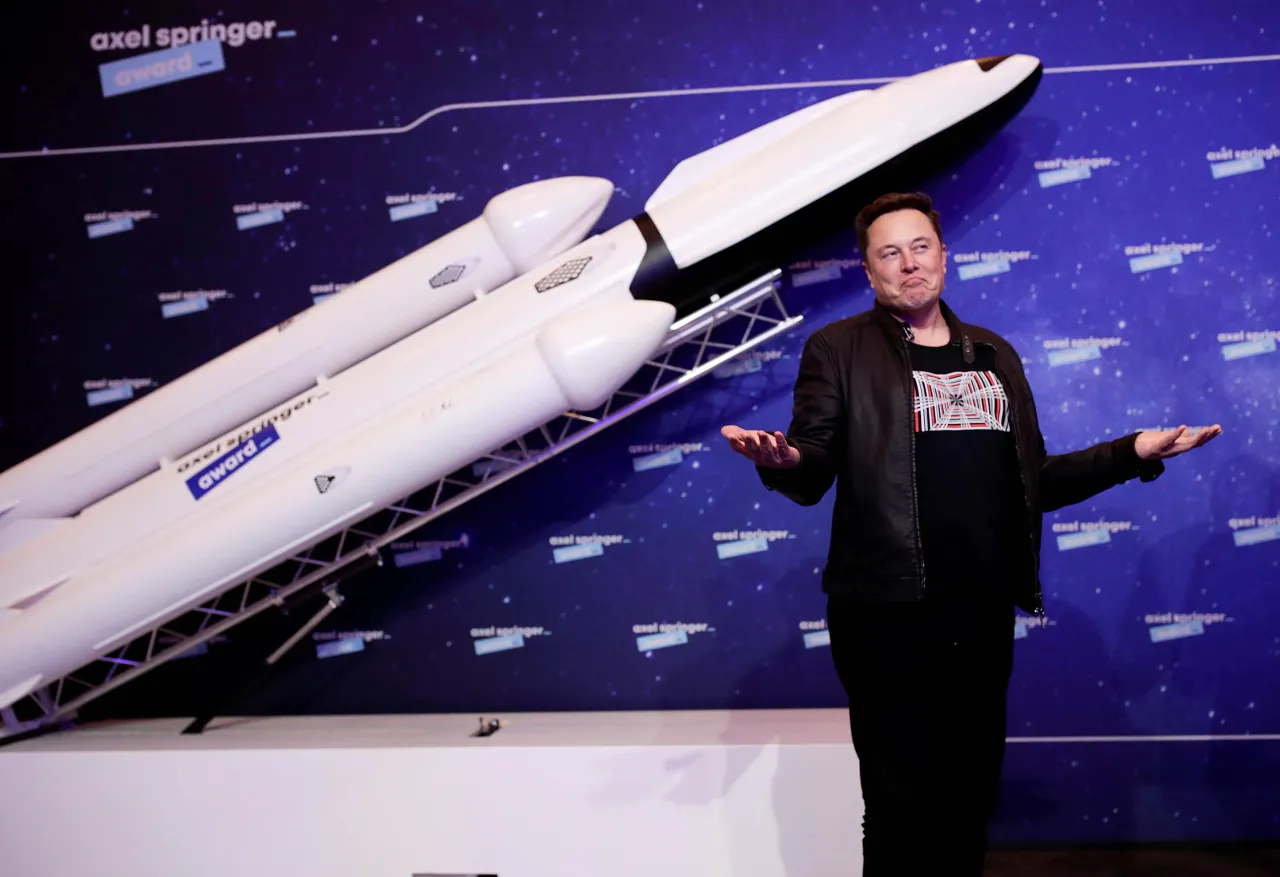


- Wedbush contends that Musk is methodically building a unified AI-driven ecosystem that spans computing power, advanced manufacturing, autonomous technologies, energy solutions and space infrastructure.
- The firm says increasing integration across Tesla, SpaceX and xAI is laying the groundwork for a potential future merger.
- Wedbush’s Dan Ives stated that the SpaceX IPO could mark a pivotal moment for investors looking to capitalize on the Fourth Industrial Revolution.
Advertisement|Remove ads.
Tesla Inc. (TSLA) and SpaceX may be on a path toward an eventual merger, according to Wedbush, which assigned more than 80% odds that Elon Musk will combine the two companies following SpaceX's initial public offering (IPO).
In a new note reposted by Wedbush’s Global Head of Tech Research Dan Ives, the firm expects a high likelihood that Tesla and SpaceX could merge by 2027.
Tesla’s shares were down nearly 1% in Wednesday’s pre-market trade.
Advertisement|Remove ads.
Wedbush Highlights What’s Bringing TSLA, SPCX Closer
Wedbush highlighted several developments that it believes are bringing Tesla and SpaceX into closer alignment. This includes Tesla's indirect exposure to SpaceX through its previous $2 billion investment in xAI, SpaceX's subsequent acquisition of xAI, and the launch of the companies' joint Terafab manufacturing facility. According to the firm, these moves suggest Musk is increasingly integrating his businesses rather than operating them as standalone entities.
Wedbush contends that Musk is methodically building a unified AI-driven ecosystem that spans computing power, advanced manufacturing, autonomous technologies, energy solutions and space infrastructure.
In the firm’s view, the growing overlap in assets, operations and strategic priorities across Tesla, SpaceX and xAI points to a future in which the companies function as interconnected pillars of a broader technology platform, potentially paving the way for an eventual merger.
Advertisement|Remove ads.
SPCX IPO Pivotal Moment For Investors, Says Ives
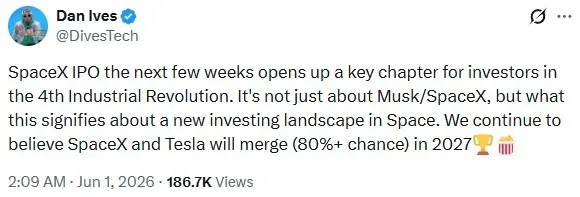
In another post on X, Ives stated that the SpaceX IPO could mark a pivotal moment for investors looking to capitalize on the Fourth Industrial Revolution.
He argued the IPO represents more than just another Musk-led milestone, signaling the emergence of a new investment era centered on the commercialization of space.
Gary Black Has A Divergent View
The Future Fund LLC’s Managing Partner, Gary Black, has a divergent view from Ives.
Advertisement|Remove ads.
In a recent post on X, Black said that he does not understand the logic around a potential SpaceX-Tesla merger. Large mergers between very different megacap companies rarely deliver the promised synergies, and simply labeling both businesses as AI plays doesn't make the combination compelling, he said.
Black added that merger advocates largely ignore the dilution math. He argued that if a highly-valued company like SpaceX merged with a lower-valued company like Tesla, the combined company would likely trade closer to Tesla's lower valuation multiple. That could reduce the value investors assign to the merged entity, potentially wiping out nearly 30% of its combined enterprise value, he said.
“Why would a $SPCX investor other than maybe Elon who might presumably prefer to be CEO of 1 rather than 2 megacap companies go for that? Investors like pure plays. Conglomerates almost always trade at a discount,” he said.
Advertisement|Remove ads.
TSLA Market Share In EU Inches Up
Tesla’s car sales in the European market soared 67% year-on-year in April, extending the company’s winning run in the region to the third consecutive month.
According to data from the European Automobile Manufacturers’ Association (ACEA) released last week, Tesla sold 9,169 cars in the European Union in April, up from 5,483 units in the same period a year ago.
In the EU, European Free Trade Association, and the U.K. in April, Tesla sold 10,654 cars, up 47% YoY from 7,272 units in the same month a year ago.
Advertisement|Remove ads.
Tesla’s market share in the battery electric vehicle segment for April 2026 inched up to 0.9%, from 0.6% during the year-ago period.
How Did Retail Investors React To TSLA Stock?
Retail sentiment on Stocktwits around Tesla trended in the ‘bearish’ territory at the time of writing.
One user urged the company to announce that Tesla shareholders will get a preferred opportunity to buy SpaceX shares.
Advertisement|Remove ads.
TSLA stock is down 6% year-to-date, but up 24% over the past 12 months. The S&P 500 ETF (SPY) is up 30% over the past 12 months, while the Invesco QQQ Trust (QQQ) is up 43%.
The Procure Space ETF (UFO) is up 151% during this period, while the Tema Space Innovators ETF (NASA) is up 57%.
Advertisement|Remove ads.
For updates and corrections, email newsroom[at]stocktwits[dot]com.
Comments posted here will also appear on symbol pages.

Latest News
/filters:format(webp)https://news.stocktwits-cdn.com/large_Getty_Images_2290360640_1ec7422bc6.jpg)
/filters:format(webp)https://news.stocktwits-cdn.com/Anushka_Basu_make_me_smile_in_the_picture_b92832aa_af59_4141_aacc_4180d2241ba8_1_2_png_1086e0ed8c.webp) Anushka Basu·11m ago
Anushka Basu·11m ago/filters:format(webp)https://news.stocktwits-cdn.com/large_Getty_Images_2184298752_597d0bfcd2.jpg) Anushka Basu·2h ago
Anushka Basu·2h ago/filters:format(webp)https://st-everywhere-cms-prod.s3.us-east-1.amazonaws.com/large_charles_schwab_resized_79fd4282b7.jpg) Anushka Basu·4h ago
Anushka Basu·4h ago/filters:format(webp)https://news.stocktwits-cdn.com/large_Getty_Images_1236413131_82e1a6f16e.jpg) Anushka Basu·5h ago
Anushka Basu·5h ago/filters:format(webp)https://news.stocktwits-cdn.com/large_Getty_Images_2255514431_jpg_95e96b4025.webp)
/filters:format(webp)https://st-everywhere-cms-prod.s3.us-east-1.amazonaws.com/i_OS_App_Icon_1_8054f2a2fe.png) Stocktwits News Desk·5h ago
Stocktwits News Desk·5h ago/filters:format(webp)https://news.stocktwits-cdn.com/large_US_economy_representative_image_jpg_88c3aa4736.webp) Stocktwits News Desk·6h ago
Stocktwits News Desk·6h ago