


Advertisement|Remove ads.
Trump Calls Strait Of Hormuz 'New US Territory' After Iran Warns of 'Fully Offensive' Stance, Keeping Markets On Edge


- U.S. equity futures traded in the red early Tuesday amid escalating tensions in the Middle East and rising oil prices.
- The 60-day negotiating period between the U.S. and Iran expired without a broader peace agreement on Monday.
- Iran continues to reject U.S. claims over the strait and has threatened to maintain restrictions on shipping through the critical energy route.
Advertisement|Remove ads.
President Donald Trump escalated his rhetoric over the Strait of Hormuz on Tuesday, posting a graphic on Truth Social labeling the strategically important waterway “NEW U.S. Territory.”
The post comes after Trump said last week that he would declare the strait a U.S. territory after the U.S. finishes its military campaign against Iran.
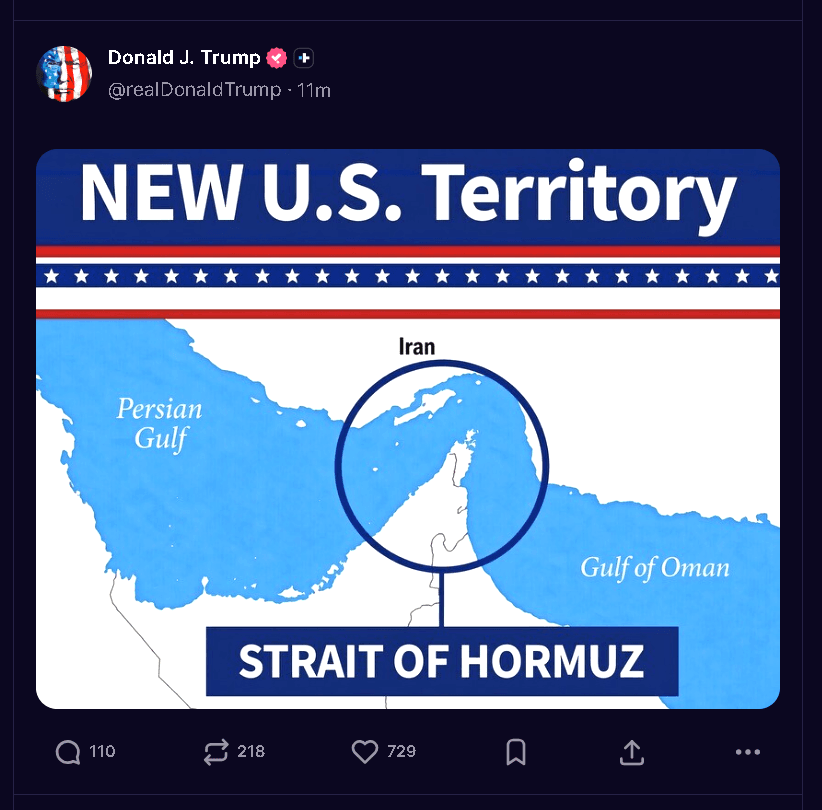
Trump has repeatedly said the U.S. now controls the strait through a naval blockade and has called for the waterway to reopen. Last week, he told reporters that declaring the Strait of Hormuz a U.S. territory was “a great idea.” The 60-day negotiating period between Washington and Tehran expired on Monday without a broader peace agreement.
Advertisement|Remove ads.
The latest escalation comes after Iran signaled a shift toward a “fully offensive” military posture following Washington's decision not to extend the existing ceasefire.
Why Is The Strait Of Hormuz Important To Markets?
The Strait of Hormuz connects the Persian Gulf with the Gulf of Oman and is a critical route for global energy supplies. Normal shipping through the waterway has been sharply reduced since the conflict began. According to a Reuters report, only limited tanker traffic has been moving through the strait, while Brent crude rose above $90 a barrel and WTI crude climbed to nearly $85 on Tuesday.
The United States Oil Fund (USO) edged 0.2% higher in pre-market trade. On Stocktwits, retail sentiment around the ETF trended in ‘bearish’ territory over the past day.
Advertisement|Remove ads.
Higher oil prices are also an added pressure on bond markets. The 30-year Treasury yield moved above 5.3%, while rising energy costs have raised concerns that geopolitical tensions could complicate the inflation outlook.
Meanwhile, U.S. equity futures fell in early trading, led by a more than 1% decline in Nasdaq futures. S&P 500 futures slipped 0.5%, while Dow futures were flat and Russell 2000 futures fell 0.3%.
On Stocktwits, retail sentiment around the SPDR S&P 500 ETF (SPY), which tracks the S&P 500, remained in ‘bullish’ territory. Sentiment around the Invesco QQQ Trust (QQQ), which tracks the Nasdaq-100, remained in the ‘neutral’ zone.
Advertisement|Remove ads.
For updates and corrections, email newsroom[at]stocktwits[dot]com.
Comments posted here will also appear on symbol pages.

Latest News
/filters:format(webp)https://news.stocktwits-cdn.com/Getty_Images_2228901180_jpg_0c2cc7dc28.webp)
/filters:format(webp)https://news.stocktwits-cdn.com/IMG_8805_JPG_6768aaedc3.webp) Deepti Sri·21m ago
Deepti Sri·21m ago/filters:format(webp)https://news.stocktwits-cdn.com/Getty_Images_2229019912_1_jpg_afc8642074.webp) Deepti Sri·29m ago
Deepti Sri·29m ago/filters:format(webp)https://news.stocktwits-cdn.com/large_iren_OG_jpg_ba842dd11a.webp)
/filters:format(webp)https://news.stocktwits-cdn.com/shivani_photo_jpg_dd6e01afa4.webp) Shivani Kumaresan·46m ago
Shivani Kumaresan·46m ago/filters:format(webp)https://news.stocktwits-cdn.com/gettyimages_2267701500_594x594_1cfbb8b517.jpg)
/filters:format(webp)https://news.stocktwits-cdn.com/IMG_9209_1_d9c1acde92.jpeg) Yuvraj Malik·56m ago
Yuvraj Malik·56m ago/filters:format(webp)https://news.stocktwits-cdn.com/large_Getty_Images_2297721644_7ea2def172.jpg)
/filters:format(webp)https://news.stocktwits-cdn.com/Ram_83262cba1d.jpg) Ramakrishnan M·2h ago
Ramakrishnan M·2h ago/filters:format(webp)https://news.stocktwits-cdn.com/large_Getty_Images_2267825783_jpg_1b90bf709b.webp) Deepti Sri·2h ago
Deepti Sri·2h ago