


Advertisement|Remove ads.
Trump Names Jay Clayton AI Czar, Head Of 'Super Intelligence Force' — What It Means For Anthropic, OpenAI, Google
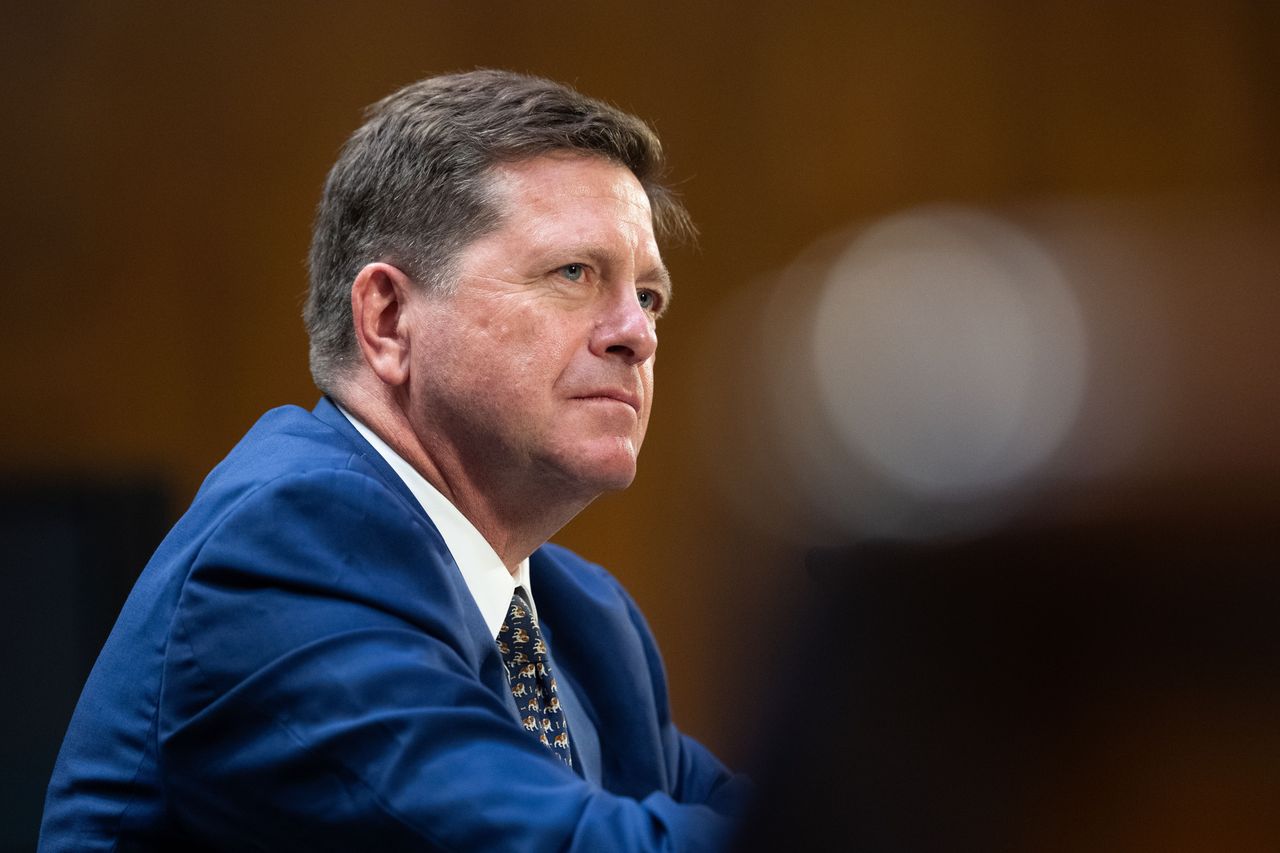

- Clayton says the U.S. should keep developing advanced AI rather than step back while other countries move ahead.
- Existing consumer-protection and product-liability laws can address AI harms, Clayton says.
- The group's charter calls for addressing AI threats without overregulation, The Wall Street Journal reports.
Advertisement|Remove ads.
President Donald Trump on Sunday named Director of National Intelligence Jay Clayton as his AI czar and chairman of the newly created "Super Intelligence Force," a group charged with coordinating the federal government's work on advanced artificial intelligence.
The group has 120 days to assess AI's risks and opportunities, examine existing laws and recommend how the government should respond to threats including AI-enabled cyberattacks, The Wall Street Journal reported. That review covers the field led by Anthropic, OpenAI and Alphabet Inc.'s Google.
Clayton Appears To Closely Align With Trump On AI
Clayton has already laid out a position that closely mirrors Trump’s approach to AI.
Advertisement|Remove ads.
In a Sept. 30 interview with CNBC’s Squawk Box, Clayton rejected the idea of pausing the development of more advanced AI models. He said “super intelligence is a national security issue” and argued that allowing other countries to develop the technology while the U.S. backs away would not be a sound strategy.
Clayton, who previously served as the chairman of the U.S. Securities and Exchange Commission, also argued that the U.S. already has consumer-protection and product-liability laws, along with the Department of Justice and other agencies, that can address AI-related harms.
That stance fits Trump’s broader position that AI development should not be stifled. The administration has pushed the industry toward voluntary safeguards, including internal controls and external reviews of AI systems.
Advertisement|Remove ads.
What It Means For Anthropic, OpenAI and Google
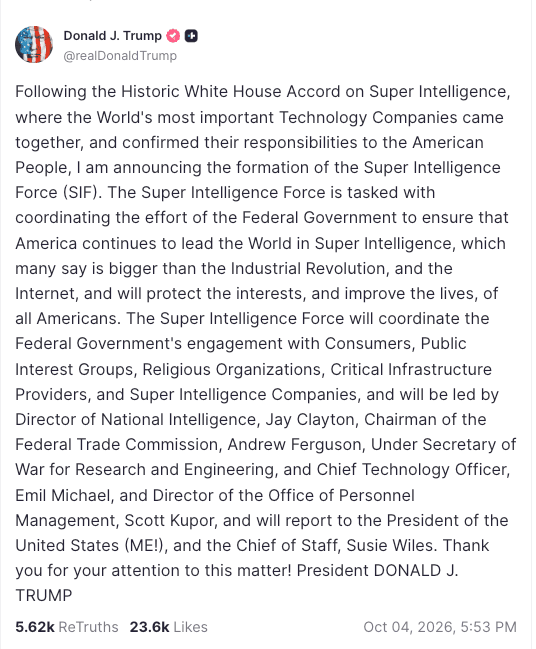
Announcing the Super Intelligence Force on Sunday, Trump said the group “is tasked with coordinating the effort of the Federal Government to ensure that America continues to lead the World in Super Intelligence, which many say is bigger than the Industrial Revolution, and the Internet, and will protect the interests, and improve the lives, of all Americans.”
Advertisement|Remove ads.
For frontier AI companies, that could mean greater government scrutiny of AI risks without an immediate push to slow model development, based on Clayton’s comments to CNBC, where he suggested a balanced approach.
“We are going to bring a whole-of-government approach to making sure that this technology develops, as we have in the past with aviation, right?” Clayton said.
“When we had aviation come to America, you know what we did? We promoted both aviation and safety at the same time. We promoted, in my time at the SEC, both capital formation and investor protection. We’re going to do the same thing here.”
Advertisement|Remove ads.
The task force’s charter explicitly calls for addressing AI threats while preventing overregulation that could stifle innovation and competition, according to the Journal's report.
Retail View On AI Firms
On Stocktwits, retail sentiment was ‘neutral’ for OpenAI, and ‘bullish’ for Anthropic and Alphabet.
AI-linked Big Tech and chip stocks broadly rose last week. The gains reflected continued optimism around AI infrastructure spending and the U.S. AI buildout, although moves were uneven as investors also weighed elevated Treasury yields and company-specific catalysts.
Advertisement|Remove ads.
For updates and corrections, email newsroom[at]stocktwits[dot]com.
Read Next: Cerebras Stock Gets A Boost After OpenAI CEO Sam Altman Calls Chipmaker ‘Close Partner’
Advertisement|Remove ads.
Comments posted here will also appear on symbol pages.

Latest News
/filters:format(webp)https://news.stocktwits-cdn.com/Getty_Images_2228900888_jpg_338103de79.webp)
/filters:format(webp)https://news.stocktwits-cdn.com/Anushka_Basu_make_me_smile_in_the_picture_b92832aa_af59_4141_aacc_4180d2241ba8_1_2_png_1086e0ed8c.webp) Anushka Basu·8h ago
Anushka Basu·8h ago/filters:format(webp)https://news.stocktwits-cdn.com/large_Getty_Images_1767602875_jpg_db2e050c08.webp) Anushka Basu·9h ago
Anushka Basu·9h ago/filters:format(webp)https://news.stocktwits-cdn.com/large_new_york_stock_exchange_jpg_e1f85c0d8c.webp)
/filters:format(webp)https://st-everywhere-cms-prod.s3.us-east-1.amazonaws.com/i_OS_App_Icon_1_8054f2a2fe.png) Stocktwits News Desk·9h ago
Stocktwits News Desk·9h ago/filters:format(webp)https://news.stocktwits-cdn.com/large_grayscale_OG_jpg_c35dc5b1a2.webp) Anushka Basu·10h ago
Anushka Basu·10h ago/filters:format(webp)https://news.stocktwits-cdn.com/large_Google_Office_in_New_York_City_2ff844002a.jpg) Stocktwits News Desk·10h ago
Stocktwits News Desk·10h ago/filters:format(webp)https://news.stocktwits-cdn.com/large_mark_rubio_original_jpg_1e75e0c7f2.webp) Stocktwits News Desk·11h ago
Stocktwits News Desk·11h ago