


Advertisement|Remove ads.
US Mortgage ETFs See Heavy Outflows As Elevated Interest Rates Make Homebuying Expensive



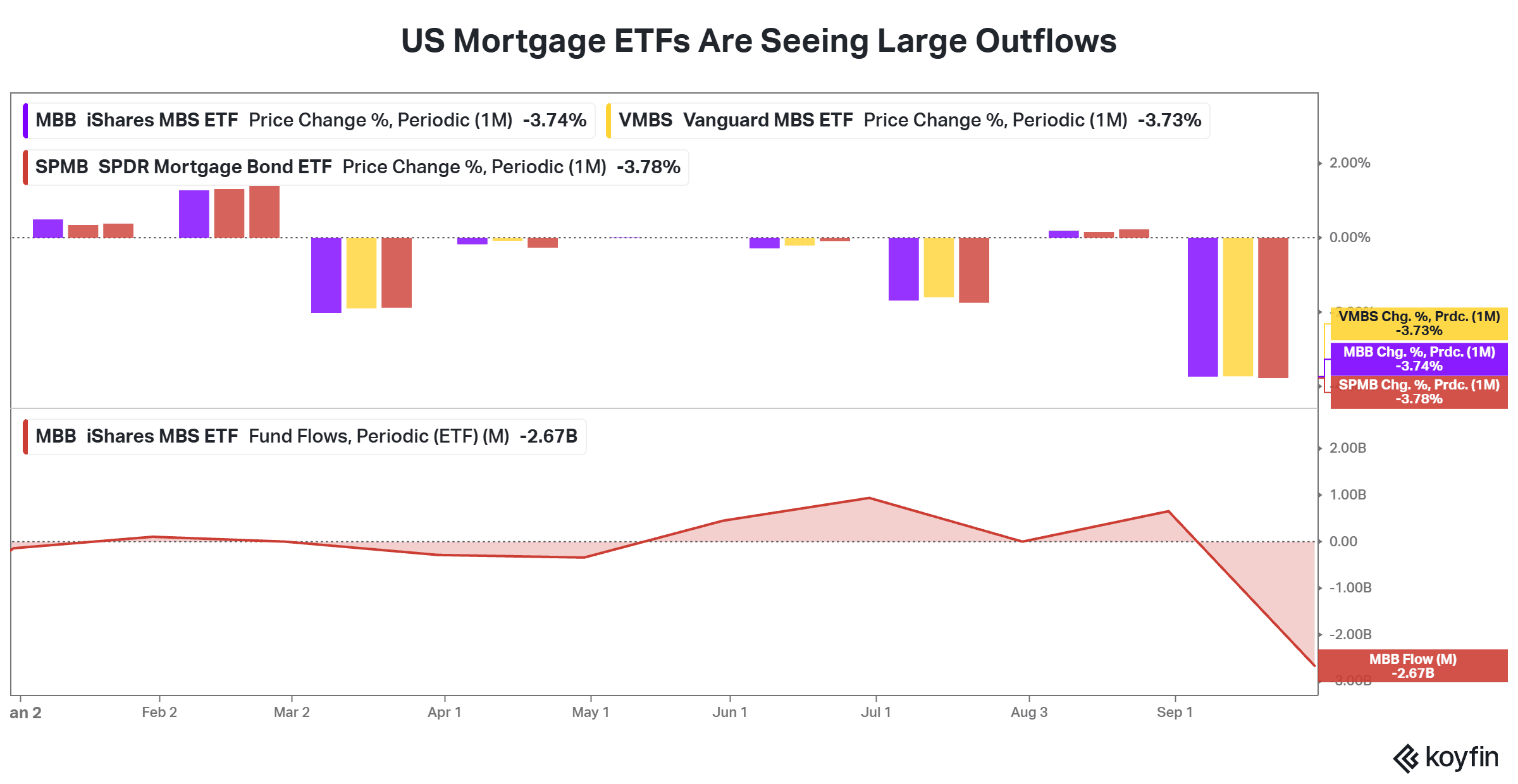
- Investors pulled $2.4 billion from U.S. mortgage-backed securities (MBS) exchange-traded funds in September, the highest monthly redemption rate since March 2020, Bloomberg reported.
- The average 30-year fixed home loan jumped 25 basis points in a single week to 7.28%, representing the largest weekly surge in nearly four years and the highest rate recorded since late 2023.
- Pending home sales fell 4.1% year-on-year in September.
Advertisement|Remove ads.
Rapidly rising bond yields and fears of higher-for-longer interest rates are weighing on U.S. housing and financial markets.
As borrowing costs march higher, investors are abandoning ETFs tracking mortgage-backed securities (MBS) at the fastest pace in years, while prospective homebuyers face the steepest mortgage rates seen since late 2023, affecting overall home sales.

Investors Flee Mortgage Bond Funds
In the capital markets, exchange-traded funds holding U.S. mortgage debt saw $2.4 billion in net redemptions in September, the heaviest selling in the sector since the onset of the pandemic in March 2020, according to Bloomberg.
Advertisement|Remove ads.
The sell-off has been driven largely by a sharp rally in U.S. Treasury yields, which have hovered near multi-decade peaks amid expectations that the Federal Reserve will keep monetary policy tight to combat inflation.
Because surging benchmark rates reduce the likelihood of homeowners refinancing, holders of mortgage debt risk remaining locked into lower-yielding assets for extended durations. Furthermore, with risk-free Treasuries offering nominal yields above 5%, the complex structure of mortgage bonds has grown increasingly unappealing to market participants.
For instance, BlackRock’s iShares MBS ETF (MBB) logged roughly $2.7 billion in monthly outflows—its largest on record—and posted a 3% total loss for September. Competitor funds, including the Schwab Mortgage-Backed Securities ETF and the Simplify MBS ETF, also notched record monthly redemptions of $245.8 million and $342 million, respectively, as per Bloomberg.
Advertisement|Remove ads.
Home Borrowing Costs Hit New Highs
According to data released by Freddie Mac, the average benchmark 30-year fixed mortgage rate escalated to 7.28%, up from 6.34% a year earlier. The 25-basis-point single-week increase represents the sharpest weekly spike in borrowing costs since October 2022.
Economists note that the rapid rate rise has sharply undermined home affordability, compounding challenges for prospective buyers who are already grappling with near-record purchase prices. Consequently, real estate demand is deteriorating rapidly across multiple metrics.
Advertisement|Remove ads.
Cooling Housing Demand
Data shows pending home sales fell 4.1% year over year in September, while loan application metrics from the Mortgage Bankers Association dropped to their lowest point since April 2025. Refinance applications fell sharply as well, tumbling another 8.7%.
To adapt to the tightening environment, an increasing proportion of sellers are forced to reduce asking prices. According to Realtor.com, the percentage of listings with price cuts hit its highest September level since 2018.
On Stocktwits, retail sentiment around the SPDR S&P 500 ETF (SPY), which tracks the S&P 500, remained ‘extremely bullish.’ Sentiment for the Invesco QQQ Trust (QQQ), which tracks the Nasdaq-100, and the SPDR Dow Jones ETF (DIA) stayed ‘bullish’.
Advertisement|Remove ads.
Sentiment on iShares 20+ Year Treasury ETF (TLT) was ‘bullish’, with ‘high’ message volumes.
For updates and corrections, email newsroom[at]stocktwits[dot]com.
Comments posted here will also appear on symbol pages.

Latest News
/filters:format(webp)https://news.stocktwits-cdn.com/large_Getty_Images_2296215726_e82f86b85a.jpg)
/filters:format(webp)https://news.stocktwits-cdn.com/1707726834303_jpg_11f20a9aa9.webp) Shashank Nayar·2m ago
Shashank Nayar·2m ago/filters:format(webp)https://news.stocktwits-cdn.com/large_Getty_Images_2299257316_ebdab0e9aa.jpg)
/filters:format(webp)https://news.stocktwits-cdn.com/unnamed_jpg_9dff551b50.webp) Anan Ashraf·15m ago
Anan Ashraf·15m ago/filters:format(webp)https://st-everywhere-cms-prod.s3.us-east-1.amazonaws.com/large_Morgan_Stanley_b6f4ee64ac.jpg) Shashank Nayar·53m ago
Shashank Nayar·53m ago/filters:format(webp)https://news.stocktwits-cdn.com/large_capricor_jpg_9f4f8ab098.webp) Anan Ashraf·2h ago
Anan Ashraf·2h ago/filters:format(webp)https://news.stocktwits-cdn.com/large_Getty_Images_2298278370_c1742670a6.jpg) Anan Ashraf·3h ago
Anan Ashraf·3h ago/filters:format(webp)https://news.stocktwits-cdn.com/large_Getty_Images_1975322989_4931eda944.jpg) Shashank Nayar·3h ago
Shashank Nayar·3h ago