


Advertisement|Remove ads.
US Raises 2026 Oil Forecast To $87 A Barrel Amid Hormuz Disruption


- The EIA updated its forecast to reflect higher crude oil and wholesale motor fuel costs through 2026 to $87 a barrel.
- U.S. commercial crude stocks are projected to remain below five-year historical lows through the end of 2026 due to strong foreign demand.
- In contrast to liquid fuels, natural gas spot prices were revised downward amid strong production and abundant storage.
Advertisement|Remove ads.
Persistently elevated fuel prices threaten to reignite consumer inflation pressures across the United States, as the latest Short-Term Energy Outlook released by the U.S. Energy Information Administration (EIA) hiked its 2026 oil price forecasts.
The independent statistical agency bumped up its price expectations for crude oil, wholesale gasoline, and diesel for 2026, warning that persistent Middle East geopolitical tensions and maritime shipping constraints along the Strait of Hormuz will keep global inventories tight through the end of the year.
"Reduced oil shipments through the Strait of Hormuz lower global oil inventories further in the coming months," the EIA noted in its report, projecting that U.S. commercial crude oil inventories will hover below five-year lows for the remainder of 2026.
Advertisement|Remove ads.
Middle East Bottlenecks Drive Up Fuel Costs
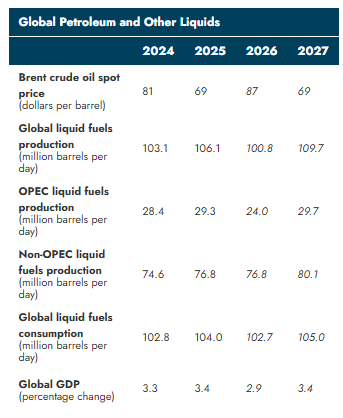
According to the report, Brent crude oil spot prices are now expected to average $87 per barrel in 2026, up from previous projections. The upward momentum is primarily fueled by expanded estimates of shut-in crude production in the Middle East, where shipping disruptions are expected to persist before regional supply gradually recovers near early-2027 levels.
“In addition to renewed attacks on ships transiting the Strait of Hormuz, crude oil prices were driven higher due to a new blockade threat on Saudi Arabia’s oil exports through the Bab el-Mandeb Strait, EIA said.
Advertisement|Remove ads.
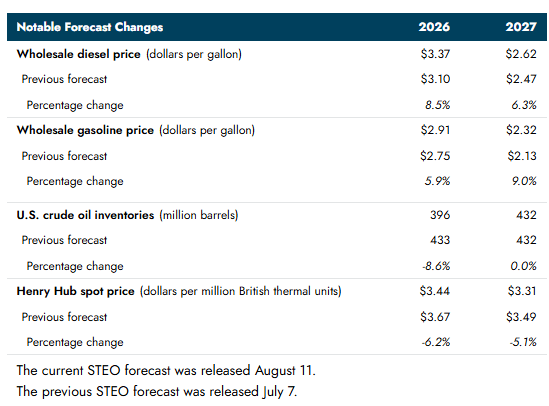
The upward adjustment in crude markets is feeding directly into domestic pump prices. The agency raised its 2026 wholesale diesel price forecast by 8.5% to $3.37 per gallon, while wholesale gasoline projections rose 5.9% to $2.91 per gallon. Retail gasoline is expected to average $3.78 per gallon over the course of the year.
Natural Gas And Electricity Dynamics
While liquid fuel markets remain squeezed, natural gas consumers may see relief. The EIA lowered its third-quarter 2026 Henry Hub spot price forecast to $2.87 per million British thermal units (MMBtu)—a 50-cent drop from last month's forecast—citing near-record storage levels and temporary maintenance slowdowns at U.S. liquefied natural gas (LNG) export facilities like Freeport LNG.
Meanwhile, electricity demand faces regional realignments. Although power generation continues to grow overall to support expanding technology infrastructure, the EIA sharply reduced its 2027 demand growth forecast for Texas from 14% to 6% following state policy adjustments on new data center development. Renewable sources—led by solar capacity additions—continue to capture a growing share of the nation's power grid.
Advertisement|Remove ads.
Inflation Risks And Labor Market Challenges
The revised energy forecasts arrive at a delicate juncture for the U.S. economy, where surging energy costs threaten to complicate the Federal Reserve's effort to guide inflation back toward its 2% target.
Consumer price inflation cooled to 3.5% year-over-year in June, down from 4.2% in May, while core inflation—excluding volatile food and energy—eased to 2.6%. However, economists warn that any sustained rebound in gasoline and heating fuels could quickly spill over into transport, goods delivery, and service costs, reversing recent gains on overall price stability.
Advertisement|Remove ads.
Adding to the macroeconomic policy challenge is a visibly cooling labor market. Data from the Bureau of Labor Statistics showed total U.S. nonfarm payrolls unexpectedly contracted by 23,000 jobs in July, alongside downward revisions to prior months, even as the unemployment rate held relatively low at 4.1%.
With fresh Consumer Price Index (CPI) numbers slated for release this week, financial markets are bracing for evidence of how recent energy volatility is flowing through consumer expenses.
US Stock Indices Drop
Benchmark U.S indices, S&P 500, Nasdaq, and Dow Jones Industrial Average all eased on Tuesday, and ETFs tracking these indices cooled off. The SPY, QQQ, and DIA eased between 0.2% and 0.4%. The United States Oil Fund (USO) gained 1.2%.
Advertisement|Remove ads.
For updates and corrections, email newsroom[at]stocktwits[dot]com.
Comments posted here will also appear on symbol pages.

Latest News
/filters:format(webp)https://news.stocktwits-cdn.com/large_Getty_Images_2291403399_8dbede0ce6.jpg)
/filters:format(webp)https://news.stocktwits-cdn.com/Anushka_Basu_make_me_smile_in_the_picture_b92832aa_af59_4141_aacc_4180d2241ba8_1_2_png_1086e0ed8c.webp) Anushka Basu·21m ago
Anushka Basu·21m ago/filters:format(webp)https://news.stocktwits-cdn.com/large_us_treasury_yields_jpg_074c6369d6.webp)
/filters:format(webp)https://st-everywhere-cms-prod.s3.us-east-1.amazonaws.com/i_OS_App_Icon_1_8054f2a2fe.png) Stocktwits News Desk·2h ago
Stocktwits News Desk·2h ago/filters:format(webp)https://news.stocktwits-cdn.com/large_Getty_Images_2203983775_jpg_74bdd5dd43.webp) Stocktwits News Desk·2h ago
Stocktwits News Desk·2h ago/filters:format(webp)https://news.stocktwits-cdn.com/large_Getty_Images_970689240_a56e0542ad.jpg) Anushka Basu·2h ago
Anushka Basu·2h ago/filters:format(webp)https://news.stocktwits-cdn.com/large_spacex_jpg_7fbc0f33e4.webp) Stocktwits News Desk·3h ago
Stocktwits News Desk·3h ago/filters:format(webp)https://news.stocktwits-cdn.com/large_US_economy_representative_image_jpg_88c3aa4736.webp) Stocktwits News Desk·3h ago
Stocktwits News Desk·3h ago