


Advertisement|Remove ads.
RKLB And FLY Investors, Take Note: Planet Labs Flags SpaceX Rideshare Crunch As Smaller Operators Seek Alternatives



- CEO Will Marshall said launch prices have “been going up a little bit” as Planet invests to secure access.
- SpaceX is reportedly restricting new Falcon 9 and rideshare bookings beyond 2028 as Starlink consumes more launch capacity.
- Planet beat Q2 estimates and raised its FY27 outlook as its satellite-services pipeline topped $4 billion.
Advertisement|Remove ads.
Planet Labs (PL) has flagged growing congestion in SpaceX’s rideshare business, potentially boosting the case for alternative launch providers Rocket Lab (RKLB) and FireFly Aerospace (FLY) as smaller satellite operators seek more certainty over launch dates and orbital destinations.
PL stock tumbled more than 8% on Thursday to its lowest close of the year, marking its worst session in over a month. Shares are also on track for a third consecutive weekly loss.
“There is definitely a lot of demand, especially for the rideshare missions with SpaceX right now,” Planet Labs (PL) CEO Will Marshall said on the company’s second-quarter (Q2) earnings call. “That is driving some challenges for some of the players, especially the smaller players.”
Advertisement|Remove ads.
While launch costs are well below historical levels, Marshall said prices have “been going up a little bit,” prompting Planet to invest in securing access. The comments follow his June warning that launch was becoming “a little bit more competitive than it used to be.”
SpaceX Launch Capacity Tightens
SpaceX’s Transporter program is currently active, and Planet is using it. Pelican-11 flew aboard Transporter-17, while Planet’s second Tanager satellite and 18 SuperDoves are slated for Transporter-18.
The constraint is emerging in bookings beyond 2028. SpaceX has reportedly begun turning away operators seeking dedicated Falcon 9 launches after that point and has stopped accepting future rideshare reservations. At least nine partners and customers have apparently found Transporter reservations unavailable beyond late 2028 or early 2029, while at least seven spacecraft companies were told Falcon 9 was fully booked across mission types until 2028 or 2029.
Advertisement|Remove ads.
The squeeze comes as SpaceX devotes more Falcon capacity to its own payloads. Of 38 launches in the second quarter, 28 were internal, and 10 carried customer missions. Starlink’s share of Falcon 9 flights climbed from 54% in 2020 to about 79% in 2026.
Where Rocket Lab Fits
Rocket Lab’s connection to the squeeze is in its dedicated launch model. Electron carries 300 kilograms and cannot match Falcon 9’s capacity or rideshare economics, but it gives customers control over their launch date, orbit and mission profile.
Recently, Rocket Lab flew its 94th Electron mission and its 15th in 2026, deploying a Synspective StriX radar satellite. The company has been Synspective’s sole launch provider since 2020 and has 16 more dedicated missions booked for the constellation before 2030. Rocket Lab has also added more than $437 million in Electron, Haste and Neutron bookings, taking its launch backlog above 90 missions. Its total backlog stood at $2.36 billion on June 30, including $940 million in launch services.
Advertisement|Remove ads.
For larger payloads, Rocket Lab is developing Neutron. CEO Peter Beck called Kepler Communications’ first dedicated-rocket booking, targeted no earlier than 2028, “another strong signal” that Neutron could become the industry’s “alternate ride to space for medium-lift missions.” Neutron has yet to fly, however. Beck said its end-of-2026 debut window was “narrowing,” leaving a possible slip into 2027.
RKLB stock was up 0.6% overnight Thursday after finishing the regular session more than 1.1% higher.
Firefly Also Targets Capacity Gap
Firefly Aerospace is another potential alternative, though Planet Labs’ newly contracted provider is Isar Aerospace. Firefly’s Alpha rocket can carry about 1,000 kilograms, while the larger reusable Eclipse vehicle, being developed with Northrop Grumman, is aimed at medium-lift missions.
Advertisement|Remove ads.
Firefly’s Alpha manifest includes a Lockheed Martin agreement for up to 25 Block II launches through 2031, and the company said most of its 2027 manifest is sold. Flights 8 and 9, including the Block II debut, are targeted for the fourth quarter of this year. However, Alpha has a short record. Four of its first six missions failed, and a first stage was destroyed during ground testing last year. Flight 7 successfully reached orbit in March with a Lockheed demonstrator.
Eclipse could eventually compete for missions served by Falcon 9 and Rocket Lab’s Neutron, but it has not flown yet. Its debut is expected next year. FLY stock was up 0.2% overnight late Thursday after ending the regular session marginally in the red.
Planet Lab’s Pipeline Tops $4B
Planet Labs has deployed 688 Earth-imaging satellites aboard 42 rockets across 10 vehicle types, including 16 SpaceX flights. It recently booked Germany’s Isar Aerospace to launch a Pelican satellite next year. “We like investing in contracts with new players because it helps encourage them to get going,” Marshall said. “They want to show they have got real opportunities to their investors.”
Advertisement|Remove ads.
The diversification comes as Planet’s satellite-services pipeline exceeds $4 billion, with $1 billion considered near term. “What we mean by near term is quarters, not years,” Marshall said. “I have never seen it as big as it is now.”
Planet reported record Q2 revenue of $116.1 million, up 58% from a year ago and above the $104.22 million consensus. Adjusted earnings of $0.02 per share also beat expectations for a $0.02 loss. The company raised its fiscal 2027 revenue outlook to $430 million-$441 million from $415 million-$440 million. However, its third-quarter forecast of $101 million-$105 million missed the $114.49 million consensus.
How Do Retail Traders Feel About PL?
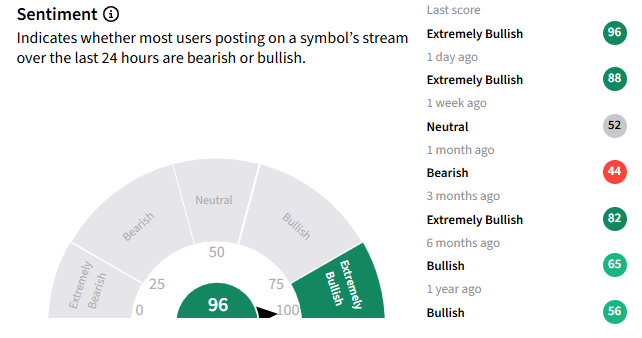
On Stocktwits, retail sentiment for PL jumped to ‘extremely bullish’ from ‘neutral’ levels a week ago amid a 908% surge in 24-hour message volumes.
Advertisement|Remove ads.
One user said, “$PL yeah, this company’s financials are so much better than many many others that are up big lately. The market dynamics should recognize this at some point and correct this thing back up into the high $20’s where it should be.”
Another user said, “$PL today was a good buy, the chasers will come on the right narrative. More governments and businesses will need Planet labs.”
Advertisement|Remove ads.
PL stock has jumped 185% over the past year.
For updates and corrections, email newsroom[at]stocktwits[dot]com.
Advertisement|Remove ads.
Comments posted here will also appear on symbol pages.

Latest News
/filters:format(webp)https://news.stocktwits-cdn.com/large_Michael_Bury_resized_jpg_14e6fc7c2b.webp)
/filters:format(webp)https://news.stocktwits-cdn.com/Prabhjote_DP_67623a9828.jpg) Prabhjote Gill·34m ago
Prabhjote Gill·34m ago/filters:format(webp)https://news.stocktwits-cdn.com/Getty_Images_2232490610_jpg_b3810c3eca.webp)
/filters:format(webp)https://news.stocktwits-cdn.com/vivekkrishnanphotography_58_jpg_0e45f66a62.webp) Arnab Paul·53m ago
Arnab Paul·53m ago/filters:format(webp)https://news.stocktwits-cdn.com/large_crypto_atm_OG_jpg_ab7e4567eb.webp) Prabhjote Gill·1h ago
Prabhjote Gill·1h ago/filters:format(webp)https://news.stocktwits-cdn.com/large_Getty_Images_2245498821_jpg_a630ddc6e3.webp)
/filters:format(webp)https://news.stocktwits-cdn.com/IMG_9209_1_d9c1acde92.jpeg) Yuvraj Malik·2h ago
Yuvraj Malik·2h ago/filters:format(webp)https://news.stocktwits-cdn.com/large_Getty_Images_72608012_jpg_3da2f4e2a2.webp)
/filters:format(webp)https://news.stocktwits-cdn.com/Revised_Profile_JPG_0e0afdf5e2.webp) Preeti Ayyathurai·3h ago
Preeti Ayyathurai·3h ago/filters:format(webp)https://news.stocktwits-cdn.com/large_Getty_Images_2240848338_2f6626256c.jpg)
/filters:format(webp)https://news.stocktwits-cdn.com/shivani_photo_jpg_dd6e01afa4.webp) Shivani Kumaresan·3h ago
Shivani Kumaresan·3h ago