


Advertisement|Remove ads.
Why Is KORU Plunging More Than 18% Overnight?



- Samsung Electronics and SK Hynix stocks dipped sharply after China’s largest DRAM manufacturer, ChangXin Memory Technologies, announced plans to develop new products earlier this week.
- This stoked concerns that Chinese products could edge out other players and weigh on major semiconductor companies.
- An exodus of foreign funds from South Korean markets has also added to the pressure.
Advertisement|Remove ads.
The Direxion Daily South Korea Bull 3X ETF (KORU) plunged more than 18% overnight late Wednesday as sustained weakness in South Korea’s benchmark KOSPI, driven by a sharp slide in chip giants, triggered a selloff.
The KOSPI dipped below 6,000 intraday on Wednesday, dropping below the threshold for the first time since late July as top semiconductor stocks Samsung Electronics and SK Hynix dipped sharply on China concerns.
KOSPI was down more than 7% at the open on Thursday. “The KOSPI is now down -40% from its record high seen on June 19th,” The Kobeissi Letter said in a post on X.
Advertisement|Remove ads.
Why Are South Korean Stocks Selling Off?
China’s ChangXin Memory Technologies (CXMT), the country’s largest DRAM manufacturer, announced plans to develop new products earlier this week. The company also said it will release next-generation products by the end of the year, likely reducing the cell area for data storage in current DRAMs by about 33%.
This stoked concerns that Chinese products could edge out other players and weigh on major semiconductor companies.
In the U.S., Nvidia Corp. (NVDA) dipped 3% at Wednesday's close, while Micron Technology Inc. (MU) and Advanced Micro Devices Inc. (AMD) fell more than 4% and 5% each, respectively.
Advertisement|Remove ads.
Yoon Chang-yong, head of Shinhan Securities Research Center, told The Chosun Daily: "Unlike advanced foundries such as TSMC, domestic semiconductor companies are highly sensitive to changes in memory prices and supply, causing their profits to react sharply."
He added that the entry of Chinese companies into the mix and the expansion of supply will “inevitably place a greater burden on domestic semiconductor stocks."
Meanwhile, Kamal Govan, a portfolio manager at Allan Gray, a South Africa-focused investment management company that has $29 billion in assets, told Bloomberg that the KOSPI is narrow and thematic, “concentrated in two memory chip companies.”
Advertisement|Remove ads.
Samsung Electronics and SK Hynix account for nearly half of the KOSPI, with the AI trade deeply impacting the index.
U.S.-listed shares of SK Hynix (SKHY) fell more than 6% at Wednesday's close and are down more than 12% since its July debut.
Additionally, an exodus of foreign funds from South Korean markets has also added to the pressure. According to the Korea Exchange, as stated in an article from The Chosun Daily, foreign investors had sold about 199.1 trillion Korean won worth of KOSPI stocks as of Oct. 12. Of that, 173.2 trillion Korean won was tied to Samsung Electronics and SK Hynix stocks.
Advertisement|Remove ads.
Park Yeon-joo, head of Mirae Asset Securities Research Center, told the South Korean news outlet, "Amid weakened investment sentiment due to concerns over excessive AI investment, foreign investors have not stopped realizing gains as KOSPI volatility increased."
"Since Korean semiconductor companies are perceived as cyclical stocks due to their historically high earnings volatility, selling pressure is concentrated on them," she added.
KORU: Retail Stance
On Stocktwits, retail sentiment around KORU slipped from ‘extremely bullish’ to ‘bullish’ over 24 hours amid ‘extremely high’ message volumes.
Advertisement|Remove ads.
One user said, “This is [a] complete collapse. next 2 days can wipe you out.”
Another user said, “KOSPI is front running with the most concentrated plays in a.i, semis and tech. KOSPI is already in (a) confirmed bear market.”
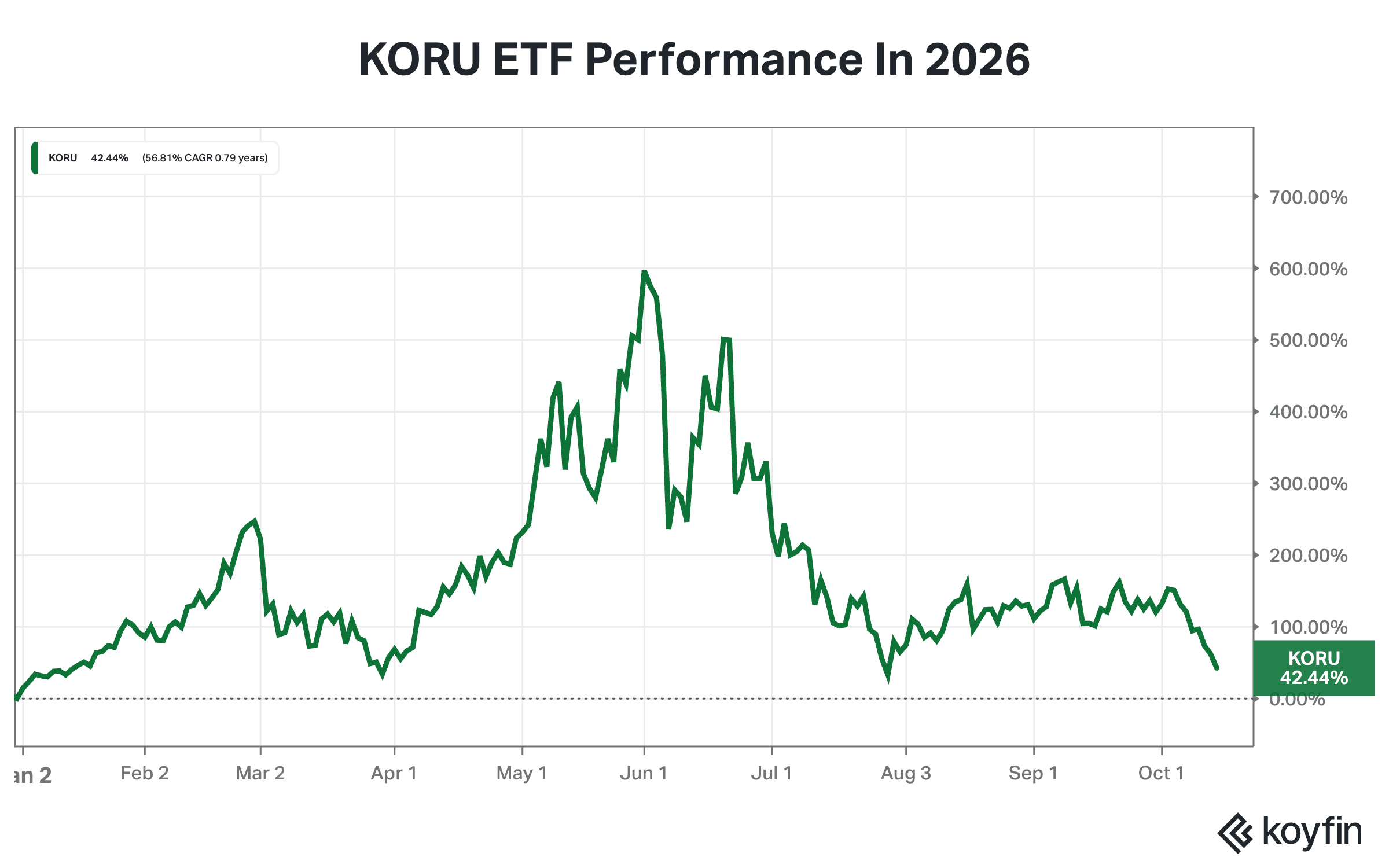
While KORU plunged 12% at Wednesday's close, the ETF is up about 42% in 2026.
Advertisement|Remove ads.
For updates and corrections, email newsroom[at]stocktwits[dot]com.
Comments posted here will also appear on symbol pages.

Latest News
/filters:format(webp)https://news.stocktwits-cdn.com/large_skydance_decde45b1e.jpg)
/filters:format(webp)https://news.stocktwits-cdn.com/shivani_photo_jpg_dd6e01afa4.webp) Shivani Kumaresan·45m ago
Shivani Kumaresan·45m ago/filters:format(webp)https://news.stocktwits-cdn.com/large_Getty_Images_2202604955_7e35cbe4e7.jpg)
/filters:format(webp)https://news.stocktwits-cdn.com/IMG_9209_1_d9c1acde92.jpeg) Yuvraj Malik·1h ago
Yuvraj Malik·1h ago/filters:format(webp)https://news.stocktwits-cdn.com/large_Getty_Images_2230137832_jpg_1de3e68131.webp)
/filters:format(webp)https://news.stocktwits-cdn.com/Revised_Profile_JPG_0e0afdf5e2.webp) Preeti Ayyathurai·1h ago
Preeti Ayyathurai·1h ago/filters:format(webp)https://news.stocktwits-cdn.com/large_Getty_Images_2249860620_jpg_2bd9e54f08.webp) Shivani Kumaresan·1h ago
Shivani Kumaresan·1h ago/filters:format(webp)https://news.stocktwits-cdn.com/large_Getty_Images_2261740761_jpg_17808aac0f.webp) Yuvraj Malik·2h ago
Yuvraj Malik·2h ago/filters:format(webp)https://news.stocktwits-cdn.com/large_Getty_Images_2228494855_jpg_5d44bc914c.webp) Shivani Kumaresan·2h ago
Shivani Kumaresan·2h ago