


Advertisement|Remove ads.
Bitcoin And Ethereum Get A Bigger Role In US Derivatives Markets: Here’s What The CFTC Changed



- CFTC Chairman Mike Selig welcomed a staff advisory that will allow regulated derivatives venues to count some crypto as part of their operating reserves.
- Under the guidance, Bitcoin and Ethereum carry a discount of at least 20%, and payment stablecoins at least 2%.
- Several registered firms and applicants already had crypto and had asked whether it counted, staff said.
Advertisement|Remove ads.
Regulated crypto exchanges and derivatives platforms are getting an easier path to using digital assets in their operations, as the Commodity Futures Trading Commission (CFTC) is allowing them to count Bitcoin (BTC), Ethereum (ETH) and payment stablecoins toward reserves needed to cover a year of operating expenses. The move provides a clearer role for crypto holdings in meeting U.S. regulatory requirements and could lessen firms' need to rely solely on conventional financial assets.
Selig said on X, “I’m happy to see CFTC staff continuing to provide important clarity on crypto assets in US derivatives markets through today’s staff advisory.”

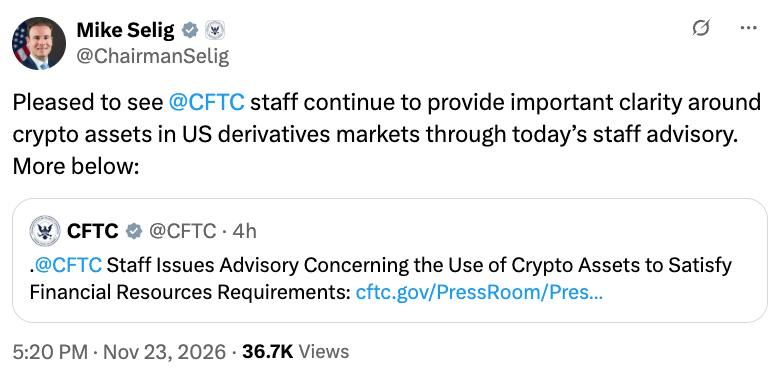
What The CFTC’s New Crypto Guidance Allows
The advisory came from the CFTC’s Division of Market Oversight and Division of Clearing and Risk. It discusses how designated contract markets, swap execution facilities, and derivatives clearing organizations could use crypto assets to meet their financial resource requirements. These firms must have enough financial resources to cover at least 12 months of operating expenses.
Advertisement|Remove ads.
Under the guidance, those firms can now count some crypto toward that cushion, with a discount. The CFTC staff indicated they would not object to a minimum 20% haircut for Bitcoin and Ether and a 2% haircut for payment stablecoins.
In practical terms, a derivatives firm holding $100 worth of Bitcoin could count $80 toward its financial resource requirement after applying a 20% haircut. The same amount in a qualifying payment stablecoin could count as $98 after a 2% haircut.
It does not create new law, is not a no-action letter position, and does not necessarily reflect the views of the Commission, the CFTC said.
Advertisement|Remove ads.
Why CFTC Issued The Advisory
Staff said several registered firms and applicants now hold crypto in their businesses and had inquired whether that would be included as part of their financial resources.
“The rules have been unclear on the question before,” said journalist Eleanor Terrett. “This change clarifies if crypto could count toward the operating cost requirement, as the rules didn’t explicitly say so before,” she wrote on X.

The Catch: Liquidity Rule Still Applies
Crypto still can’t meet a separate liquidity requirement. Exchanges and clearinghouses must hold cash or highly liquid securities equal to six months of operating costs, and swap platforms must hold them for three months.
Advertisement|Remove ads.
Crypto assets, including payment stablecoins, are not considered “cash” or “highly liquid securities” under Generally Accepted Accounting Principles, according to the CFTC.
CFTC's Broader Crypto Push
The guidance is another move by the agency on crypto in recent weeks. Selig said in October the agency was proposing its first crypto market rules, Regulation Crypto Asset Transactions and Regulation Crypto Asset Markets.
Bitcoin’s price was down 0.3% during the past 24 hours. On Stocktwits, retail sentiment around BTC remained in the ‘bullish’ zone, while chatter stayed at ‘high’ levels over the past day.
Advertisement|Remove ads.
On Stocktwits, Ethereum was one of the top trending cryptocurrencies at the time of writing. Ethereum’s price was also down 0.3% during the past 24 hours. On Stocktwits, retail sentiment around ETH remained in the ‘bullish’ zone, while chatter stayed at ‘normal’ levels over the past day.
Read more: RDW Stock Rises Overnight: Redwire CEO Keeps Buying Shares, But Mizuho Sees 22% Downside
For updates and corrections, email newsroom[at]stocktwits[dot]com.
Advertisement|Remove ads.
Comments posted here will also appear on symbol pages.

Latest News

 Yuvraj Malik·18m ago

 Aashika Suresh·20m ago

 Deepti Sri·42m ago

 Shivani Kumaresan·46m ago
 Aashika Suresh·1h ago

 Anushka Basu·1h ago