


Advertisement|Remove ads.
Bitcoin Whales Selling At A Loss In Worst Capitulation Since 2022 Bear Market



- Bitcoin whales and sharks suffered losses of almost $30.9 billion in the first quarter of 2026.
- Santiment data reveal consistent negative realized profit/loss and increased whale transaction activity.
- Declining or static whale supply indicates dispersion rather than accumulation, a trend often linked with late-stage market collapse.
Advertisement|Remove ads.
On-chain data show that whales and sharks have been selling coins at a loss since the first quarter of the year, with the biggest holders of Bitcoin (BTC) clearly stressed.
The Coin Bureau pointed out on Saturday that Bitcoin whales and sharks lost more than $30.9 billion in the first quarter, or about $337 million per day. This was the worst quarter for realized losses since the 2022 bear market.
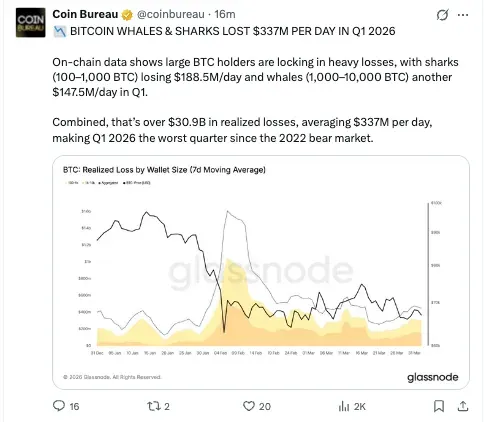
When broken down, sharks who own around 100 to 1,000 BTC lost about $188.5 million a day, and bigger whales who own 1,000 to 10,000 BTC lost another $147.5 million a day. The data shows realized losses by wallet size using a 7-day moving average. It also shows how much selling pressure existed on large holder groups.
Whales Signal Capitulation
Recent Santiment data reinforces this trend, with Network Realized Profit/Loss remaining firmly in negative territory since early February, signaling that a growing share of Bitcoin transactions are being executed at a loss.
Advertisement|Remove ads.
![Bitcoin (BTC) [06.07.20, 04 Apr, 2026].png](https://news.stocktwits-cdn.com/Bitcoin_BTC_06_07_20_04_Apr_2026_png_7362f9e63e.webp)
At the same time, whale transaction activity has remained high with frequent spikes in transfers exceeding $100,000 and $1 million, indicating that large holders are actively moving coins during this downturn.
![Bitcoin (BTC) [06.13.14, 04 Apr, 2026].png](https://news.stocktwits-cdn.com/Bitcoin_BTC_06_13_14_04_Apr_2026_png_ac1386500b.webp)
Supply distribution data confirms this, indicating that wallets holding between 100 and 10,000 BTC, often referred to as whales and sharks, have witnessed stagnation or a drop in their percentage of total supply. This suggests dispersion rather than accumulation, even if prices have failed to rebound.
Taken together, the data reveal that losses are being incurred throughout the network, while large holders remain active but do not increase their positions, indicating that whales are selling into weakness and incurring losses. Historically, this sort of behaviour has been connected with capitulation stages, where even well-capitalized investors begin to de-risk.
Advertisement|Remove ads.
While this does not necessarily signal an immediate market bottom, it often appears in the later stages of corrections. Bitcoin’s price was at $67,147, up 0.4 in the last 24 hours. On Stocktwits, retail sentiment around BTC remained in the ‘bearish’ territory, while chatter levels remained at ‘low’ over the past day.
Bitcoin has struggled to regain upward momentum in recent weeks, and continued selling by large holders could keep pressure on prices in the near term. However, if this wave of loss-driven selling begins to subside, it may also signal that selling pressure is nearing exhaustion.
Read also: Did A Whale Just Scoop $82M In Ethereum? Arkham Data Points To Tom Lee’s Bitmine
Advertisement|Remove ads.
For updates and corrections, email newsroom[at]stocktwits[dot]com
Comments posted here will also appear on symbol pages.

Latest News
/filters:format(webp)https://news.stocktwits-cdn.com/large_Getty_Images_2279869782_8049b29afc.jpg)
/filters:format(webp)https://news.stocktwits-cdn.com/Aashika_Suresh_Profile_Picture_jpg_2acd6f446c.webp) Aashika Suresh·26m ago
Aashika Suresh·26m ago/filters:format(webp)https://news.stocktwits-cdn.com/large_Getty_Images_2300173637_79e4bae290.jpg)
/filters:format(webp)https://news.stocktwits-cdn.com/IMG_9209_1_d9c1acde92.jpeg) Yuvraj Malik·42m ago
Yuvraj Malik·42m ago/filters:format(webp)https://news.stocktwits-cdn.com/large_Getty_Images_2288509244_fc180e6aec.jpg)
/filters:format(webp)https://news.stocktwits-cdn.com/shivani_photo_jpg_dd6e01afa4.webp) Shivani Kumaresan·48m ago
Shivani Kumaresan·48m ago/filters:format(webp)https://news.stocktwits-cdn.com/large_patrick_soon_shiong_jpg_32b8924ac2.webp)
/filters:format(webp)https://news.stocktwits-cdn.com/IMG_8805_JPG_6768aaedc3.webp) Deepti Sri·2h ago
Deepti Sri·2h ago/filters:format(webp)https://news.stocktwits-cdn.com/large_Getty_Images_2203983775_jpg_74bdd5dd43.webp) Aashika Suresh·2h ago
Aashika Suresh·2h ago/filters:format(webp)https://news.stocktwits-cdn.com/gettyimages_1161631184_594x594_0063399eed.jpg)
/filters:format(webp)https://news.stocktwits-cdn.com/1707726834303_jpg_11f20a9aa9.webp) Shashank Nayar·3h ago
Shashank Nayar·3h ago