


Advertisement|Remove ads.
Blackstone’s $48 Billion Private Credit Fund Breaks 3-Year Streak—What It Means For Bitcoin



- Rising redemptions and loan markdowns indicate increasing stress in the private credit industry, with Blackstone's $48 billion private credit fund reporting its first loss in more than three years.
- Amid worries about software-sector risk and AI-driven disruption, Wall Street firms are tightening their exposure and providing ways to short private credit.
- Liquidity shocks may initially put pressure on Bitcoin, according to analysts, but it could push the crypto asset to rebound strongly.
Advertisement|Remove ads.
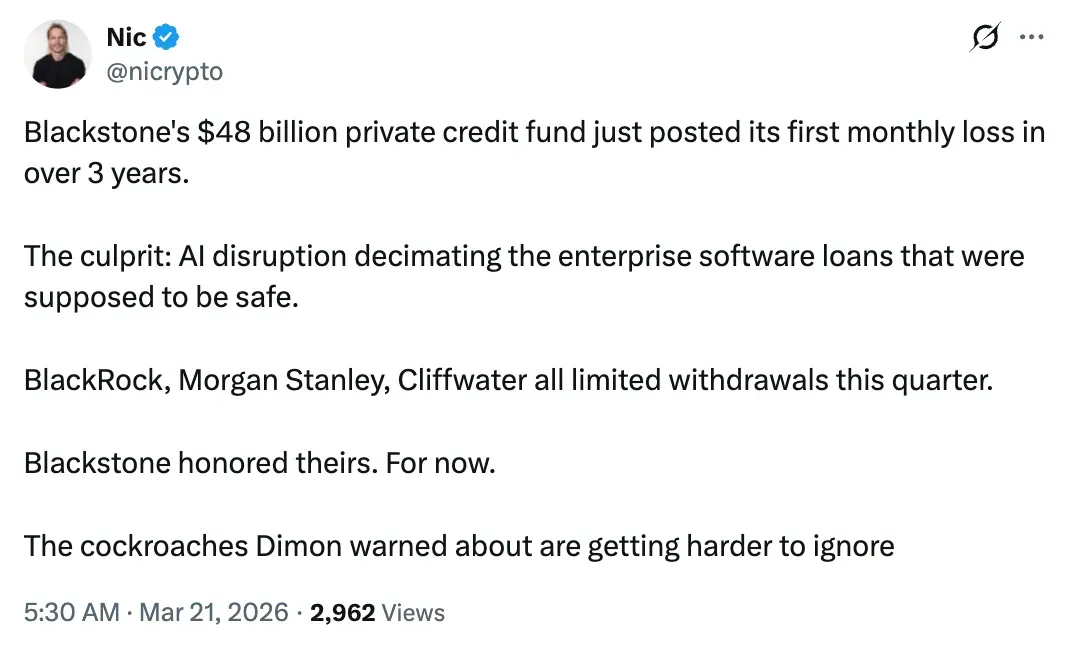
Blackstone Inc.'s (BX) main private credit fund lost money for the first time in more than three years. This shows that the sector is becoming more stressed, even though it has quickly become a key part of global credit markets.
The Blackstone Private Credit Fund (BCRED), which has $48 billion in assets, lost 0.4% in value this month, the first time it has lost value since September 2022. The broader leveraged-loan market also weakened, according to reports.

The outcome coincides with growing investor worries about credit quality and liquidity in the private credit market, which was valued at about $3 trillion at the beginning of 2025 and is expected to grow to $5 trillion by 2029. After the global financial crisis, banks withdrew from riskier lending, which led to a notable increase in the asset class.
Advertisement|Remove ads.
Stress Builds In Private Credit Market
Recent events point to growing stress. In the first quarter, BCRED saw high redemptions, with investors taking out about $3.7 billion. Other companies, such as BlackRock (BLK) and Morgan Stanley (MS), have restricted redemptions in comparable funds following spikes in investor withdrawals, even though Blackstone has continued to fulfill withdrawal requests.
Additionally, Wall Street has started to modify its exposure. It is anticipated that JPMorgan Chase (JPM) will cut back on lending to the software industry after marking down the value of some loans connected to private credit borrowers. In response to the growing need for downside protection, Goldman Sachs and JPMorgan have also launched products that let hedge fund clients take positions against private credit.
The industry's exposure to software companies, which account for a sizable share of private credit portfolios, is a major cause for concern. Artificial intelligence developments are beginning to upend established business models, casting doubt on the creditworthiness, pointed out Nic Puckrin, CEO of crypto research platform Coin Bureau.
Advertisement|Remove ads.
Liquidity Concerns Rise
Some investors are also looking at wider market implications as uncertainty increases. According to a recent analysis by investor Jordi Visser, stress in private credit may eventually affect broader liquidity conditions, which could then affect other asset classes, including cryptocurrencies.
Liquid assets like Bitcoin (BTC) are often sold first during periods of market stress as investors seek cash, according to Visser. He did note, though, that in the past, digital assets have recovered after policy changes that reinstate liquidity.
Historical examples include the sharp selloff in March 2020, when Bitcoin fell more than 30% before rallying significantly amid global stimulus measures.
Advertisement|Remove ads.
Similar to the pattern observed following stimulus-driven recoveries and crises such as the 2023 banking turmoil, Bitcoin typically sells off hard during liquidity shocks (capitulation), such as in March 2020, but then rallies strongly once conditions stabilize and liquidity returns.
Now, many market analysts, including Mikybull, are hinting at a bullish momentum for the asset.
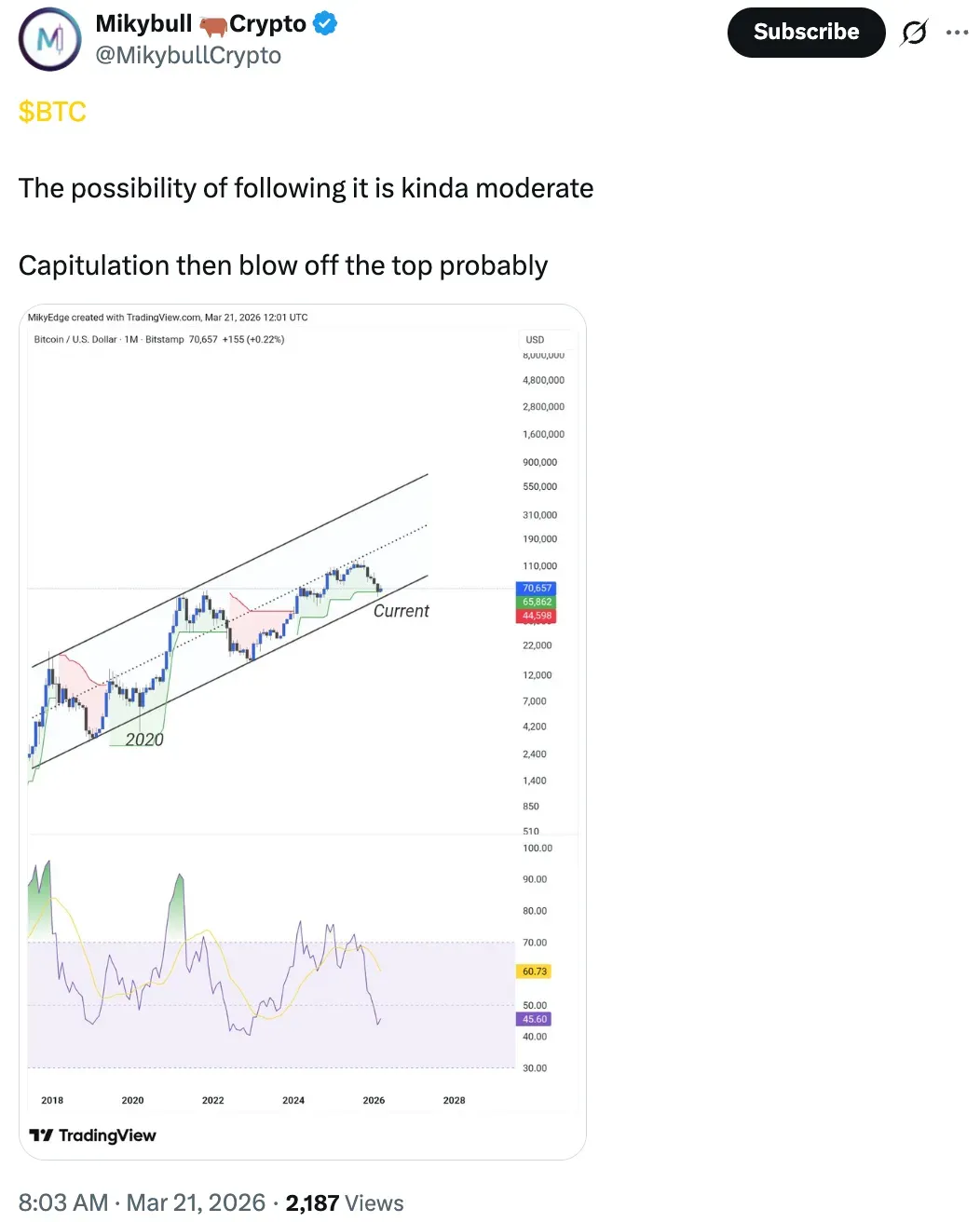
Bitcoin was trading at $70,706, up over 0.4% in the last 24 hours. On Stocktwits, retail sentiment around BTC remained in the ‘bullish’ territory, with ‘low’ chatter levels over the past day.
Advertisement|Remove ads.

However, some analysts contend that the risks might not be systemic despite the pressures. According to a recent J.P. Morgan Private Bank report, recent worries might stem from "isolated pockets of weakness" rather than a general decline in the fundamentals of private credit.
Read also: Smart Money Returns To Ethereum As Whale Buys Back ETH Sold In 2021
For updates and corrections, email newsroom[at]stocktwits[dot]com.
Advertisement|Remove ads.
Comments posted here will also appear on symbol pages.

Latest News
/filters:format(webp)https://st-everywhere-cms-prod.s3.us-east-1.amazonaws.com/large_Crown_Castle_resized_jpg_1ddf452bb6.webp)
/filters:format(webp)https://news.stocktwits-cdn.com/shivani_photo_jpg_dd6e01afa4.webp) Shivani Kumaresan·24m ago
Shivani Kumaresan·24m ago/filters:format(webp)https://news.stocktwits-cdn.com/large_space_stocks_2_6f2aa9bc90.jpg)
/filters:format(webp)https://news.stocktwits-cdn.com/IMG_8805_JPG_6768aaedc3.webp) Deepti Sri·40m ago
Deepti Sri·40m ago/filters:format(webp)https://news.stocktwits-cdn.com/large_michael_burry_cropped_b787ce89b4.jpg) Deepti Sri·1h ago
Deepti Sri·1h ago/filters:format(webp)https://news.stocktwits-cdn.com/large_Getty_Images_2286863020_e80075951f.jpg) Shivani Kumaresan·2h ago
Shivani Kumaresan·2h ago/filters:format(webp)https://news.stocktwits-cdn.com/large_tesla_stock_jpg_9d4cbf6a46.webp) Deepti Sri·2h ago
Deepti Sri·2h ago/filters:format(webp)https://news.stocktwits-cdn.com/large_Getty_Images_2261924569_e7eed2419d.jpg)
/filters:format(webp)https://news.stocktwits-cdn.com/IMG_9209_1_d9c1acde92.jpeg) Yuvraj Malik·3h ago
Yuvraj Malik·3h ago