


Advertisement|Remove ads.
Hyperliquid Fee Windfall: Machi Big Brother’s $1.94M Payment Raises Questions Around Crypto Trading Costs



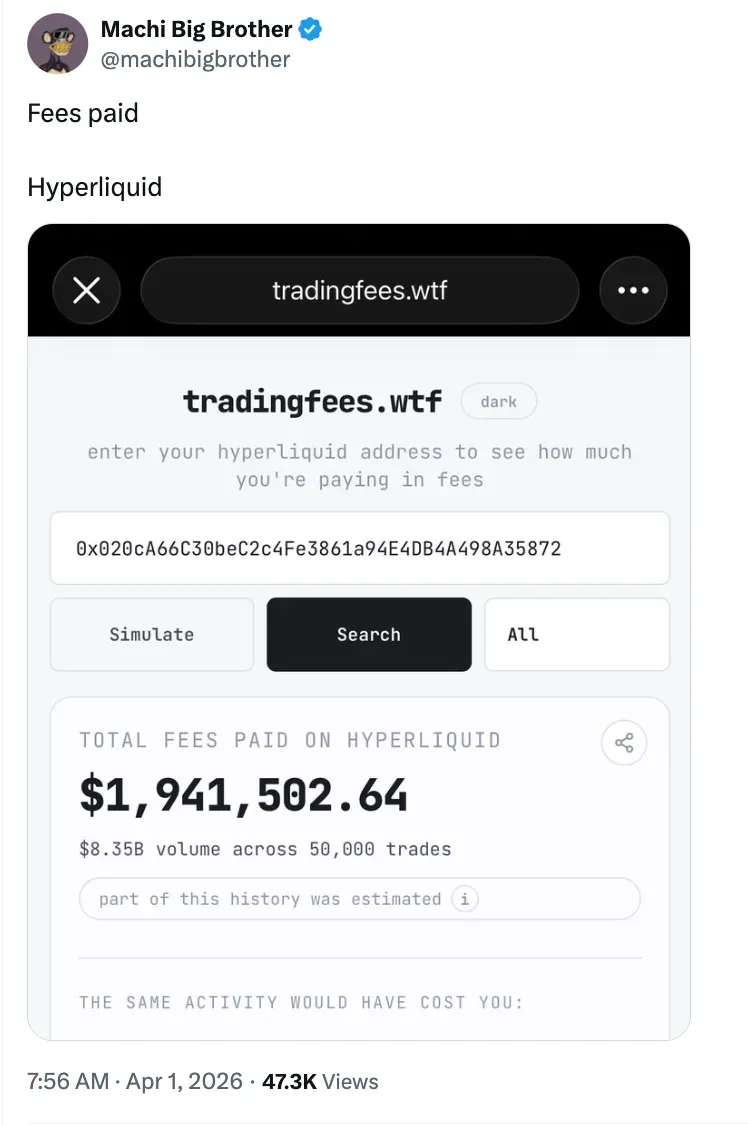
- A trader popularly known as Machi Big Brother reported $1.94 million in Hyperliquid costs from $8.35 billion in volume.
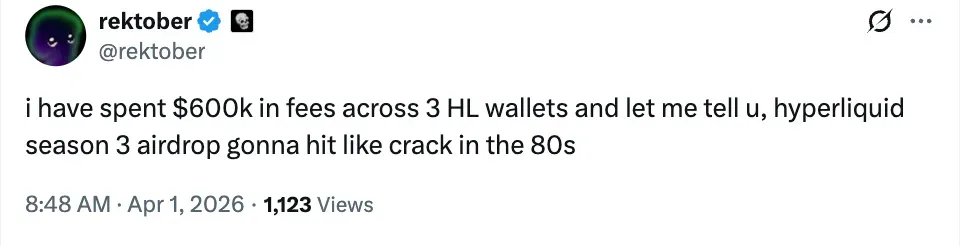
- Some traders earn over $600,000 in referral fees, suggesting that fees may be an investment rather than a cost.
- Previous arguments have pitted Binance's zero-fee initiatives against Coinbase's opposition.
Advertisement|Remove ads.
Machi Big Brother, a well-known trader, revived the debate on Wednesday about cryptocurrency trading fees after exposing roughly $2 million spent on Hyperliquid (HYPE).
On X, the trader provided data showing that a single wallet produced around $8.35 billion in trading volume over 50,000 deals, resulting in $1.94 million in total fees on the decentralized derivatives platform. The message soon spread around the crypto community, and traders argued over whether these fees fit with Hyperliquid's image as a high-performance, low-fee venue.
One trader named Rektober claimed to have paid over $600,000 in fees across multiple wallets, viewing it as a worthwhile trade-off in anticipation of a prospective Season 3 airdrop.
Advertisement|Remove ads.
Others cited referral dynamics and reward schemes, with one trader earning almost $80,000 through referrals, suggesting that fee-heavy behavior may be somewhat offset by incentive programs. The tone of the conversation indicated a growing agreement among power users that high fees may be justified if accompanied by incentives, liquidity, or expected token dividends.
Hyperliquid’s price was over $36, up 0.6% in the last 24 hours. On Stocktwits, retail sentiment around HYPE remained in the ‘bearish’ zone, while chatter levels remained at ‘normal’ over the past day.

Debate Over Fees
This discussion also parallels a wider industry discussion over trading costs that has previously occurred among major exchanges. For example, Binance's (BNB) introduction of zero-fee trading campaigns in 2022 sparked debate about whether the industry was entering a "race to zero," while Coinbase (COIN) executives had stated at the time that the company did not intend to eliminate fees entirely.
Advertisement|Remove ads.
Coinbase’s fee structure has repeatedly been brought up as a point of contention, with many, including Nansen CEO Alex Svanevik, as recently as January. Coinbase had previously cited regulatory compliance, security, and customer trust for its high fees.
Wash Trading To Farm Rebates Or Incentives
Market makers and high-frequency traders rarely modify fee structures directly, but instead optimize around them in ways that shift their effective costs. Wash trading to farm rebates or token incentives, maker-taker rebate arbitrage, and fast-expanding volume to unlock lower fee tiers are all common tactics on platforms like dYdX, Blur, and Hyperliquid.
On Monday, the Department of Justice accused 10 executives and employees from four crypto market-making businesses, Gotbit, Vortex, Antier, and Contrarian, of influencing token trading volume and prices via wash trading.
Advertisement|Remove ads.
Read also: BlackRock’s Bitcoin Income ETF Nears Launch – Could Go Live In ‘Weeks,’ Analyst Says
For updates and corrections, email newsroom[at]stocktwits[dot]com
Comments posted here will also appear on symbol pages.

Latest News
/filters:format(webp)https://news.stocktwits-cdn.com/large_Getty_Images_1424203411_jpg_051aa2d880.webp)
/filters:format(webp)https://news.stocktwits-cdn.com/IMG_9209_1_d9c1acde92.jpeg) Yuvraj Malik·8m ago
Yuvraj Malik·8m ago/filters:format(webp)https://news.stocktwits-cdn.com/large_Getty_Images_2212423186_d6371420b5.jpg)
/filters:format(webp)https://news.stocktwits-cdn.com/shivani_photo_jpg_dd6e01afa4.webp) Shivani Kumaresan·39m ago
Shivani Kumaresan·39m ago/filters:format(webp)https://news.stocktwits-cdn.com/large_GEV_Vernova_resized_jpg_2fd59ac745.webp)
/filters:format(webp)https://news.stocktwits-cdn.com/Aashika_Suresh_Profile_Picture_jpg_2acd6f446c.webp) Aashika Suresh·51m ago
Aashika Suresh·51m ago/filters:format(webp)https://news.stocktwits-cdn.com/large_asts_a3f37696a9.jpg)
/filters:format(webp)https://news.stocktwits-cdn.com/IMG_8805_JPG_6768aaedc3.webp) Deepti Sri·1h ago
Deepti Sri·1h ago/filters:format(webp)https://news.stocktwits-cdn.com/large_qualcomm_jpg_bf257cee94.webp) Yuvraj Malik·1h ago
Yuvraj Malik·1h ago/filters:format(webp)https://news.stocktwits-cdn.com/large_BE_Bloom_faee9b1d61.webp) Aashika Suresh·2h ago
Aashika Suresh·2h ago