


Advertisement|Remove ads.
Nvidia CEO Jensen Huang Joins Elon Musk, Michael Saylor In Calling Bitcoin ‘A Store Of Energy’
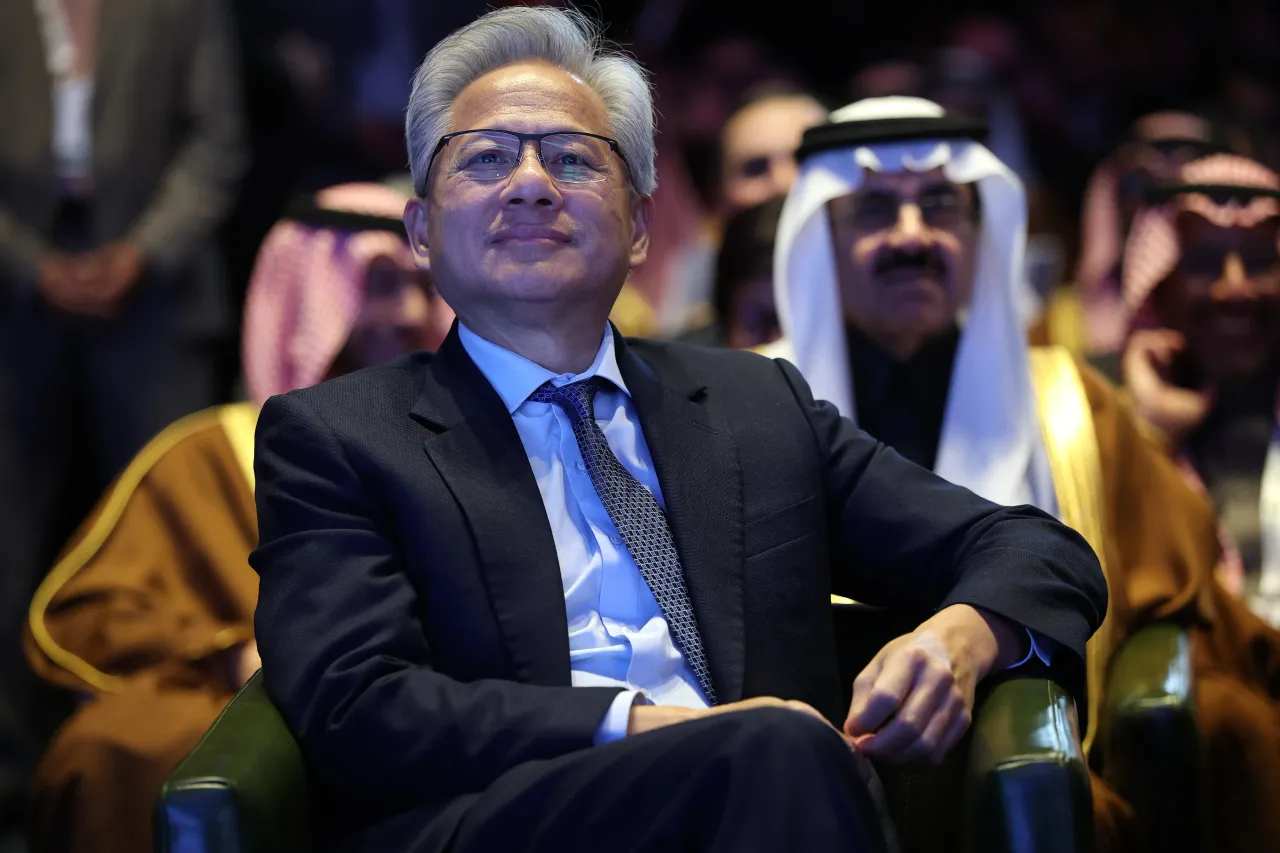


- Huang described Bitcoin as a way to store and transport excess energy globally.
- His comments echo similar views previously expressed by Elon Musk and Michael Saylor.
- However, Huang also compared Bitcoin with AI, calling intelligence a more universal currency.
Advertisement|Remove ads.
Nvidia (NVDA) CEO Jensen Huang described Bitcoin (BTC) as a store of energy this week, joining the same school of thought as tech leaders Elon Musk and Michael Saylor.
Speaking at the Consumer Electronics Show on Monday, Huang said Bitcoin effectively converts surplus energy into a transferable economic asset. “Essentially, what Bitcoin is doing is taking excess energy and storing it into a new form. It’s called currency. And you take that currency, and you take it wherever you like,” he said. “You took energy from one place, and now you’ve transported it everywhere.”
Bitcoin’s price traded at around $92,600 on Tuesday night, down 1.2% in the last 24 hours. On Stocktwits, retail sentiment around the apex cryptocurrency remained in ‘extremely bullish’ territory over the past day, with chatter at ‘high’ levels.
Advertisement|Remove ads.
Bitcoin As A Store Of Energy
Huang’s remarks align with a narrative generally promoted by Bitcoin advocates who argue the network monetizes stranded or excess energy by converting it into a globally portable asset.
Tesla (TSLA) Chief Executive Elon Musk has described Bitcoin as “based on energy” in the last year. Musk was replying to a post by ZeroHedge about AI energy demands and fiat debasement. "True. That is why Bitcoin is based on energy: you can issue fake fiat currency, and every government in history has done so, but it is impossible to fake energy," he wrote in a post on X.

Michael Saylor, executive chairman of Strategy (MSTR), has also referred to Bitcoin as “digital energy.” In fact, he is attributed with popularizing the phrase "Bitcoin is digital energy" during his keynote speech at the MIT Bitcoin Expo in 2022.
Advertisement|Remove ads.
During the talk, Saylor quoted Nikola Tesla to explain how Bitcoin is digital energy that can “vibrate at all frequencies” in cyberspace, enabling energy conservation and transformation into property or capital. He also emphasized that Bitcoin's underlying proof-of-work mechanism converts physical energy into an “immortal, indestructible digital form” superior to other data center outputs, such as streaming video.
AI Seen As A More Universal Currency
At CES, however, Huang did draw a distinction between Bitcoin and artificial intelligence (AI). He suggested that intelligence itself could become a more “universal” medium of value transfer. “You find places with excess energy. Go put a data center there,” Huang said. “Transfer that energy, compress it into an AI model, and take that model all over the place to use it.”
The comments come as Nvidia remains central to the global buildout of AI infrastructure, especially as the race for dominance between the U.S. and China heats up.
Advertisement|Remove ads.
Nvidia’s stock was the top trending ticker on Stocktwits at the time of writing. The shares rose 0.49% in after-hours trading after a 0.47% drop in regular trading. Retail sentiment around the company on the platform trended in ‘bullish’ territory amid ‘high levels of chatter.
Read also: Arthur Hayes Calls On Binance, Bybit To List This Crypto Token After It Hit A Record High
For updates and corrections, email newsroom[at]stocktwits[dot]com.
Advertisement|Remove ads.
Comments posted here will also appear on symbol pages.

Latest News
/filters:format(webp)https://news.stocktwits-cdn.com/large_Getty_Images_2294264991_a1d08b075d.jpg)
/filters:format(webp)https://news.stocktwits-cdn.com/Anushka_Basu_make_me_smile_in_the_picture_b92832aa_af59_4141_aacc_4180d2241ba8_1_2_png_1086e0ed8c.webp) Anushka Basu·9h ago
Anushka Basu·9h ago/filters:format(webp)https://news.stocktwits-cdn.com/large_Getty_Images_1925090359_f160f05588.jpg) Anushka Basu·10h ago
Anushka Basu·10h ago/filters:format(webp)https://news.stocktwits-cdn.com/large_Getty_Images_2213700296_87303c323b.jpg) Anushka Basu·10h ago
Anushka Basu·10h ago/filters:format(webp)https://news.stocktwits-cdn.com/large_franklin_templeton_OG_jpg_4b3a7330d9.webp) Anushka Basu·12h ago
Anushka Basu·12h ago/filters:format(webp)https://news.stocktwits-cdn.com/large_Getty_Images_1445160636_5780a5fdde.jpg) Anushka Basu·13h ago
Anushka Basu·13h ago/filters:format(webp)https://news.stocktwits-cdn.com/Getty_Images_540198451_jpg_3e5f3d8ee7.webp) Anushka Basu·14h ago
Anushka Basu·14h ago