


Advertisement|Remove ads.
Prediction Markets ETFs Could Make The Sector ‘More Legit,’ Analyst Says – But Critic Calls Them ‘Las Vegas in a New Outfit’



- Bloomberg analyst Eric Balchunas said prediction market exchange-traded funds could offer low-cost, regulated access to bet on macro events like elections and Fed decisions.
- Institutional interest in prediction markets is rising, with ARK Invest partnering with Kalshi.
- Critics like Strike CEO Jack Mallers stated that the products resemble gambling, citing data showing most users lose money while profits concentrate among a small group.
Advertisement|Remove ads.
Prediction market exchange-traded funds (ETFs) could go mainstream, offering investors a regulated and low-cost way to bet on macroeconomic events, Bloomberg’s Eric Balchunas said on Tuesday, even as critics compare the products to gambling.
Balchunas, a Senior ETF analyst at Bloomberg, noted in a post on X that ETFs could allow investors to take positions on outcomes, in elections, Federal Reserve decisions, and recession risks simply in a “yes/ no fashion.”

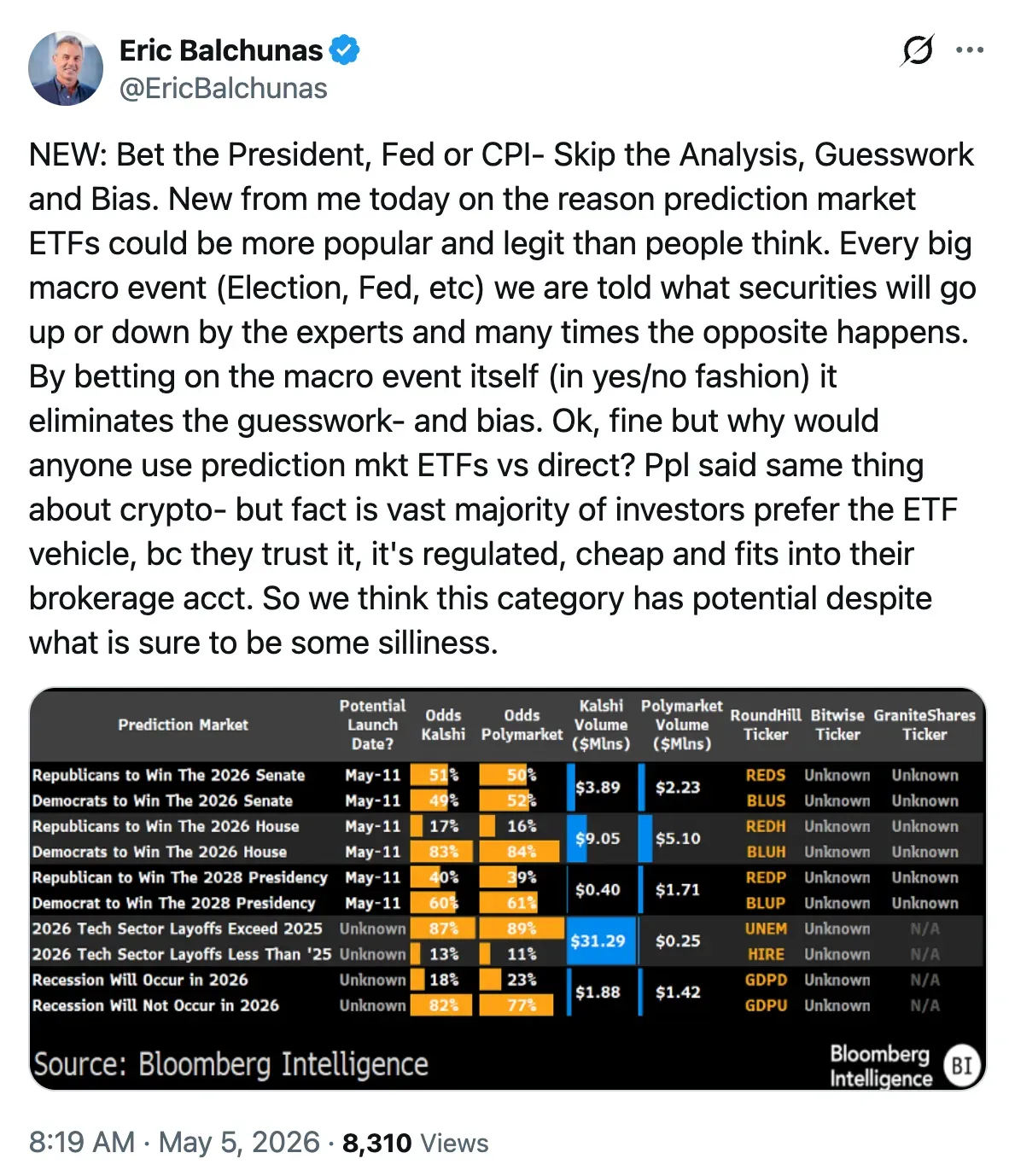
He argued that betting on the event itself removes the need for traditional market forecasting, and that ETF structures tend to appeal to investors because they are regulated, accessible through brokerage accounts, and relatively low-cost.
Advertisement|Remove ads.
According to Balchunas, prediction market ETFs could become “more popular and legit than people think.”
Prediction Markets Compared To Gambling Platforms
However, the trend has drawn sharp criticism from some crypto industry leaders.
Strike CEO Jack Mallers on Monday said in a post on X that prediction markets resembled gambling platforms rather than tools for financial empowerment. “Prediction markets aren’t freedom, they’re Las Vegas in a new outfit,” Mallers wrote, adding that such platforms monetize speculation driven by fiat currency dynamics.
Advertisement|Remove ads.

Mallers cited a Wall Street Journal analysis that found 67% of profits on Polymarket were concentrated among just 0.1% of accounts, while most users incurred losses. He contrasted prediction markets with Bitcoin (BTC), describing it as a system designed for saving rather than speculation.
Bitcoin’s price was trading at $80,987, up over 2% during the past 24 hours. On Stocktwits, the retail sentiment around BTC remained in the ‘bullish’ zone, while chatter around it moved to ‘high’ from ‘normal’ zones over the past day.
Wall Street Push Meets Crypto Skepticism
These comments come as prediction platforms like Polymarket and Kalshi have become increasingly popular over the last few years, where users trade contracts tied to real-world outcomes.
Advertisement|Remove ads.
Earlier this year, Cathie Wood’s ARK Invest partnered with Kalshi, signaling the rising institutional interest in integrating prediction markets into more traditional financial frameworks. Other top crypto firms, such as Coinbase (COIN) and Gemini (GEMI), have also ventured into prediction markets.
The rising interest comes as prediction markets are projected to reach $1 trillion by 2030, according to Bernstein. However, the regulatory momentum around the products has stalled.
The US Securities and Exchange Commission (SEC) has reportedly put on hold multiple prediction-market ETFs scheduled for launch this week. This includes the Roundhill ETF, which was expected to launch today.
Advertisement|Remove ads.
For updates and corrections, email newsroom[at]stocktwits[dot]com.
Comments posted here will also appear on symbol pages.

Latest News
/filters:format(webp)https://news.stocktwits-cdn.com/large_Getty_Images_2247416070_jpg_3898db2638.webp)
/filters:format(webp)https://news.stocktwits-cdn.com/Prabhjote_DP_67623a9828.jpg) Prabhjote Gill·27m ago
Prabhjote Gill·27m ago/filters:format(webp)https://news.stocktwits-cdn.com/large_Getty_Images_1757401303_e51e9c74d8.jpg)
/filters:format(webp)https://news.stocktwits-cdn.com/Anushka_Basu_make_me_smile_in_the_picture_b92832aa_af59_4141_aacc_4180d2241ba8_1_2_png_1086e0ed8c.webp) Anushka Basu·31m ago
Anushka Basu·31m ago/filters:format(webp)https://news.stocktwits-cdn.com/gettyimages_2301241032_594x594_fc9a358791.jpg)
/filters:format(webp)https://news.stocktwits-cdn.com/Heera_1_1c30cb0170.PNG) Heera Hari·1h ago
Heera Hari·1h ago/filters:format(webp)https://news.stocktwits-cdn.com/large_apple_iphone18promax_10a3113689.jpg)
/filters:format(webp)https://news.stocktwits-cdn.com/Harshita_3cfe02022c.jpg) Harshita Tyagi·1h ago
Harshita Tyagi·1h ago/filters:format(webp)https://news.stocktwits-cdn.com/large_Getty_Images_2247481493_2752b5d809.jpg) Prabhjote Gill·1h ago
Prabhjote Gill·1h ago/filters:format(webp)https://news.stocktwits-cdn.com/large_Getty_Images_2209365060_jpg_2e461baefa.webp) Anushka Basu·2h ago
Anushka Basu·2h ago