


Advertisement|Remove ads.
A Quantum Rally On Wall Street Is Reopening One Of Bitcoin’s Long-Term Biggest Security Fears


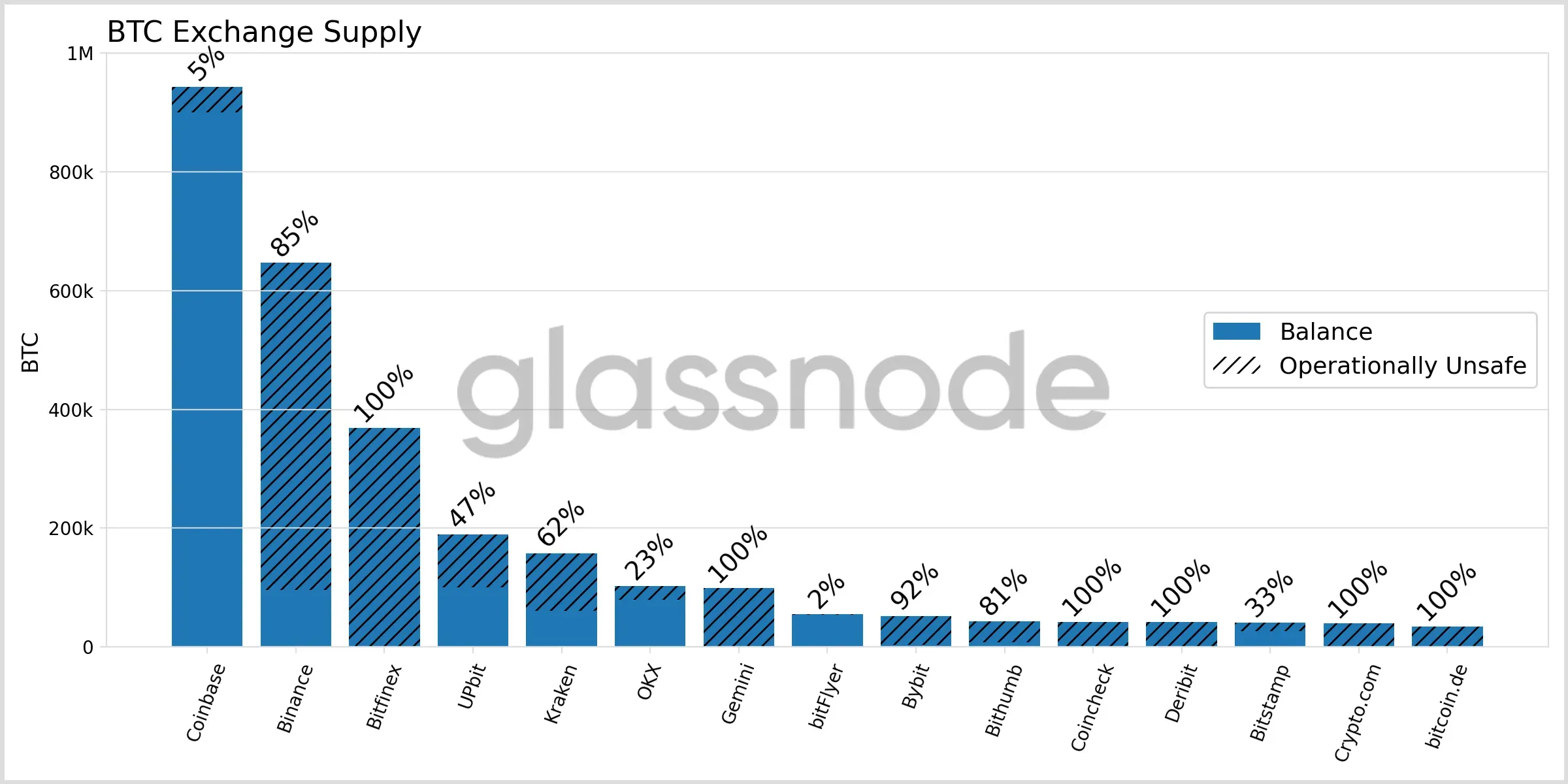
- Coinbase showed relatively low exposure levels in Glassnode’s report at just 5%.
- Binance, Gemini, and Bitfinex recorded significantly higher exposure, with the latter two at 100% exposure.
- The report identified exchange wallet-management practices and address reuse as major contributors to operational quantum exposure.
Advertisement|Remove ads.
Quantum-computing stocks rallied in pre-market trade on Thursday, reviving debate around Bitcoin’s (BTC) long-term security model and putting crypto exchanges like Coinbase (COIN), Binance (BNB), and Gemini’s (GEMI) wallet-management practices under renewed scrutiny.
A recent Glassnode report from earlier this week added fuel to the debate by estimating that more than 30% Bitcoin’s circulating supply is exposed to potential future quantum-computing attacks. It flagged that balances on some exchanges are at greater risk than on others.
BTQ Technologies (BTQ) is among the few public companies explicitly pitching quantum-safe Bitcoin infrastructure. BTQ’s stock rallied nearly 20% in the previous session and was edging higher in pre-market trade. Retail sentiment on Stocktwits around the company rose to ‘bullish’ from ‘neutral’ over the past day, and chatter jumped to ‘high’ from ‘low’.
Advertisement|Remove ads.
The renewed focus on quantum risks comes as investors pile into quantum computing names following the Trump administration's announcement of a $2 billion equity investment across nine quantum computing companies. More than 50% was allocated in a new International Business Machines Corp. (IBM) venture that will manufacture quantum chips.
Coinbase, Binance, and Gemini Bitcoin Risk Analysis
According to a Glassnode report, around 6.04 million Bitcoin, which account for 30.2% of BTC’s total supply, currently have public keys visible on-chain, putting them at “at-rest” quantum exposure.
It also found that exchange-related balances account for roughly 1.66 million Bitcoin, equivalent to around 8.3% of the total supply.
Advertisement|Remove ads.
Glassnode’s data pegged Coinbase to have comparatively limited exposure, with only around 5% of labeled balances categorized as exposed. Binance, on the other hand, showed exposure at 85%, while Bitfinex and Gemini were listed at 100% under the report’s framework.
Outside traditional exchanges, the report showed Robinhood (HOOD) and WisdomTree with fully exposed balances, while Fidelity and Block’s (XYZ) Cash App were closer to 2%.
Advertisement|Remove ads.
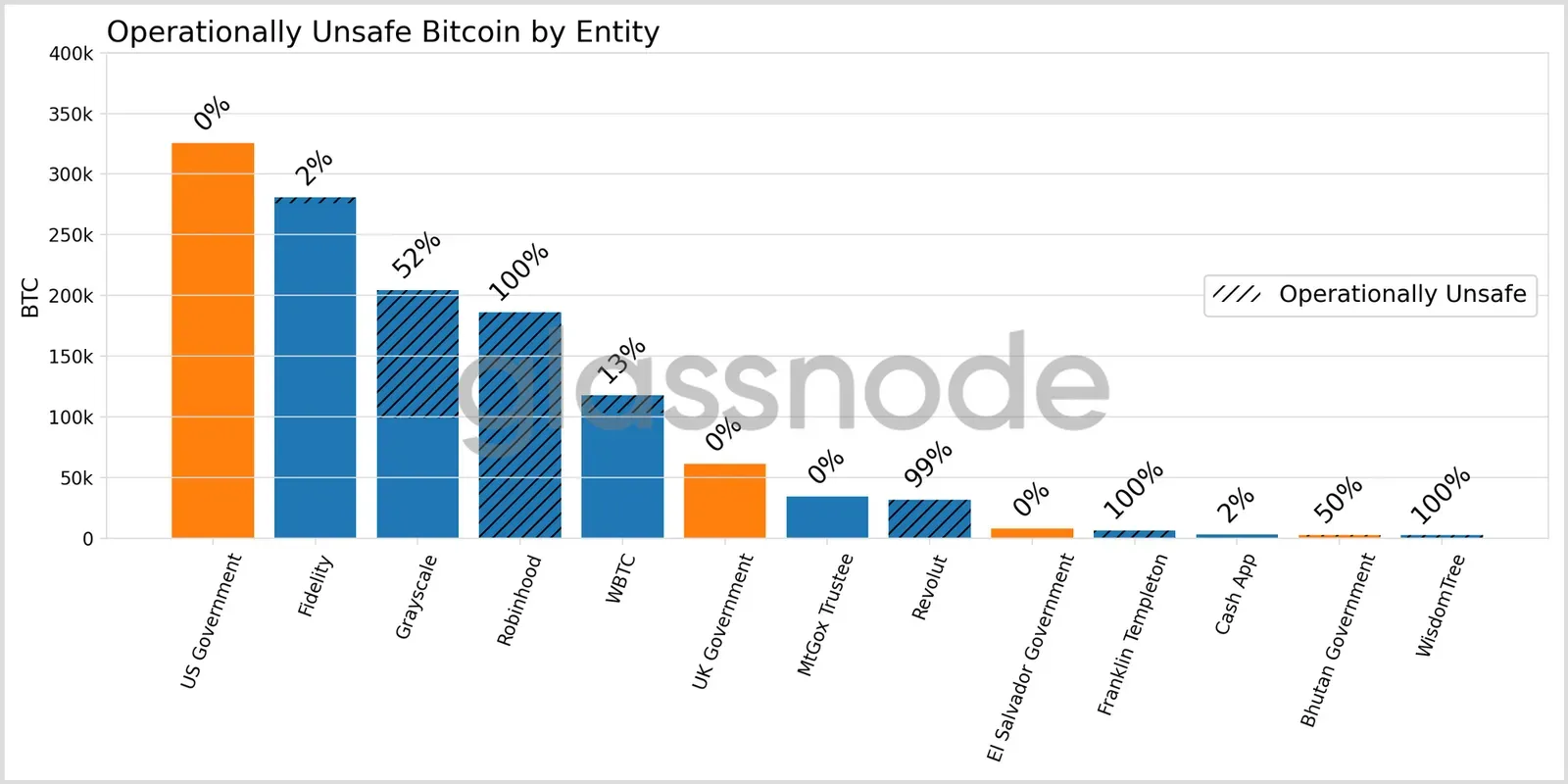
The report identified exchange wallet-management practices and address reuse as major contributors to operational quantum exposure.
What Is Bitcoin’s Quantum Exposure?
The quantum threat to Bitcoin centers around BTC addresses where public keys are already visible on-chain. Bitcoin addresses normally conceal public keys behind cryptographic hashes until coins are spent. However, repeated address reuse or certain wallet structures can permanently expose public keys while coins remain stored there.
However, market watchers like Strategy (MSTR) chief executive Michael Saylor and Bitcoin cryptographer Adam Back have pushed back, saying that the threat is not immediate. Back even warned that premature fixes might pose greater risks than the quantum threat.
Advertisement|Remove ads.
Glassnode split the vulnerable supply into two categories across “structural exposure” and “operational exposure.” It said structural exposure refers to Bitcoin inherently exposed by design, including early Bitcoin-era wallets and certain modern Taproot structures. That category accounts for roughly 1.92 million BTC.
Operational exposure, the larger category at 4.12 million Bitcoin, results from user behavior and custody management practices such as address reuse and exchange reserve handling. It added that operational exposure is potentially reversible through better practices.
Bitcoin’s price edged 0.2% higher in the last 24 hours, trading at around $77,300. Retail sentiment around the apex cryptocurrency on Stocktwits remained in ‘bearish’ territory over the past day, accompanied by ‘normal’ levels of chatter.
Advertisement|Remove ads.
Read also: Mark Cuban Claims Bitcoin Failed As War Hedge – But Data Shows BTC Outperforming Gold
For updates and corrections, email newsroom[at]stocktwits[dot]com
Comments posted here will also appear on symbol pages.

Latest News
/filters:format(webp)https://news.stocktwits-cdn.com/large_Getty_Images_2248643644_jpg_b1cf0e9d8a.webp)
/filters:format(webp)https://news.stocktwits-cdn.com/1707726834303_jpg_11f20a9aa9.webp) Shashank Nayar·2h ago
Shashank Nayar·2h ago/filters:format(webp)https://news.stocktwits-cdn.com/large_ross_stores_resized_jpg_e7e996e005.webp)
/filters:format(webp)https://news.stocktwits-cdn.com/unnamed_jpg_9dff551b50.webp) Anan Ashraf·2h ago
Anan Ashraf·2h ago/filters:format(webp)https://news.stocktwits-cdn.com/Getty_Images_2197860201_jpg_c4f2083335.webp) Shashank Nayar·3h ago
Shashank Nayar·3h ago/filters:format(webp)https://news.stocktwits-cdn.com/large_Getty_Images_2227980543_jpg_29597f359b.webp) Anan Ashraf·3h ago
Anan Ashraf·3h ago/filters:format(webp)https://news.stocktwits-cdn.com/Getty_Images_2250240969_jpg_dd9be8c5ea.webp)
/filters:format(webp)https://news.stocktwits-cdn.com/Whats_App_Image_2026_05_11_at_09_45_43_1_jpeg_a08c0cf251.webp) Aveek Bhowmik·4h ago
Aveek Bhowmik·4h ago/filters:format(webp)https://news.stocktwits-cdn.com/large_Getty_Images_2269282844_jpg_933bcaa49e.webp) Shashank Nayar·4h ago
Shashank Nayar·4h ago