


Advertisement|Remove ads.
SEC's Hester Peirce Says Rule 611 Has Outlived Its Usefulness, Backs Plan To Scrap Two-Decade-Old Mandate
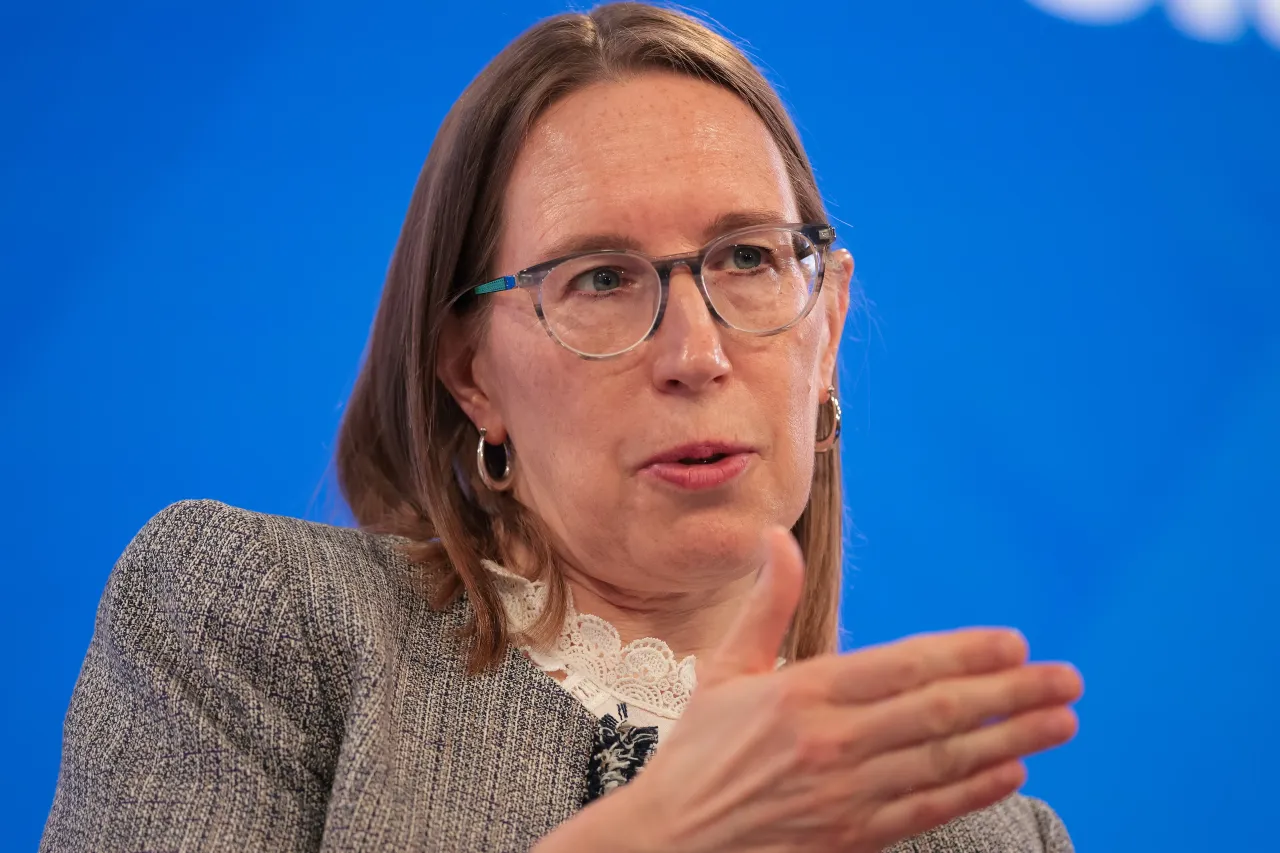


- Hester Peirce backed the agency's proposal to eliminate Rule 611 on Saturday, arguing modern markets no longer need the 20-year-old regulation.
- Peirce said the rule has contributed to market complexity and makes it harder for blockchain-based stock trading platforms to operate.
- She also downplayed expectations for the SEC's upcoming Innovation Exemption, saying it will be narrower than many expect.
Advertisement|Remove ads.
The US Securities and Exchange Commission (SEC) Commissioner Hester Peirce said that a key stock-market rule created two decades ago has outlived its usefulness.
Speaking to The Rollup on Friday, the SEC Commissioner Hester Peirce backed the agency's proposal to eliminate Rule 611, a regulation introduced in 2005 to ensure investors received the best available price when buying or selling stocks.

Peirce argued that modern markets no longer need the rule because traders and market participants naturally seek out price differences on their own. "Markets don't need a rule to bind them together, that's what arbitrageurs do," she said. Simply put, Peirce believes competition between traders can keep prices aligned without regulators forcing exchanges to follow a complex set of requirements. She also said the rule has created unintended side effects, including a more fragmented market and increasingly complicated trading systems.
Advertisement|Remove ads.
What Is SEC’s Rule 611?
According to Peirce, Rule 611 creates hurdles for tokenized equities because blockchain trading venues cannot easily comply with requirements tied to the National Best Bid and Offer, the benchmark used to determine the best available stock price across exchanges.
Earlier this month, the SEC formally proposed eliminating Rule 611 and the related Rule 610(e). SEC Chairman Paul Atkins described the effort as part of a broader plan to simplify market rules and reduce costs.
The proposal is also something of a personal victory for Atkins. When the rule was originally adopted in 2005, Atkins, then serving as an SEC commissioner, had co-authored a lengthy dissent arguing against it. Now, as SEC chairman, he is in a position to help remove it.
Advertisement|Remove ads.
Peirce Cools Expectations Around Crypto Exemption
Peirce also pushed back against growing speculation surrounding the SEC's planned Innovation Exemption, a proposal many in the crypto industry hope will make it easier to launch blockchain-based financial products.
She said the exemption has not yet been released and is more limited than many headlines suggest. "It will not cover synthetic securities," Peirce said, adding that the initiative focuses on regulated on-chain finance rather than fully decentralized finance. "It's not even that big of a step, frankly,” she added.
CLARITY Act Could Reshape SEC Priorities
While the SEC is working on its own reforms, Congress could soon hand the agency a much larger task.
Advertisement|Remove ads.
Peirce identified the pending CLARITY Act as one of the biggest factors shaping the regulator's agenda. If passed, the bill would require extensive new rulemaking and coordination between the SEC and the Commodity Futures Trading Commission (CFTC). Peirce, whose term officially ended last June, said she expects to leave the agency before the end of the year to return to teaching law.
At the same time, industry leaders are pushing for broader access to investment opportunities.
Coinbase (COIN) CEO Brian Armstrong argued on Friday that accredited-investor rules should be replaced with a financial-literacy test, saying the current system favors wealthy investors. Peirce has separately indicated that the SEC is exploring ways to expand retail access to private markets, putting regulators and industry executives on increasingly parallel tracks.
Advertisement|Remove ads.
COIN’s stock closed down by 1% on Friday. On Stocktwits, retail sentiment around COIN remained in the ‘bullish’ zone, while chatter stayed at ‘normal’ levels over the past day.
Read also: 'Why Hold Robinhood Over Gold?': Helius CEO Mert Mumtaz Brushes Off SOL Vs ZEC Narrative Debate
For updates and corrections, email newsroom[at]stocktwits[dot]com
Advertisement|Remove ads.
Comments posted here will also appear on symbol pages.

Latest News
/filters:format(webp)https://news.stocktwits-cdn.com/large_Getty_Images_2295800057_fd745de575.jpg)
/filters:format(webp)https://news.stocktwits-cdn.com/shivani_photo_jpg_dd6e01afa4.webp) Shivani Kumaresan·5m ago
Shivani Kumaresan·5m ago/filters:format(webp)https://news.stocktwits-cdn.com/large_Bloom_Energy_jpg_de9372f92d.webp)
/filters:format(webp)https://news.stocktwits-cdn.com/Aashika_Suresh_Profile_Picture_jpg_2acd6f446c.webp) Aashika Suresh·11m ago
Aashika Suresh·11m ago/filters:format(webp)https://news.stocktwits-cdn.com/moderna_hq_resized_jpg_97563ed423.webp) Aashika Suresh·34m ago
Aashika Suresh·34m ago/filters:format(webp)https://news.stocktwits-cdn.com/large_Getty_Images_2295513588_4013502a48.jpg) Shivani Kumaresan·1h ago
Shivani Kumaresan·1h ago/filters:format(webp)https://news.stocktwits-cdn.com/large_new_york_stock_exchange_jpg_e1f85c0d8c.webp) Aashika Suresh·1h ago
Aashika Suresh·1h ago/filters:format(webp)https://st-everywhere-cms-prod.s3.us-east-1.amazonaws.com/large_lam_research_logo_resized_3eeb50952a.jpg)
/filters:format(webp)https://news.stocktwits-cdn.com/IMG_8805_JPG_6768aaedc3.webp) Deepti Sri·1h ago
Deepti Sri·1h ago