


Advertisement|Remove ads.
Tether CEO Says Bank For International Settlements Is ‘Rightfully Worried’ Stablecoins Expose Banking’s Fractional-Reserve Problem



- Paolo Ardoino said on Sunday the BIS was "rightfully worried" that stablecoins expose a fractional-reserve problem in traditional banking.
- He contrasted it with fully-reserved stablecoins with tokenized bank deposits, which he says hold only about 10% in liquid reserves.
- BIS General Manager Pablo Hernández de Cos said tokenized bank deposits, not stablecoins, are the more promising foundation for future money.
Advertisement|Remove ads.
Tether (USDT) CEO Paolo Ardoino said that the Bank for International Settlements (BIS) was “rightfully worried” that stablecoins were exposing a fractional-reserve problem at the heart of traditional banking.
On Sunday, Ardoino argued that fully-reserved stablecoins were structurally safer than tokenized bank deposits. He drew comparisons between stablecoins and tokenized bank deposits, saying that the former was "100% reserved by liquid assets (ie., treasuries). On the other hand, tokenized bank deposits, according to Ardoino, were "pinky swear uninsured bank deposits (usually only 10% reserved by liquid assets)."
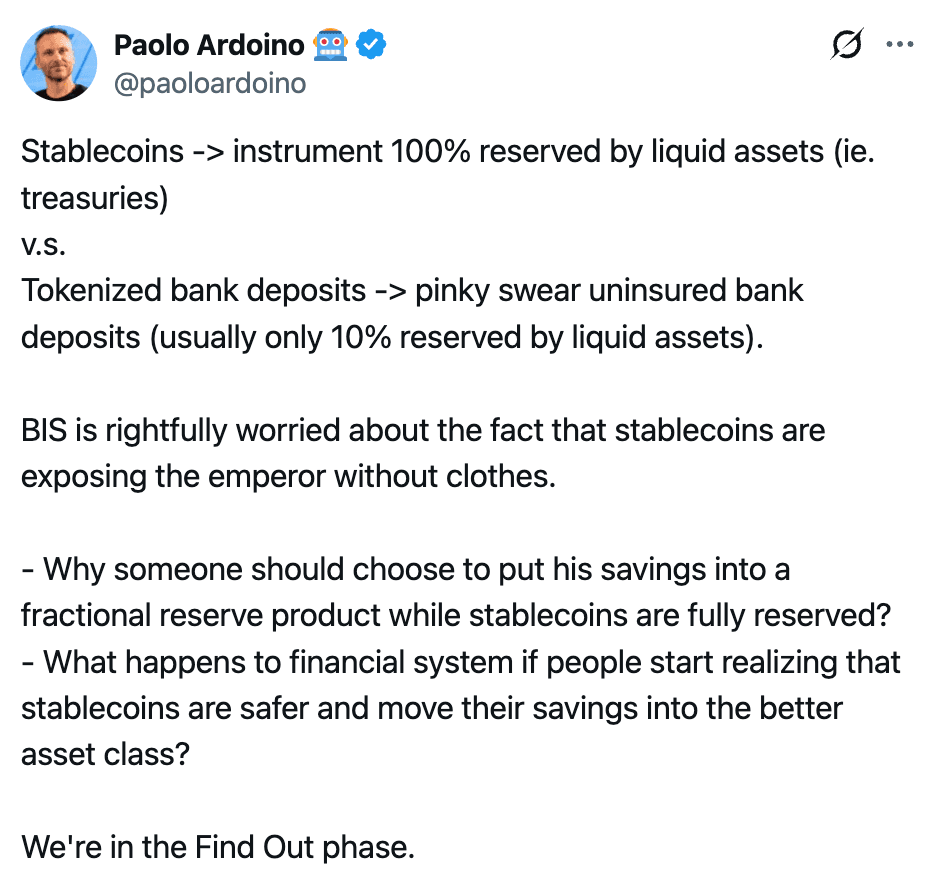
Why Choose Fractional-Reserve Banks Over Fully-Reserved Stablecoins?
That 10% number was a clue to fractional-reserve banking, the normal system in which banks keep only a fraction of deposits and loan out the rest. This system works as long as depositors don't all try to pull out their money at once
Advertisement|Remove ads.
Additionally, the Tether CEO asked why anyone would choose a fractional-reserve product over a fully-reserved one, and what would happen to the financial system if depositors acted on that realization and moved their savings into stablecoins. “We’re in the find out phase,” he added.
USDT’s price, Tether’s dollar-pegged stablecoin, traded flat over the past 24 hours. On Stocktwits, the retail sentiment around USDT moved to ‘neutral’ from the ‘bullish’ zone, while chatter around it stayed at ‘high’ levels over the past day.
BIS Chief Warns Stablecoins Could Pose Systemic Risks
Ardoino was responding to a speech delivered by BIS General Manager Pablo Hernández de Cos at the Jackson Hole Economic Symposium on Friday.
Advertisement|Remove ads.
De Cos said tokenized bank deposits, not stablecoins, were a more promising base for the monetary system of the future.
He said there were three areas that stablecoins currently lacked, including “singleness,” as redemption at par was not guaranteed, as stablecoins could deviate in secondary markets, and “interoperability,” as stablecoins were fragmented across incompatible blockchains. The third was "financial integrity," where he cited evidence that most stablecoin balances are in self-custodied wallets outside of traditional monitoring.
The BIS Chief also warned of macro-level risks that if stablecoins were adopted at scale, banks could see their funding costs increase as deposits shift away from them, and stablecoin issuers themselves could face "run risk" - a scenario where a wave of redemptions forces them to sell reserve assets quickly, potentially destabilizing broader markets.
Advertisement|Remove ads.
The Bigger Fight Over Stablecoins In The US: CLARITY Act
The debate comes amid the growing discussions surrounding stablecoins and tokenized deposit accounts merging with the broader fight over U.S crypto regulation. The GENIUS Act, signed last year, provides a federal structure for stablecoin payments. The much-anticipated passing of the CLARITY Act could help with the establishment of proper federal regulation of digital assets.
However, the bill has attracted much criticism, as banks have argued that the adoption of cryptocurrencies could threaten their deposit base, the very risk cited by BIS.
Read also: Bitcoin Buyers Step Back In As Realized Cap Gains $4.6 Billion, Is A Bull Market Finally Here?
Advertisement|Remove ads.
For updates and corrections, email newsroom[at]stocktwits[dot]com.
Comments posted here will also appear on symbol pages.

Latest News
/filters:format(webp)https://news.stocktwits-cdn.com/large_trump_putin_jpg_eb42a46830.webp)
/filters:format(webp)https://st-everywhere-cms-prod.s3.us-east-1.amazonaws.com/i_OS_App_Icon_1_8054f2a2fe.png) Stocktwits News Desk·49m ago
Stocktwits News Desk·49m ago/filters:format(webp)https://news.stocktwits-cdn.com/large_Getty_Images_2286326398_84fc8215c8.jpg)
/filters:format(webp)https://news.stocktwits-cdn.com/Prabhjote_DP_67623a9828.jpg) Prabhjote Gill·1h ago
Prabhjote Gill·1h ago/filters:format(webp)https://news.stocktwits-cdn.com/large_Getty_Images_2162497795_jpg_c07f3aa255.webp)
/filters:format(webp)https://news.stocktwits-cdn.com/vivekkrishnanphotography_58_jpg_0e45f66a62.webp) Arnab Paul·2h ago
Arnab Paul·2h ago/filters:format(webp)https://news.stocktwits-cdn.com/large_Getty_Images_2250139725_0ccee3701a.jpg)
/filters:format(webp)https://news.stocktwits-cdn.com/unnamed_jpg_9dff551b50.webp) Anan Ashraf·3h ago
Anan Ashraf·3h ago/filters:format(webp)https://news.stocktwits-cdn.com/large_Getty_Images_1390829031_d0ceb471aa.jpg) Anan Ashraf·3h ago
Anan Ashraf·3h ago/filters:format(webp)https://news.stocktwits-cdn.com/large_Getty_Images_2288503385_05d85c70be.jpg)
/filters:format(webp)https://news.stocktwits-cdn.com/1707726834303_jpg_11f20a9aa9.webp) Shashank Nayar·4h ago
Shashank Nayar·4h ago