


Advertisement|Remove ads.
MAG 7 Voices: How Nvidia, Microsoft, Alphabet, Meta Reshaped AI This Week



- Nvidia CEO Jensen Huang is pushing to bring Nvidia’s AI computing platform to personal computers and has committed $1 billion over five years to U.S. scientific research.
- Microsoft CEO Satya Nadella sees secure desktop environments as essential for AI agents, predicting that local and cloud-based intelligence will increasingly work together.
- Alphabet CEO Sundar Pichai has emphasized Google’s integrated AI stack, while its new Gemini agent’s use of rival models highlights a more flexible approach.
Advertisement|Remove ads.
The Magnificent Seven are no longer making the same bet on artificial intelligence. Microsoft (MSFT) wants them running securely on personal computers. Alphabet’s (GOOG, GOOGL) Google is building a cloud-based agent that can handle complex tasks and retain context. Meta (META) is putting its assistant into new devices, including a wearable pendant.
But the race to make AI more capable is running alongside a harder question for investors: how quickly can the technology generate durable revenue?
A Financial Times report on Thursday stated that OpenAI told prospective investors its annualized revenue was approaching $50 billion, below the roughly $68 billion figure widely reported two months earlier.
Advertisement|Remove ads.
The report attributed the gap in part to different accounting methods. Anthropic includes revenue from cloud partners such as Amazon Web Services and Google Cloud, while OpenAI does not.
The distinction does not necessarily indicate a sudden deterioration in demand, but it has given investors another reason to scrutinize the numbers behind the AI investment cycle. Nvidia (NVDA) underperformed the Roundhill Magnificent Seven ETF (MAGS) so far this week, while Apple (AAPL) outperformed.
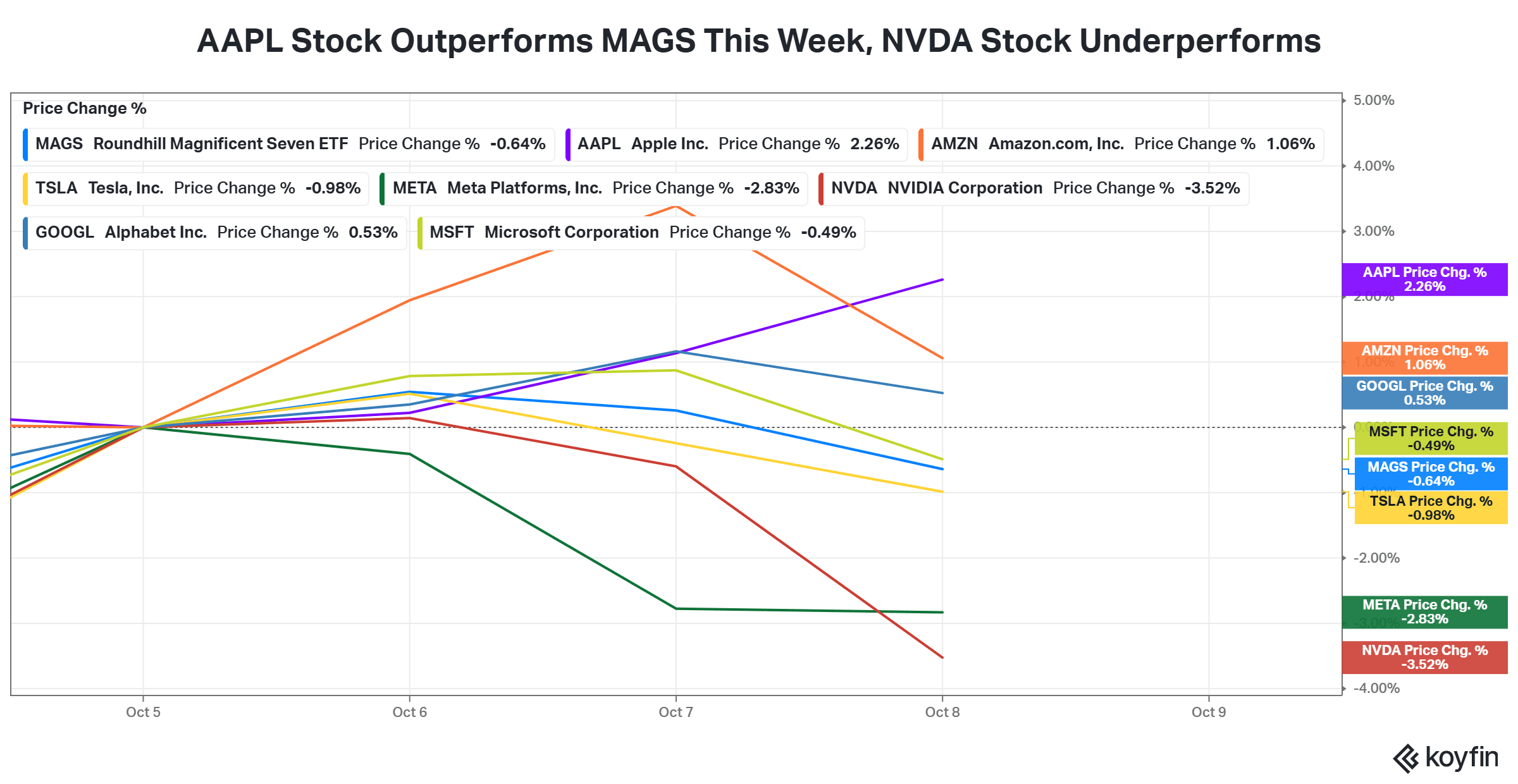
Washington is also trying to shape the next phase of the industry. President Donald Trump named Director of National Intelligence Jay Clayton as AI czar on Sunday to lead a “Super Intelligence Force,” which has 120 days to report.
Advertisement|Remove ads.
Nvidia: Bringing The AI Stack To The Desktop
Clayton’s 120-day reporting clock is also running. For investors, the bigger question is whether the next round of AI launches can show a credible path from impressive capabilities and heavy infrastructure spending to durable revenue. OpenAI’s latest revenue disclosure has brought that question back to the center of the AI trade.
The pitch extends Nvidia’s business beyond the data centers that have driven its growth. RTX Spark laptop preorders opened Wednesday ahead of an October 16 release, and Nvidia previewed a Windows version of its GB300-based DGX Station with 748GB of memory.
Huang also tied Nvidia’s strategy to the administration’s science agenda. At a Washington event Thursday, the company committed $1 billion over five years to U.S. scientific research, quantum computing, healthcare and energy security under Trump’s Genesis Mission.
Advertisement|Remove ads.
“With a $1 billion investment, NVIDIA is putting advanced Super Intelligence in the hands of America’s scientists,” Huang said, describing the effort as a way to turn “scientific leadership into industrial leadership.” The language echoes the administration’s “Super Intelligence” branding, while Nvidia continues to sell the computing systems needed to support those ambitions.
Microsoft: The Sandbox Is The Product
Microsoft made its Execution Containers generally available Wednesday, giving AI agents a restricted environment in which to operate without unrestricted access to a user’s data or ability to take actions on a device. Anthropic, OpenAI and Nvidia will use the technology.
“We needed to make the desktop the most secure place for agents to execute,” Microsoft CEO Satya Nadella said. He added that “hybrid intelligence will be everywhere,” suggesting that local computing and cloud services will increasingly work together rather than compete as mutually exclusive options.
Advertisement|Remove ads.
Hardware is only part of the story. Microsoft has guided for Windows OEM and Devices revenue to decline in the high teens in fiscal 2027, while demand for its Azure cloud service continues to exceed available supply. Moor Insights analyst Anshel Sag said the memory crunch could make local AI a purchase mainly for customers with the budget to afford it.
Alphabet: One Agent, Multiple Models
Google Cloud introduced its Gemini agent Thursday, presenting it as a single assistant for work that takes “objectives, not instructions.” The system can coordinate sub-agents on tasks that may run for hours or days. It remains in private preview, with broader availability across Workspace expected later.
A notable feature is its ability to select the model best suited to a task. The agent currently uses both Google’s Gemini and Anthropic’s Claude models.
Advertisement|Remove ads.
Wall Street is watching the hardware behind that strategy. Wells Fargo raised its price target on Alphabet to $417 from $411 and projected external sales of its tensor processing units (TPUs) at $9.2 billion in the third quarter (Q3) and $11.5 billion in the fourth quarter (Q4). Those estimates include hardware installed in customers’ own data centers.
Meta: Free AI, Unanswered Questions
Meta is taking a different approach by distributing its AI assistant through consumer devices. Muse is free for now while Meta explores its options, and IDC analyst Meredith Whalen said “the real question is trust.”
Microsoft may help Meta expand the assistant’s reach. Microsoft’s announcement said Muse will integrate with its execution containers and receive a native Windows app, although no release date, pricing or user target was provided.
Advertisement|Remove ads.
Amazon: Making The Case For $220 Billion In Spending
Amazon’s (AMZN) AI spending drew attention through comments from AWS CEO Matt Garman on the a16z podcast Thursday. Garman said AWS’s largest customer accounts for only a single-digit share of revenue and put Amazon’s 2026 capital expenditure near $220 billion. He also noted that startups contribute 30% to 40% of AWS revenue, with Trainium capacity sold out for the next year.
Amazon founder Jeff Bezos offered a more personal view of AI’s potential in an interview with Fox News. He said AI could allow some people to decide, “I can support my family working three days a week,” and promoted Prometheus, the startup he co-leads.
Apple: Cook Steps Back, Ternus Faces The AI Test
Apple’s week was defined by the transition from Tim Cook to John Ternus. In an interview with The Independent, Cook said he stepped down on September 1 partly to give Ternus “some wind at his back.” He also called the iPhone Duo amazing, while Ternus remained largely out of the spotlight.
Advertisement|Remove ads.
Apple has confirmed a second fall event for Octo ber. 13. Bloomberg’s Mark Gurman expects the company to introduce a smart-home hub with a screen, a new HomePod mini and an updated Apple TV, all built around Siri AI.
Tesla: Terafab Takes A New Turn
Tesla’s (TSLA) AI plans also shifted during the week. CEO Elon Musk confirmed Saturday that talks with Taiwan Semiconductor Manufacturing Co. (TSM) about the Terafab chip complex were “just discussions, but something may come of it.” By Wednesday, Musk said Tesla and his other companies would build and operate Terafab themselves, with TSMC potentially limited to subleasing space.
Musk also accused unnamed “oligarchs” in India of blocking Starlink’s launch to protect a “monopolistic chokehold” on connectivity, according to comments reported Wednesday.
Advertisement|Remove ads.
Tesla’s robotaxi operations continued to expand. Service hours in Austin moved to 11 p.m., with Musk explaining the limit as “literally trying to avoid grey kittens on grey tarmac in the dark.” Round-the-clock service is tied to the planned release of FSD v15 this month.
Texas records reportedly show Cybercab registrations at 319, up from 169, although Austin remains the only public robotaxi market. Tesla also faces an October 30 deadline to provide the National Highway Traffic Safety Administration with sworn answers about Cybercab safety certification.
The operating numbers offered a brighter spot. Tesla delivered 486,532 vehicles in the third quarter, beating the 461,974 consensus estimate by 5.3%. Energy-storage deployments totaled 13.7 gigawatt-hours, below the 15.9 GWh estimate. Tesla reports earnings on October 21.
Advertisement|Remove ads.
What To Watch
Slated for next week is Apple’s event on Tuesday. Tesla’s Roadster demonstration is scheduled for Thursday, followed by the October 16 start of RTX Spark laptop shipments and Surface Laptop Ultra deliveries.
Clayton’s 120-day reporting clock is also running. For investors, the bigger question is whether the next round of AI launches can show a credible path from impressive capabilities and heavy infrastructure spending to durable revenue.
Advertisement|Remove ads.
For updates and corrections, email newsroom[at]stocktwits[dot]com.
Comments posted here will also appear on symbol pages.

Latest News
/filters:format(webp)https://news.stocktwits-cdn.com/large_trump_putin_jpg_eb42a46830.webp)
/filters:format(webp)https://st-everywhere-cms-prod.s3.us-east-1.amazonaws.com/i_OS_App_Icon_1_8054f2a2fe.png) Stocktwits News Desk·18m ago
Stocktwits News Desk·18m ago/filters:format(webp)https://news.stocktwits-cdn.com/large_Getty_Images_2286326398_84fc8215c8.jpg)
/filters:format(webp)https://news.stocktwits-cdn.com/Prabhjote_DP_67623a9828.jpg) Prabhjote Gill·32m ago
Prabhjote Gill·32m ago/filters:format(webp)https://news.stocktwits-cdn.com/large_Getty_Images_2162497795_jpg_c07f3aa255.webp)
/filters:format(webp)https://news.stocktwits-cdn.com/vivekkrishnanphotography_58_jpg_0e45f66a62.webp) Arnab Paul·2h ago
Arnab Paul·2h ago/filters:format(webp)https://news.stocktwits-cdn.com/large_Getty_Images_2250139725_0ccee3701a.jpg)
/filters:format(webp)https://news.stocktwits-cdn.com/unnamed_jpg_9dff551b50.webp) Anan Ashraf·3h ago
Anan Ashraf·3h ago/filters:format(webp)https://news.stocktwits-cdn.com/large_Getty_Images_1390829031_d0ceb471aa.jpg) Anan Ashraf·3h ago
Anan Ashraf·3h ago/filters:format(webp)https://news.stocktwits-cdn.com/large_Getty_Images_2288503385_05d85c70be.jpg)
/filters:format(webp)https://news.stocktwits-cdn.com/1707726834303_jpg_11f20a9aa9.webp) Shashank Nayar·4h ago
Shashank Nayar·4h ago