


Advertisement|Remove ads.
Tether's Biggest Exchange Outflow In 3 Months Could Hint At Bitcoin Bounce: Santiment



- Santiment reported $1.29 billion in net Tether outflows from exchanges on Saturday, the largest such move in roughly three months.
- According to the analytics platform, the outflows likely reflected whales and institutions moving capital into self-custody wallets, decentralized finance protocols, and over-the-counter desks.
- Santiment noted that a similar USDT outflow event in February was followed by a short-term Bitcoin pullback before the cryptocurrency later rebounded.
Advertisement|Remove ads.
Blockchain analytics platform Santiment reported on Saturday that Tether’s (USDT) exchange flow balance on Ethereum (ETH) recorded its largest exchange outflow in roughly three months, with $1.29 billion in net USDT moving off exchanges.
According to Santiment data, the large USDT outflow likely reflected whales and institutional investors moving funds into self-custody wallets, decentralized finance protocols, or over-the-counter trading desks rather than exiting crypto markets entirely. “When stablecoins flow off exchanges, it means holders are withdrawing their buying power from trading platforms rather than deploying it into immediate purchases,” the firm added.


The comments came as Bitcoin (BTC) continued trading near the $80,000 level following recent market volatility across crypto assets.
Advertisement|Remove ads.
Santiment noted that lower stablecoin balances on exchanges can initially appear bearish due to reduced immediate buying liquidity, but previous outflow spikes have historically preceded larger repositioning moves by major market participants.
The analytics platform pointed to a similar USDT outflow event in February, when roughly $3.72 billion moved off exchanges. According to Santiment, the move coincided with a mild Bitcoin pullback over the following two weeks before the cryptocurrency later rebounded.
Watching For Return Flows
According to Santiment, the key metric to monitor now is whether USDT begins flowing back onto exchanges in the coming days. “If USDT begins flowing back onto exchanges, it would signal that deployment into crypto assets is imminent,” the platform wrote. Santiment added that large exchange outflows often indicate capital is being repositioned rather than permanently leaving digital asset markets.
Advertisement|Remove ads.
However, analyst Darkfost questioned Santiment’s analysis. He said the $1.29 billion Tether outflow may have had nothing to do with whale repositioning. He added that CryptoQuant data suggests the move might be just a reserve reshuffle between USDC and USDT, with USDT leaving exchanges, possibly offset by USDC coming in, rather than a real withdrawal of buying power.
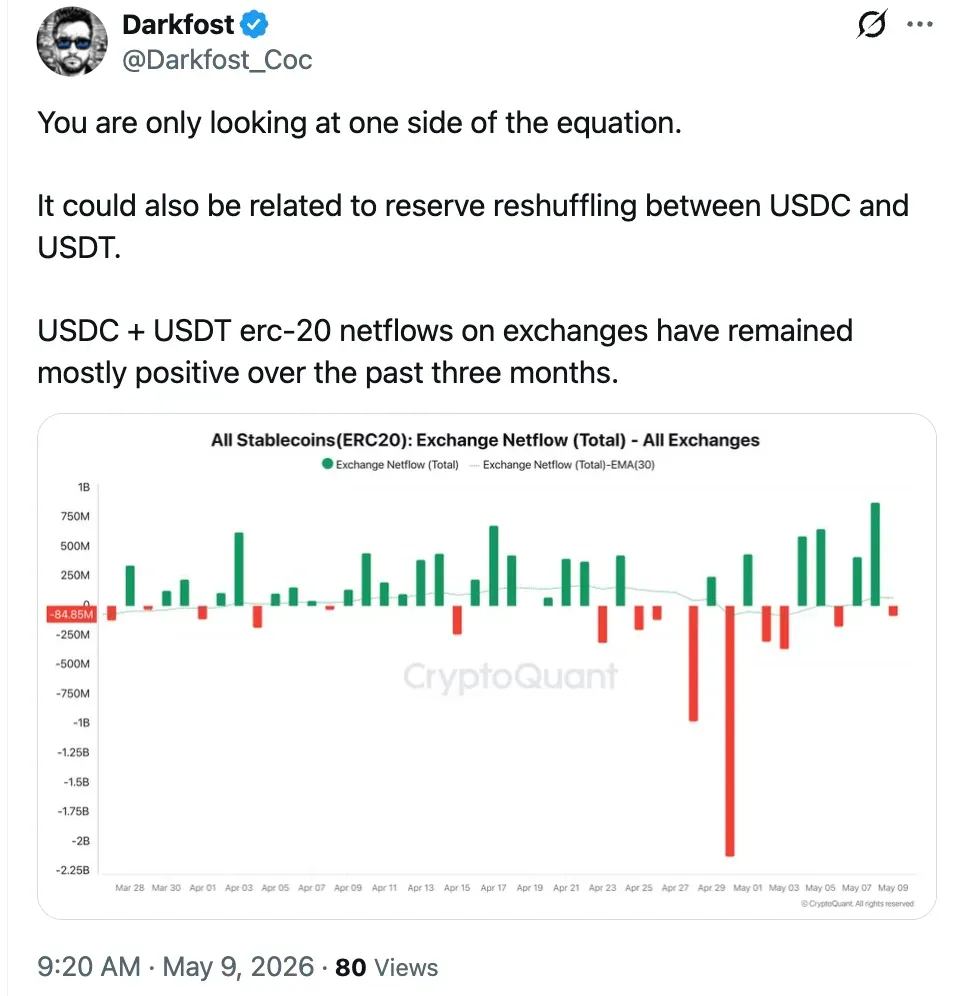
He backed this argument by noting that net flows of USDC and USDT ERC-20 on exchanges have generally been favorable over the past three months, with green (positive inflow) bars dominating the chart. In other words, the two largest stablecoins combined have been seeing net gains in stablecoin liquidity on exchanges, not losses.
The crux of his argument was that USDT is not the whole picture, and the bullish or bearish indicator raised by Santiment may vanish if USDC flows are added.
Advertisement|Remove ads.
On Stocktwits, retail sentiment around USDT shifted to ‘extremely bearish’ from ‘bearish’ zone, while chatter stayed at ‘normal’ levels over the past day. In contrast, retail sentiment around USDC remained in the ‘bearish’ zone, while chatter stayed at ‘normal’ levels over the past day.
Read also: Bitcoin Could Retest $126K Highs Within A Year Despite Nasdaq Correlation Risk: VanEck’s Sigel
For updates and corrections, email newsroom[at]stocktwits[dot]com
Advertisement|Remove ads.
Comments posted here will also appear on symbol pages.

Latest News
/filters:format(webp)https://news.stocktwits-cdn.com/large_chips_ai_4770ebc76c.jpg)
/filters:format(webp)https://news.stocktwits-cdn.com/1707726834303_jpg_11f20a9aa9.webp) Shashank Nayar·50m ago
Shashank Nayar·50m ago/filters:format(webp)https://news.stocktwits-cdn.com/large_Anthropic_ec1c7b5ee9.jpg) Shashank Nayar·2h ago
Shashank Nayar·2h ago/filters:format(webp)https://st-everywhere-cms-prod.s3.us-east-1.amazonaws.com/large_bloom_energy_resized_d69c98fd7a.jpg) Shashank Nayar·3h ago
Shashank Nayar·3h ago/filters:format(webp)https://news.stocktwits-cdn.com/gettyimages_2257971883_594x594_1606ccd0ba.jpg)
/filters:format(webp)https://news.stocktwits-cdn.com/Heera_1_1c30cb0170.PNG) Heera Hari·5h ago
Heera Hari·5h ago/filters:format(webp)https://news.stocktwits-cdn.com/large_Amazon_10819d8d5b.jpg) Shashank Nayar·5h ago
Shashank Nayar·5h ago/filters:format(webp)https://news.stocktwits-cdn.com/gettyimages_2296155088_594x594_e8c6d1d489.jpg)
/filters:format(webp)https://news.stocktwits-cdn.com/Harshita_3cfe02022c.jpg) Harshita Tyagi·5h ago
Harshita Tyagi·5h ago