


Advertisement|Remove ads.
Crypto Bill Momentum Builds After Swipe-Fee Proposal Is Shelved
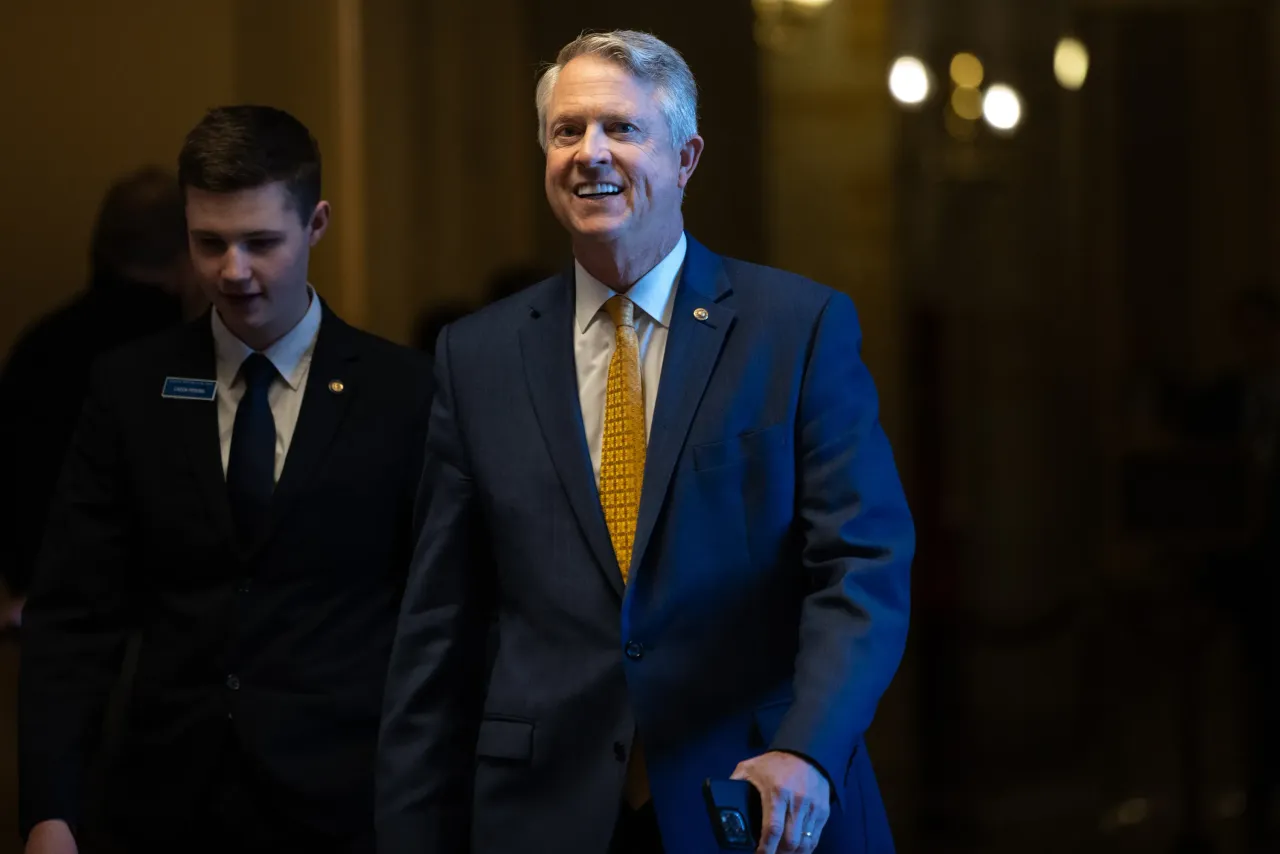


- Senator Roger Marshall dropped a swipe-fee amendment during a Senate Agriculture crypto markup, Politico reported.
- The White House intervened amid concerns the provision could slow progress on crypto legislation.
- Lawmakers continue reconciling competing House and Senate versions of the Clarity Act.
Advertisement|Remove ads.
As Congress moves to advance major cryptocurrency legislation, Senator Roger Marshall chose to set aside a proposal on credit card swipe fees, removing a potential complication for the bill’s progress.
Senator Roger Marshall decided not to advance an amendment targeting credit card transaction fees during a Senate Agriculture Committee markup of crypto market structure legislation on Thursday, according to multiple people with direct knowledge of the discussions, as reported by Politico on Monday.

Marshall, a Kansas Republican, had filed the amendment last week as part of the Senate Agriculture Committee’s crypto market structure bill. The proposal would have required payment networks to compete more directly on credit card swipe fees, an approach similar to the Credit Card Competition Act that Marshall has long supported alongside Sen. Dick Durbin (D-Ill.)
Advertisement|Remove ads.
White House officials became involved in the discussions as concerns grew that adding a swipe-fee provision could complicate efforts to advance the cryptocurrency bill, according to Politico. The administration was focused on avoiding provisions that could delay or fracture support for the legislation as it moves through Congress.
The new amendment would allow banks and crypto firms to be on equal footing, which previously was a point of contention between the two.
Clarity Act And Competing Drafts
The move comes as lawmakers navigated through multiple versions of the CLARITY Act. Chair John Boozman released an updated text designed to expand the CFTC’s authority over “digital commodities,” with the committee scheduling a business meeting for Thursday.
Advertisement|Remove ads.
Separately, the House’s Digital Asset Market Clarity Act of 2025 (H.R. 3633) outlined a broader market structure framework and definitions for digital assets. The differences stemmed from jurisdictional differences between congressional committees. The Senate Banking Committee focused its version of the CLARITY Act on securities law, disclosure, and consumer protections under the SEC.
On the other hand, the Senate Agriculture Committee has emphasized the CFTC’s role in overseeing digital commodities, according to a press release from the United States Senate Committee on Banking, Housing, and Urban Affairs.
Stablecoin Yield Fight And Bank Pushback
Debate over stablecoin yield has emerged as a parallel fault line in crypto legislation. In an interview with CNBC, Coinbase CEO Brian Armstrong said banks already operate under fractional-reserve lending, while some stablecoins are fully backed, arguing that restrictions on stablecoin yields create an uneven competitive landscape.
Advertisement|Remove ads.
Banks have opposed yield-bearing stablecoins, warning they could draw deposits away from traditional institutions. Investor and market commentator Mark Moss said that deposit-funded lending relies on stable balances, which banks argue could be disrupted if stablecoins offer returns comparable to those of deposits.
Markup Re-scheduled To Thursday
The Senate Agriculture Committee originally planned to hold a markup of its crypto market structure bill on Tuesday, according to a timeline announced by Chairman John Boozman.
However, severe winter weather in Washington, D.C., forced lawmakers to postpone several votes, preventing the markup from proceeding as scheduled. The session has been rescheduled for Thursday, as reported by CoinDesk.
Read also: Washington’s Crypto Bill Could Be The Make-Or-Break Moment For BMNR Stock, Believe Analysts
For updates and corrections, email newsroom[at]stocktwits[dot]com.
Advertisement|Remove ads.
Comments posted here will also appear on symbol pages.

Latest News
/filters:format(webp)https://news.stocktwits-cdn.com/large_Getty_Images_2294108581_678b1cf125.jpg)
/filters:format(webp)https://news.stocktwits-cdn.com/shivani_photo_jpg_dd6e01afa4.webp) Shivani Kumaresan·33m ago
Shivani Kumaresan·33m ago/filters:format(webp)https://news.stocktwits-cdn.com/large_Meta_jpg_0f17dacb20.webp) Shivani Kumaresan·1h ago
Shivani Kumaresan·1h ago/filters:format(webp)https://news.stocktwits-cdn.com/large_Getty_Images_2301241048_efc5b32b0a.jpg)
/filters:format(webp)https://news.stocktwits-cdn.com/IMG_8805_JPG_6768aaedc3.webp) Deepti Sri·2h ago
Deepti Sri·2h ago/filters:format(webp)https://news.stocktwits-cdn.com/large_william_li_nio_jpg_c26eaad557.webp) Deepti Sri·2h ago
Deepti Sri·2h ago/filters:format(webp)https://news.stocktwits-cdn.com/large_Getty_Images_2206295289_jpg_ad3874bcd3.webp) Shivani Kumaresan·2h ago
Shivani Kumaresan·2h ago/filters:format(webp)https://news.stocktwits-cdn.com/large_rocket_lab_peter_beck_jpg_4d8fc790a1.webp) Deepti Sri·3h ago
Deepti Sri·3h ago