


Advertisement|Remove ads.
The Question Isn’t If Stablecoin Yield Should Be Banned, But What Happens If It Isn’t, Says The ABA On CLARITY Debate
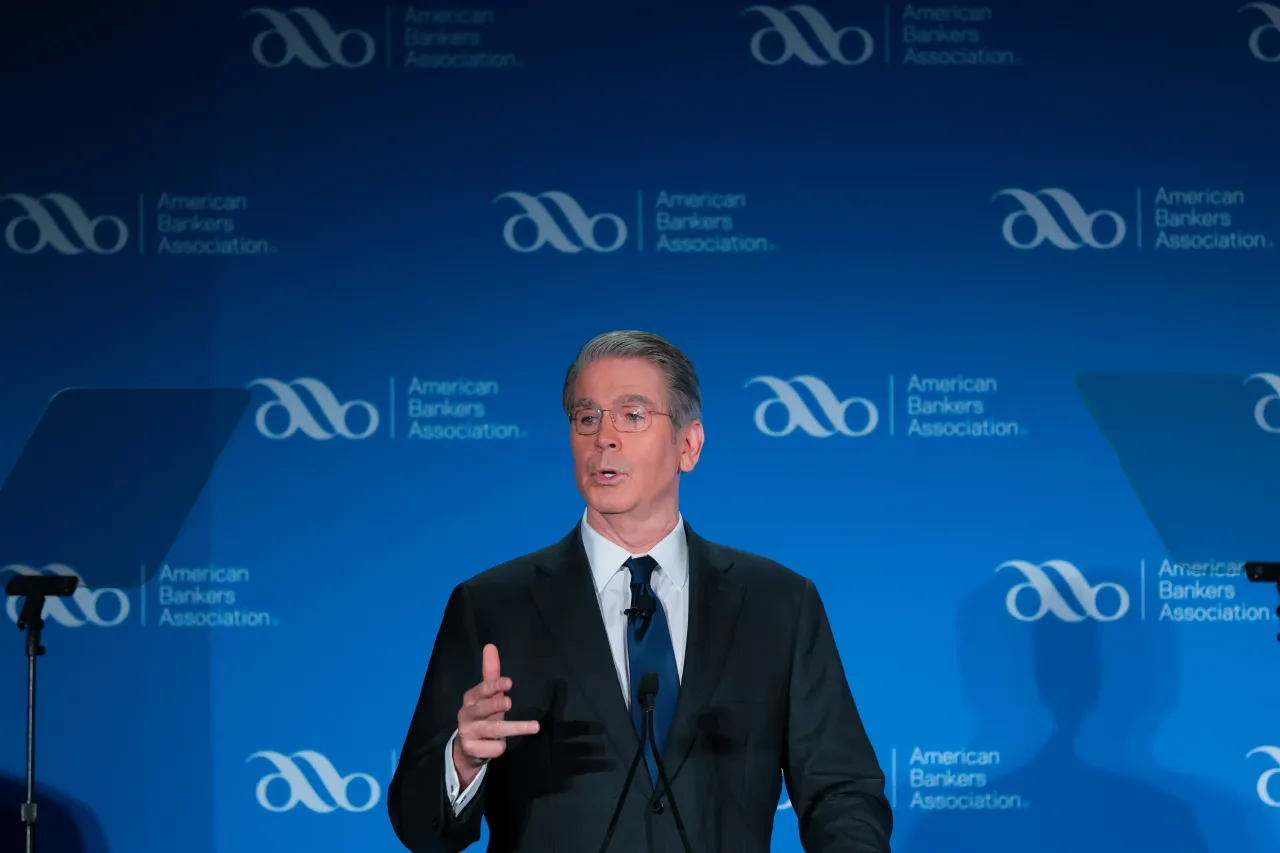


- The American Banking Association said on Monday that the White House stablecoin report asks the wrong policy question.
- According to the association, yield-bearing stablecoins could drive deposits away from banks.
- As the CLARITY Act awaits the key markup, it has gained support from Senator Cynthia Lummis and Coinbase CEO Armstrong.
Advertisement|Remove ads.
The American Bankers Association (ABA) published a paper on Monday raising concerns about the White House's Council of Economic Advisers (CEA) stablecoin report, arguing that it focuses on the wrong policy questions.
The ABA analysis questioned the CEA's method for determining whether banning yield on payment stablecoins would affect bank lending. The CEA report said that limiting stablecoin yield “increases bank lending by $2.1 billion and has a net welfare cost of $800 million” and “$500 million in additional lending from community banks.” The ABA, on the other hand, said that this framing misses the bigger picture – what would happen if yield-bearing stablecoins were allowed to grow?
According to the ABA, allowing stablecoin issuers to offer yield may hasten the migration of deposits away from banks, particularly smaller and community-based institutions. As stablecoins become more appealing to investors and businesses seeking returns, funds may shift away from traditional deposits and toward digital assets, raising banks' funding costs and potentially reducing their lending capacity.
Advertisement|Remove ads.
The consequences could be particularly severe for community banks, which rely heavily on local deposits to fund lending. The ABA stated that if deposits leave, these banks may be forced to rely on higher-cost funding sources or raise deposit rates in order to remain competitive, both of which could result in tighter credit conditions for consumers and small businesses.
While the CEA paper suggests the banking system could absorb these shifts through a “reshuffling” of deposits, the ABA argues this view understates the uneven effects across institutions. A reallocation of deposits to large banks or stablecoin issuers may reduce credit availability in areas that rely on smaller lenders.
A Case For Narrow Banking
The analysis also raised concerns about "narrow banking," in which funds are held in reserve rather than being deployed into loans. The ABA warned that expanding stablecoins in this way could weaken credit intermediation in the real economy, even if overall financial stability appears to be intact.
Advertisement|Remove ads.
The debate comes as the stablecoin market, currently worth over $320 billion, is expected to expand significantly in the coming years, potentially exacerbating risks.
CLARITY Act Debate Intensifies
Separately, the policy debate is taking place alongside legislative efforts such as the CLARITY Act, which seeks to establish clearer rules for digital assets in the United States. Patrick Witt, White House crypto adviser, had also made the case that stablecoins could strengthen the dollar and bring more business to banks.
Senator Cynthia Lummis also weighed in on the broader debate, writing on X that "America needs clarity," indicating growing momentum among lawmakers to define the regulatory framework for stablecoins and the larger crypto sector.
Advertisement|Remove ads.

The growing debate within banks and the crypto industry continues to move forward. Coinbase (COIN) CEO Armstrong wrote on X that the bill is strong enough to move forward after months of negotiations. He wrote, "It's time to pass the CLARITY Act."
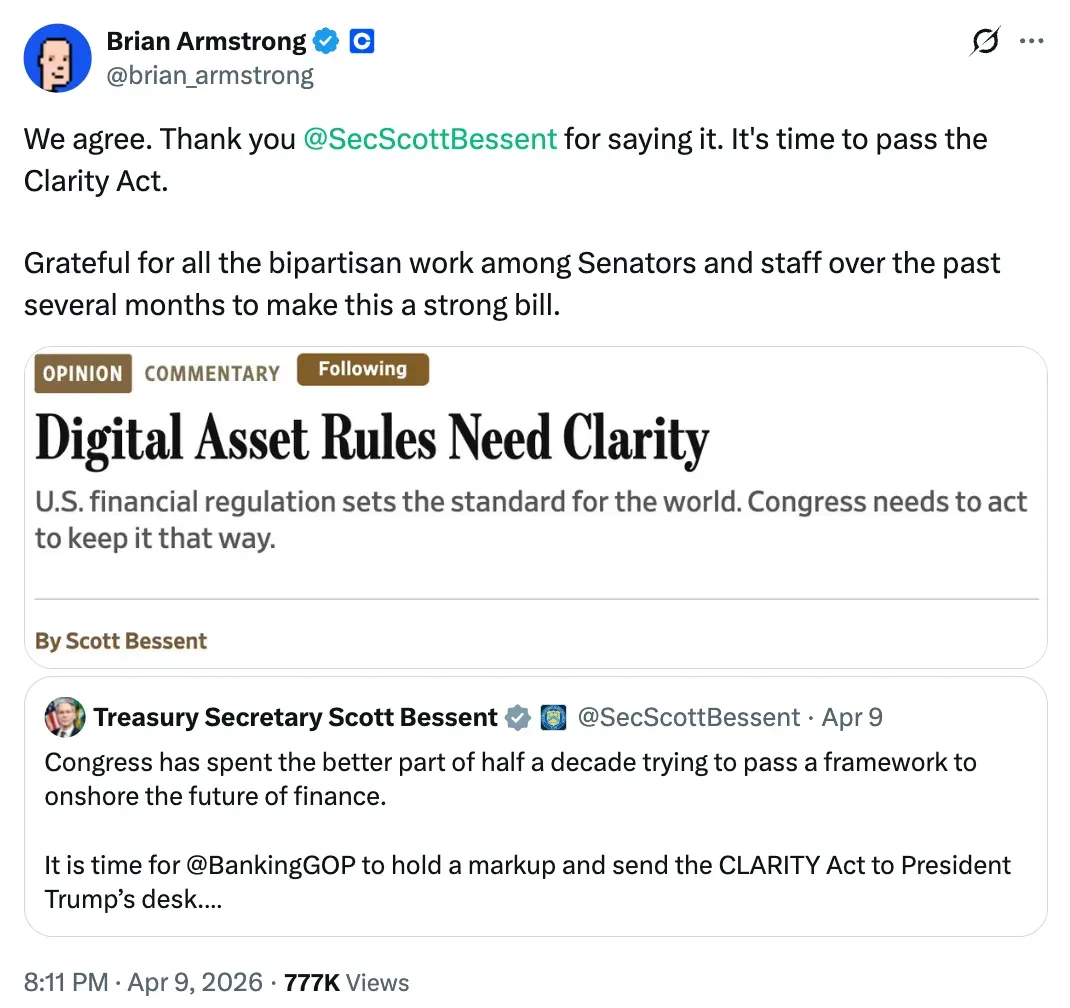
His comments came after Scott Bessent, the US Treasury Secretary, wrote an op-ed in the Wall Street Journal, he asked the Senate to send the bill to the President's desk for the final markup. However, some reports suggest that the banking community and the crypto industry could have reached a compromise.
Coinbase’s stock price was up over 2% in afternoon trade on Monday. On Stocktwits, retail sentiment around COIN remained at ‘neutral’ levels, while chatter around it also stayed ‘normal’ over the past day.
Advertisement|Remove ads.
Read also: XRP FUD Hits Two-Year High While Analyst Points To 9-Year Bullish Pattern
For updates and corrections, email newsroom[at]stocktwits[dot]com.
Comments posted here will also appear on symbol pages.

Latest News
/filters:format(webp)https://news.stocktwits-cdn.com/large_So_Fi_new_6d7889a863.webp)
/filters:format(webp)https://news.stocktwits-cdn.com/Aashika_Suresh_Profile_Picture_jpg_2acd6f446c.webp) Aashika Suresh·23m ago
Aashika Suresh·23m ago/filters:format(webp)https://news.stocktwits-cdn.com/large_Getty_Images_2272991538_826b8a4556.jpg)
/filters:format(webp)https://news.stocktwits-cdn.com/IMG_8805_JPG_6768aaedc3.webp) Deepti Sri·31m ago
Deepti Sri·31m ago/filters:format(webp)https://news.stocktwits-cdn.com/large_Getty_Images_2274484367_jpg_e7062348b5.webp)
/filters:format(webp)https://news.stocktwits-cdn.com/shivani_photo_jpg_dd6e01afa4.webp) Shivani Kumaresan·1h ago
Shivani Kumaresan·1h ago/filters:format(webp)https://news.stocktwits-cdn.com/large_SK_Hynix_jpg_efba9fa39d.webp)
/filters:format(webp)https://news.stocktwits-cdn.com/IMG_9209_1_d9c1acde92.jpeg) Yuvraj Malik·1h ago
Yuvraj Malik·1h ago/filters:format(webp)https://news.stocktwits-cdn.com/large_rocketlab_jpg_fcfa5bb73e.webp) Deepti Sri·1h ago
Deepti Sri·1h ago/filters:format(webp)https://news.stocktwits-cdn.com/gettyimages_2267701500_594x594_1cfbb8b517.jpg) Aashika Suresh·2h ago
Aashika Suresh·2h ago