


Advertisement|Remove ads.
RAVE Soars 260% Days After Collapse – Echoes Of Terra, FTX Resurface



- RaveDAO surged over 260% despite no clear fundamental catalyst, rebounding days after a sharp crash tied to pump-and-dump allegations and concentrated token ownership flagged by ZachXBT.
- The rally appears driven by post-crash volatility, thin liquidity, and speculative trading, with retail sentiment turning “extremely bullish” and activity spiking across social platforms.
- Similar post-collapse rallies were seen in Terra’s LUNC and FTX’s FTT, where sharp rebounds fueled by hype and positioning ultimately failed to signal any real fundamental recovery.
Advertisement|Remove ads.
RaveDAO (RAVE) jumped over 260% on Tuesday, recovering sharply just days after a dramatic collapse that erased billions of dollars in value and sparked accusations of market manipulation.
This is a big move, but there is no clear fundamental driver for the rally. Instead, the price action seems driven by a combination of post-crash volatility, thin liquidity, and speculative trading, mirroring trends seen in previous high-profile crypto collapses.
The recent jump follows a dive in RAVE last week after on-chain investigator ZachXBT claimed the token showed signs of a possible pump-and-dump. He also said a small number of wallets may hold a large share of the supply and urged exchanges such as Binance (BNB) and Bitget (BGB) to investigate the activity.
Advertisement|Remove ads.
RaveDao’s price was $1.5 at the time of writing. On Stocktwits, retail sentiment around RAVE improved to ‘extremely bullish’ from ‘bullish’, while chatter stayed in ‘extremely high’ levels over the past day.
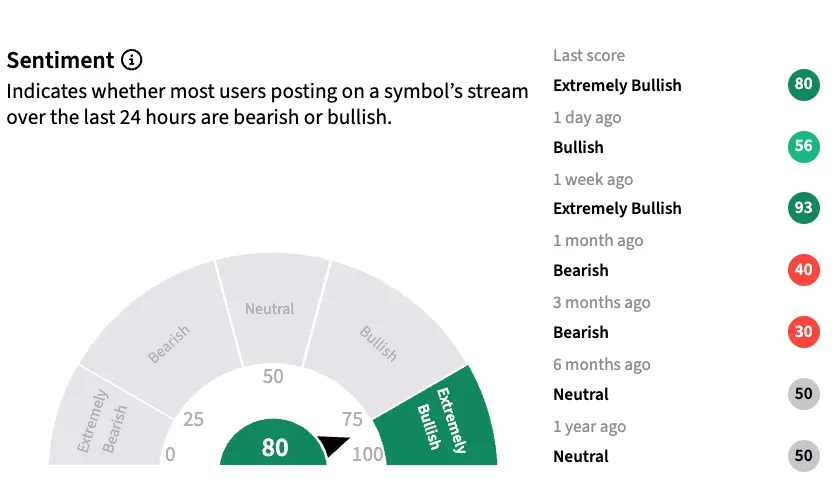
RAVE DAO: A Dead-Cat Bounce?
Traders seem to be taking advantage of oversold conditions and short-term momentum. The token’s wild swings have created what some Stocktwits users have described as a “trader’s paradise” and could soon hit $2.
Advertisement|Remove ads.
Some users called it “deadcat bounce.” This more general dead-cat-bounce pattern is consistent with RAVE's current price action. A dead cat bounce is a brief price recovery following a steep decline, in which a token sees a short-term rally before resuming its downward trend. The bounce may look like the start of a recovery, but it often traps traders as the price will eventually continue to fall.
History Repeats Itself
The same cycle was playing out in FTX’s native token, FTT, which saw several dramatic rallies after the exchange’s bankruptcy, driven more by hype of potential recoveries than real progress. But similar patterns have emerged after major crypto collapses.
Advertisement|Remove ads.
The UST depeg event had led to a near-total collapse, wiping out about $40 billion in value. Terra’s ecosystem has seen multiple sharp rebounds, with LUNC rising between 300-500% several times in the aftermath. These moves were more a function of a mix of “community revival” narratives, aggressive token-burning campaigns, and speculative hype driven by exchange activity than of any meaningful fundamental recovery, according to reports.
Read also: Ethereum Will Be 'The Chain You Can Rely On,' Vitalik Buterin Reveals 4-Year Plan
For updates and corrections, email newsroom[at]stocktwits[dot]com
Advertisement|Remove ads.
Comments posted here will also appear on symbol pages.

Latest News
/filters:format(webp)https://news.stocktwits-cdn.com/large_Getty_Images_2279869782_8049b29afc.jpg)
/filters:format(webp)https://news.stocktwits-cdn.com/Aashika_Suresh_Profile_Picture_jpg_2acd6f446c.webp) Aashika Suresh·25m ago
Aashika Suresh·25m ago/filters:format(webp)https://news.stocktwits-cdn.com/large_Getty_Images_2300173637_79e4bae290.jpg)
/filters:format(webp)https://news.stocktwits-cdn.com/IMG_9209_1_d9c1acde92.jpeg) Yuvraj Malik·41m ago
Yuvraj Malik·41m ago/filters:format(webp)https://news.stocktwits-cdn.com/large_Getty_Images_2288509244_fc180e6aec.jpg)
/filters:format(webp)https://news.stocktwits-cdn.com/shivani_photo_jpg_dd6e01afa4.webp) Shivani Kumaresan·47m ago
Shivani Kumaresan·47m ago/filters:format(webp)https://news.stocktwits-cdn.com/large_patrick_soon_shiong_jpg_32b8924ac2.webp)
/filters:format(webp)https://news.stocktwits-cdn.com/IMG_8805_JPG_6768aaedc3.webp) Deepti Sri·2h ago
Deepti Sri·2h ago/filters:format(webp)https://news.stocktwits-cdn.com/large_Getty_Images_2203983775_jpg_74bdd5dd43.webp) Aashika Suresh·2h ago
Aashika Suresh·2h ago/filters:format(webp)https://news.stocktwits-cdn.com/gettyimages_1161631184_594x594_0063399eed.jpg)
/filters:format(webp)https://news.stocktwits-cdn.com/1707726834303_jpg_11f20a9aa9.webp) Shashank Nayar·3h ago
Shashank Nayar·3h ago