


Advertisement|Remove ads.
ACHR Vs. JOBY: Boeing Deal Puts Archer On A Different Flight Path As Joby Builds Toward Commercial Air Taxis
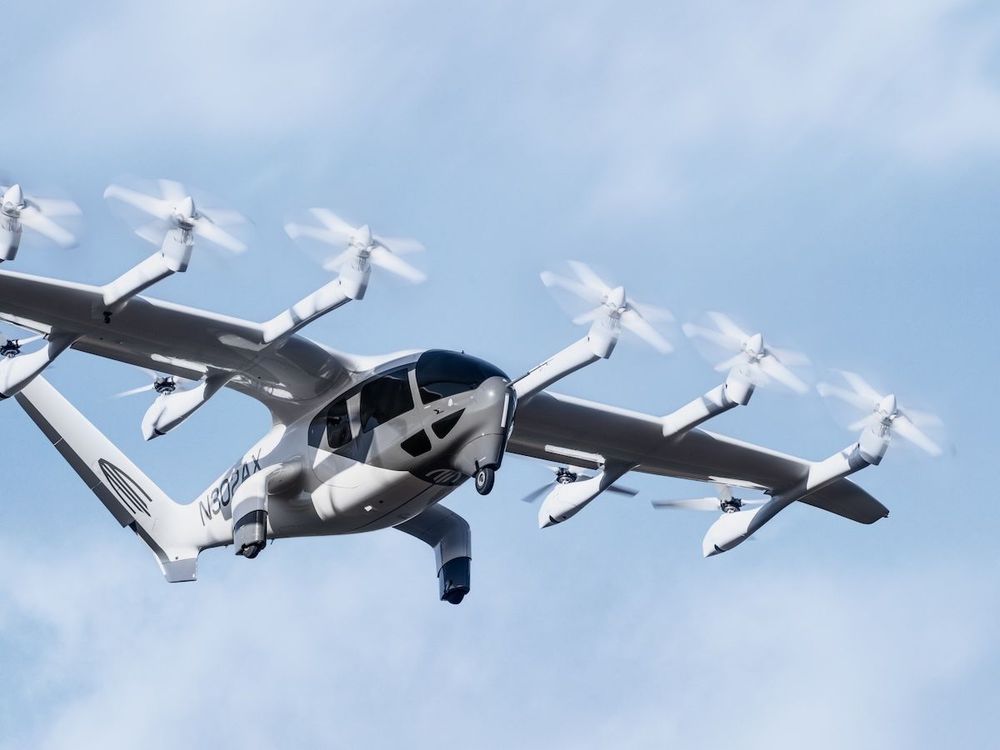


- Archer is expanding beyond air taxis through its Boeing deal, adding drone, autonomous flight and air-traffic technology.
- Archer Aviation reported $5 million in Q2 revenue, up 213% from the previous quarter and above estimates, but posted a $263.2 million net loss.
- Joby Aviation reported $39 million in Q2 revenue and raised its 2026 revenue forecast to $115 million-$125 million.
Advertisement|Remove ads.
Archer Aviation (ACHR) and Joby Aviation (JOBY) are chasing the same electric air-taxi future, but their second-quarter results reveal sharply different strategies for surviving the wait. Joby is leaning on Blade’s growing aviation revenue and Toyota-backed manufacturing push, while Archer is expanding into defense, drones and autonomy through a transformative Boeing deal.
Archer And Joby Take Different Paths Amid Heavy Cash Burn
Archer Aviation and Joby Aviation reported their fiscal second-quarter(Q2) 2026 results within days of each other, but the numbers showed two very different ways of dealing with the long and costly road to electric air taxi service. Joby reported record Q2 revenue and raised its full-year outlook, helped by its Blade helicopter business. Archer reported much lower revenue, but made a major move by agreeing to buy three aerospace and defense businesses owned by Boeing (BA) in exchange for Boeing shares. The deal shows that Archer is looking to build a broader business beyond air taxis.
Archer Has Expanded Its Air-Taxi Bet Into Defense, Autonomy
The deal would give Archer access to advanced autonomous flight, drone and air-traffic technology, helping it expand beyond electric air taxis into commercial aerospace, defense and air-traffic management.
Advertisement|Remove ads.
- Wisk Aero develops electric vertical takeoff and landing (eVTOL) aircraft.
- SkyGrid develops technology to safely manage autonomous aircraft.
- Insitu makes unmanned aircraft used mainly for surveillance and defense.
The three businesses together have nearly 2 million flight hours, giving Archer valuable real-world data and technology for its ZEE AI platform, which combines light, air-traffic, weather, terrain and aircraft data to help improve flight safety and efficiency.
Joby Has The Revenue Lead – But Blade Is Doing The Heavy Lifting
Joby Aviation had a stronger quarter, with Q2 revenue rising to $39 million, up $14 million from the previous quarter. The company also raised its 2026 revenue forecast to $115 million to $125 million, helped mainly by its Blade helicopter business.
Blade generated $36.2 million in revenue, with seat sales up more than 50% from last year. However, Joby is still losing money, reporting a $245 million net loss.
Advertisement|Remove ads.
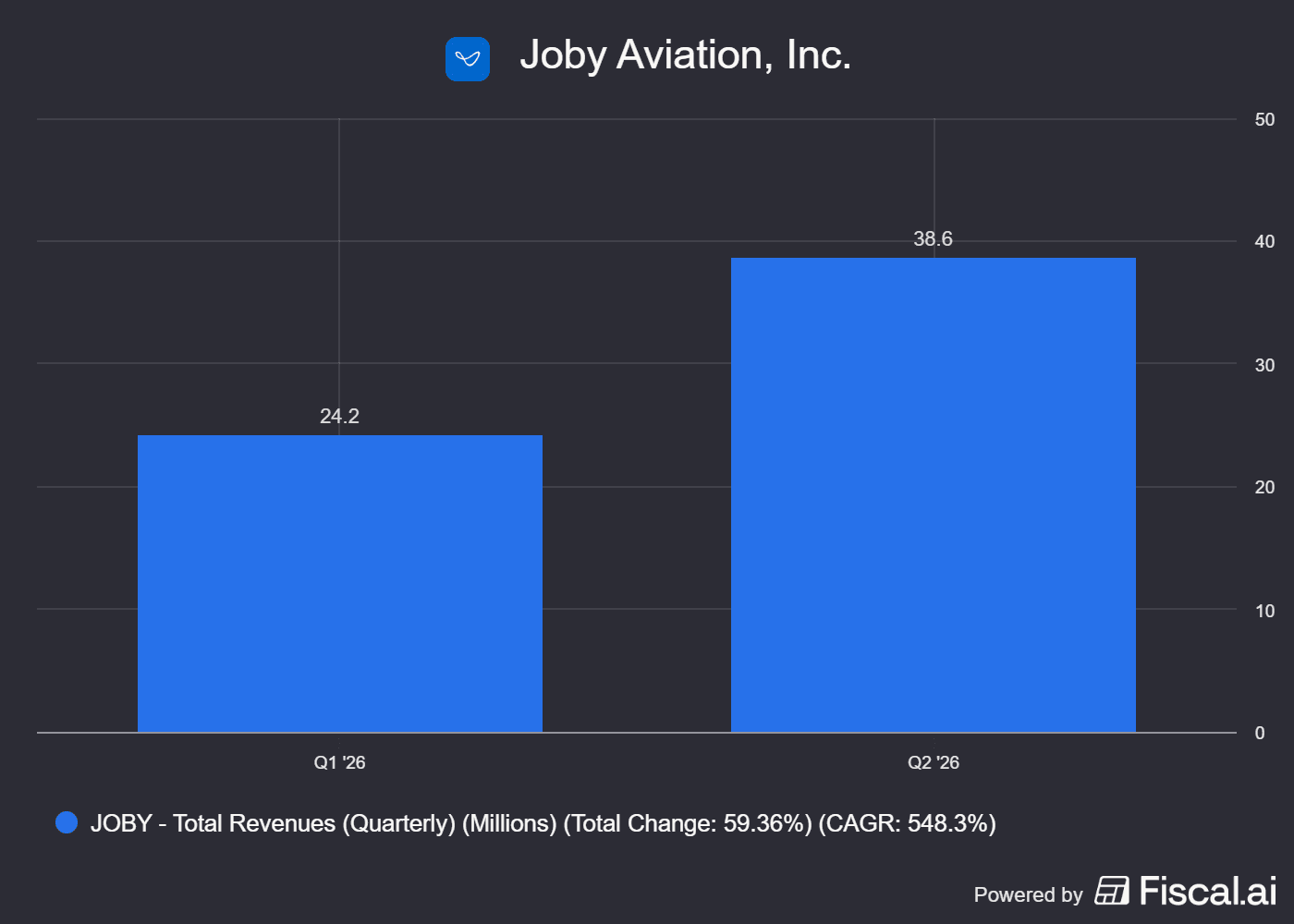
Joby CEO JoeBen Bevirt said during the Q2 earnings call that the company plans to start its first electric air taxi pilot flights in Texas next month. The White House-backed program is expected to help Joby move faster toward FAA approval and commercial operations.
“The flights in Texas will be the first of many that bring Joby together with state and local bodies as well as the FAA to prove out the value and operational maturity of our technology. Over the course of a week, we'll be flying routes across the Dallas-Fort Worth area that lay the groundwork for future commercial operations.”
Archer Aviation stock edged 0.4% lower overnight, ahead of Tuesday. Joby aviation stock inched 0.2% higher.
Advertisement|Remove ads.
The Numbers Tell Two Different Stories
| Q2 2026 Metric | Archer Aviation (ACHR) | Joby Aviation (JOBY) |
| Revenue | $5.0 million | $38.6 million |
| Operating expenses | $284.2 million | $299.5 million |
| Cash & investments | ~$1.56 billion | ~$2.3 billion |
| Net loss | $263.2 million | $245.4 million
|
The Real Race: Certification, Manufacturing And Cash
Both companies are still losing a lot of money, and both are still a while away from getting regulatory approval to operate their piloted electric vertical takeoff and landing (eVTOL) aircraft for full commercial passenger service. Both are also relying on a federal pilot program to start generating revenue before full certification. But the strategies they are using — and how much cash they are spending along the way — are becoming increasingly different.
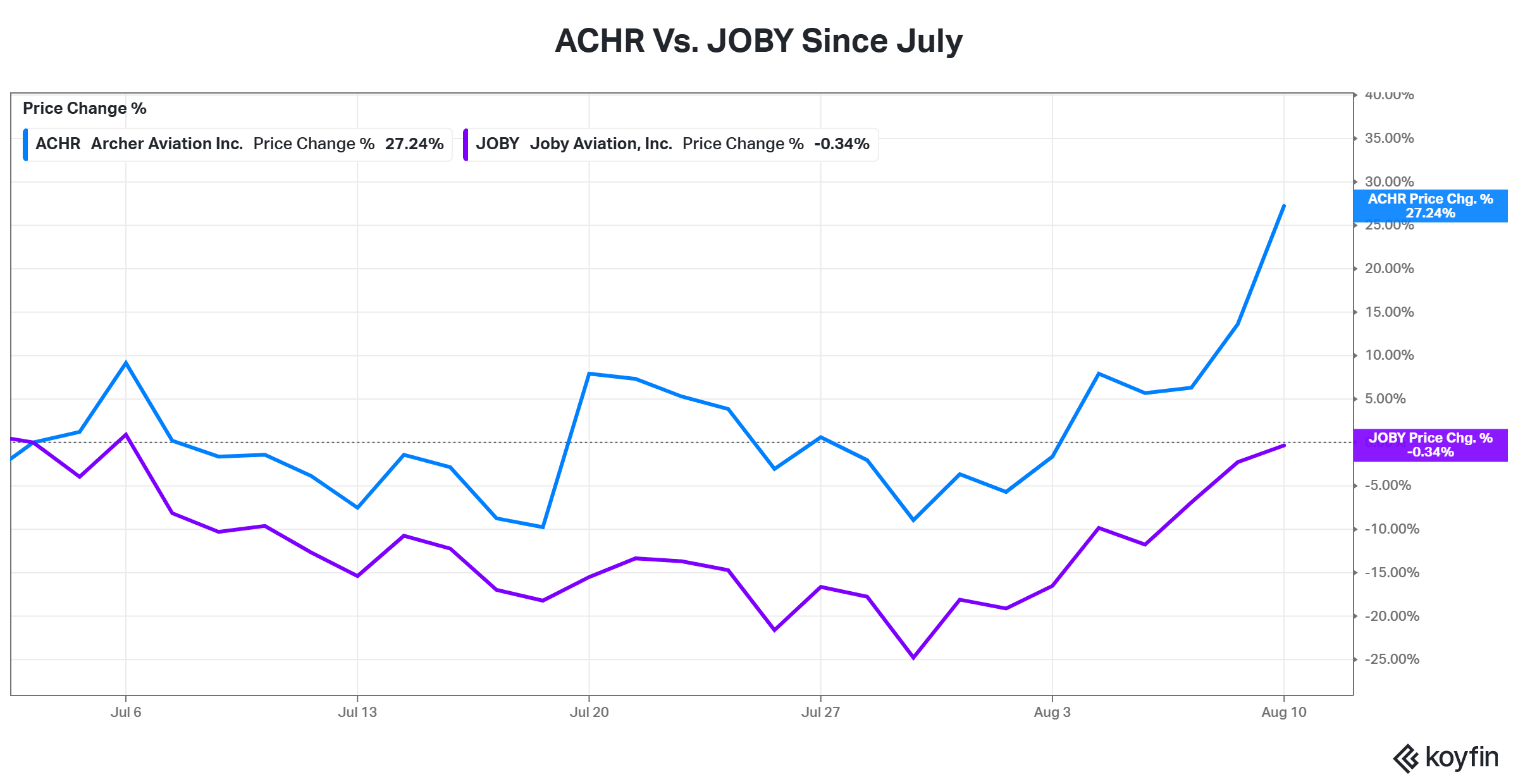
Archer’s operating expenses for Q2 were $284 million, while Joby spent $299.5 million on operations. Joby is focusing on building and operating its own air taxis while using its Blade helicopter business to generate revenue in the near term. Archer, on the other hand, is expanding into a broader aerospace and defense business through its Boeing deal, while continuing to develop its air taxi. Investors are closely watching the two strategies, with Archer shares recently gaining while Joby’s stock pulled back.
Archer's Midnight Vs Joby's S4: Who’s Closer To Commercial Flights?
Archer’s Midnight air taxi recently completed a pilot-operated round trip between Salinas and Monterey, California. Each flight took about nine minutes and was carried out with FAA coordination, marking progress toward commercial service.
Advertisement|Remove ads.
Archer says Midnight has completed Phase 3 of the FAA’s four-step certification process. The company plans to begin eIPP flights in Texas and the Los Angeles area later this year.
Joby is also moving closer to launching its air taxi service. It has five aircraft flying and 12 more in production, while a new partnership with Toyota will help increase manufacturing. The company plans to begin eIPP flights in Texas and is targeting its first paying passengers later this year.
Both the companies’ strategies come with risks. Archer still faces certification and commercialization challenges, while heavy spending on manufacturing, testing and infrastructure is keeping losses high. Joby is also expected to use more cash in the second half of 2026 despite growing revenue.
Advertisement|Remove ads.
Neither company is close to profitability, and their main air taxi businesses are still not generating meaningful commercial revenue. Additionally, the FAA has not yet fully approved their piloted eVTOL aircraft for commercial service. The Q2 results show that the companies are taking very different paths: Joby is building on an existing aviation business, while Archer is expanding into new aerospace and defense markets.
ACHR, JOBY Stocks: Retail Still Favors The eVTOL Trade
On Stocktwits, retail sentiment around Archer improved to ‘extremely bullish’ from ‘bullish’ territory the previous day, while sentiment around Joby moderated to ‘bullish’ from ‘extremely bullish’.
So far this year, ACHR has declined 16%, while JOBY has cratered 33%.
Advertisement|Remove ads.
Also See: NVDA Teams Up With Wall Street Giants On Massive $500B AI Infrastructure Funding Push: Report
For updates and corrections, email newsroom[at]stocktwits[dot]com.
Comments posted here will also appear on symbol pages.

Latest News
/filters:format(webp)https://news.stocktwits-cdn.com/large_Getty_Images_539933904_5b50447f33.jpg)
/filters:format(webp)https://news.stocktwits-cdn.com/Anushka_Basu_make_me_smile_in_the_picture_b92832aa_af59_4141_aacc_4180d2241ba8_1_2_png_1086e0ed8c.webp) Anushka Basu·32m ago
Anushka Basu·32m ago/filters:format(webp)https://news.stocktwits-cdn.com/large_Getty_Images_1454302914_ad119364f4.jpg)
/filters:format(webp)https://st-everywhere-cms-prod.s3.us-east-1.amazonaws.com/i_OS_App_Icon_1_8054f2a2fe.png) Stocktwits News Desk·1h ago
Stocktwits News Desk·1h ago/filters:format(webp)https://news.stocktwits-cdn.com/large_Getty_Images_2296453699_164b3400f3.jpg) Stocktwits News Desk·2h ago
Stocktwits News Desk·2h ago/filters:format(webp)https://news.stocktwits-cdn.com/Getty_Images_2210967011_jpg_b1d6197b5b.webp) Anushka Basu·2h ago
Anushka Basu·2h ago/filters:format(webp)https://news.stocktwits-cdn.com/large_Getty_Images_2296187035_e6f532e3f5.jpg) Stocktwits News Desk·3h ago
Stocktwits News Desk·3h ago/filters:format(webp)https://news.stocktwits-cdn.com/large_Getty_Images_2280117251_ab1ddae051.jpg) Stocktwits News Desk·4h ago
Stocktwits News Desk·4h ago