


Advertisement|Remove ads.
AI Is Powering A Profit Boom — But Is It An 'Earnings Bubble'? Wall Street Analyst Weighs In


- S&P 500 earnings are expected to jump 26% in Q3 after a 51% surge in Q2.
- Morningstar projected, citing Goldman Sachs research, that earnings growth could slow to 11% in 2027 and 2028.
- AI is also blurring the line between growth and value stocks, with Intel and Applied Materials moving to growth in a Morningstar index, while Adobe, Uber, and Intuit are shifting toward value.
Advertisement|Remove ads.
The AI boom is doing more than lifting tech stocks; it is becoming a major driver of corporate earnings, raising questions about how sustainable the profit surge will be as Wall Street heads into the third-quarter reporting season.
Morningstar, citing Goldman Sachs research, said in a new report that S&P 500 earnings are expected to rise 26% in the third quarter, following a massive 51% jump in Q2. Still, Goldman expects earnings growth to slow, forecasting about 11% growth in both 2027 and 2028. “Their takeaway: We aren’t quite in an earnings bubble,” Morningstar said in its report.
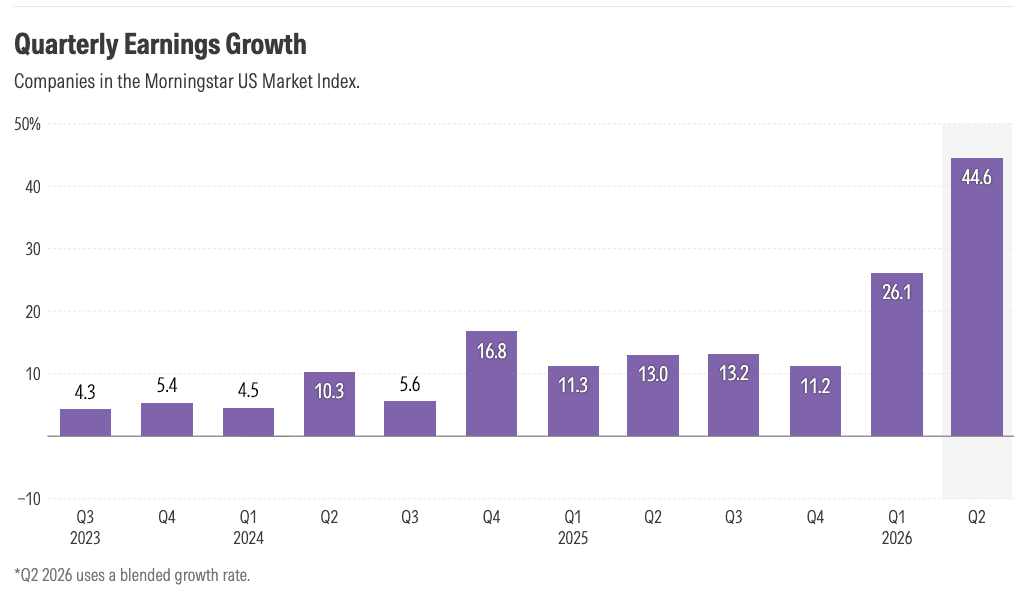
Morningstar analysts said AI capital expenditure, semiconductor margin expansion and gains from private investments are the top three factors currently supporting earnings that could eventually become headwinds.
Advertisement|Remove ads.
That puts companies such as Nvidia, Broadcom, Dell Technologies and Applied Materials, among others in focus, with hyperscalers continuing to pour billions of dollars into data centers, chips and computing infrastructure.
Morningstar also highlighted a growing debate around whether the AI investment boom is pushing up Treasury yields by “crowding out” government debt. Pimco’s analysis, however, challenges that argument, finding little evidence that individual AI-related debt deals have meaningfully moved Treasury yields.
‘AI Bubble’ Debate Far From Settled
The AI bubble debate remains sharply divided. Michael Burry has questioned the sustainability of Big Tech’s AI spending and financing, and believes the returns on investment might not be enough.
Advertisement|Remove ads.
Nvidia CEO Jensen Huang, by contrast, argues that AI has entered a “high production ramp” as products become useful and generate revenue, pushing back on the idea that the industry is simply hype.
The market, too, is flashing some caution. Nvidia, the biggest beneficiary of the AI chip boom, has lagged the broader tech trade this year, while Big Tech cloud stocks are only now regaining momentum.
Year to date, the Invesco QQQ Trust Series 1 (QQQ) has gained 21.6%, and the iShares Semiconductor ETF (SOXX) has risen 9.5%, with stocks such as Micron, SanDisk, Seagate, Intel, and Dell more than tripling.
Advertisement|Remove ads.
Distinction Between Growth, Value Stocks Blurs
Meanwhile, AI is reshaping how investors classify technology stocks. Intel and Applied Materials have moved toward Morningstar’s growth indexes as AI-driven demand improves their growth profiles, while Uber, Intuit and Adobe have shifted toward value after uncertainty around AI’s impact on software weighed on their growth prospects.
Dell offers another example. Its large-cap classification was split between growth and value after its growth metrics improved, even as it remained in the mega-cap value category against faster-growing giants such as Nvidia and Broadcom.
Morningstar said that while AI remained a powerful earnings engine, investors may increasingly distinguish between profits generated by the current spending boom and sustainable earnings growth once that investment cycle matures.
Advertisement|Remove ads.
For updates and corrections, email newsroom[at]stocktwits[dot]com.
Comments posted here will also appear on symbol pages.

Latest News
/filters:format(webp)https://news.stocktwits-cdn.com/large_michael_saylor_OG_4_jpg_292dd07afc.webp)
/filters:format(webp)https://news.stocktwits-cdn.com/Prabhjote_DP_67623a9828.jpg) Prabhjote Gill·29m ago
Prabhjote Gill·29m ago/filters:format(webp)https://news.stocktwits-cdn.com/Getty_Images_526218674_jpg_7b7468812b.webp)
/filters:format(webp)https://news.stocktwits-cdn.com/Heera_1_1c30cb0170.PNG) Heera Hari·1h ago
Heera Hari·1h ago/filters:format(webp)https://st-everywhere-cms-prod.s3.us-east-1.amazonaws.com/large_accenture_logo_resized2_jpg_128c5add71.webp)
/filters:format(webp)https://news.stocktwits-cdn.com/Harshita_3cfe02022c.jpg) Harshita Tyagi·1h ago
Harshita Tyagi·1h ago/filters:format(webp)https://news.stocktwits-cdn.com/large_Getty_Images_2267825783_jpg_1b90bf709b.webp) Prabhjote Gill·1h ago
Prabhjote Gill·1h ago/filters:format(webp)https://news.stocktwits-cdn.com/large_musk_88257e3573.jpg) Prabhjote Gill·2h ago
Prabhjote Gill·2h ago/filters:format(webp)https://news.stocktwits-cdn.com/gettyimages_2206659974_594x594_40ea0c533e.jpg) Harshita Tyagi·2h ago
Harshita Tyagi·2h ago