


Advertisement|Remove ads.
AMC CEO Adam Aron Rips Robinhood’s Stock Token Model Again, Calls It ‘Abhorrent’ Gamified Casino



- Aaron asked if tokens remain fully backed when underlying shares are lent to short sellers.
- He also criticized Robinhood for promoting the product in the U.S. despite sales restrictions.
- Aaron said the tokens undermine investor protections and called the practice "abhorrent."
Advertisement|Remove ads.
AMC Entertainment Holdings (AMC) CEO Adam Aron asked on late Saturday whether Robinhood Markets' (HOOD) Stock Tokens are collateralized as advertised. If the underlying shares are lent to short sellers, do the tokens stay backed one-for-one?
Aron wrote on X directly to Robinhood Chief Legal Officer Dan Gallagher and CEO Vlad Tenev, noting that the two had spent the past week publicly defending the product.
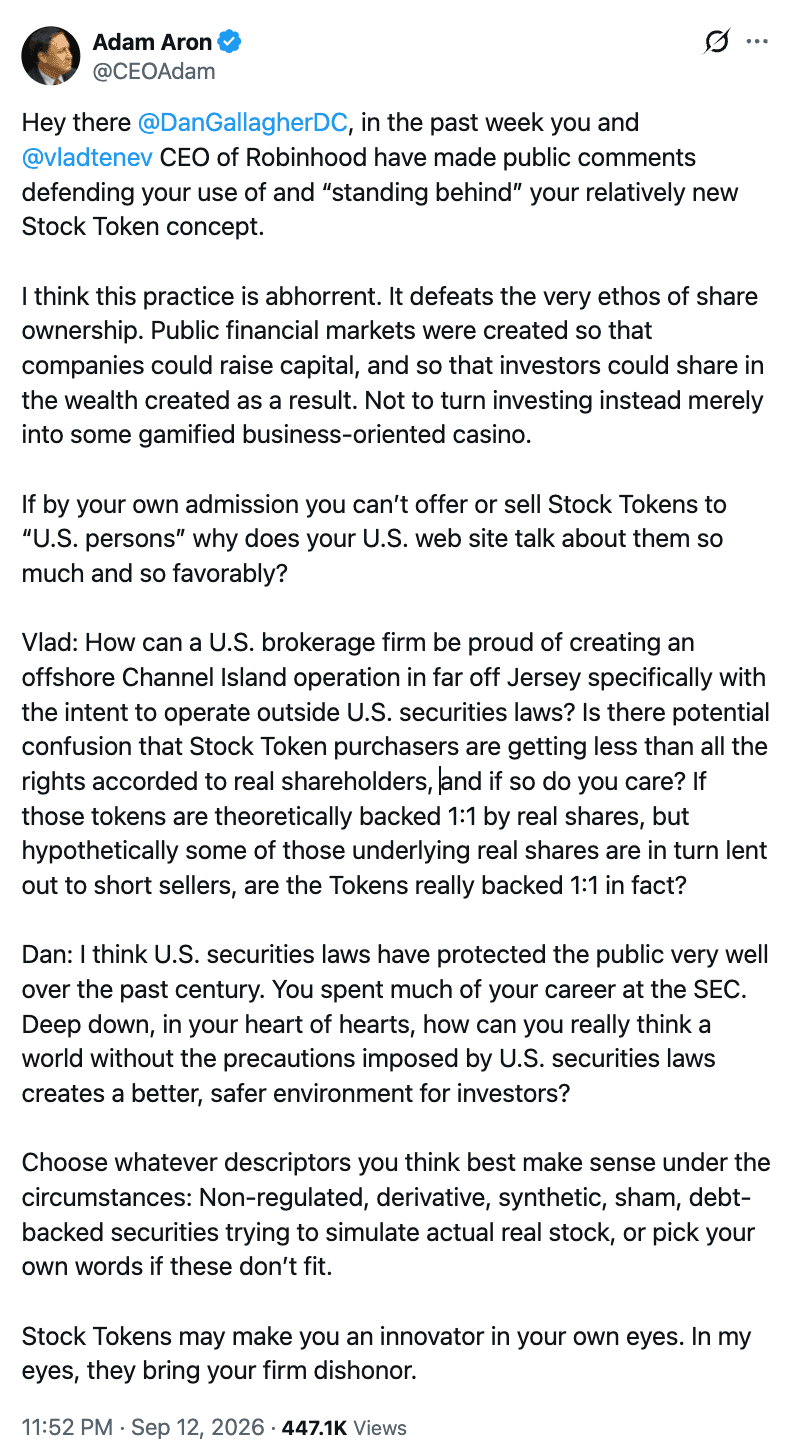
He called the practice “abhorrent" and said it ran counter to the ethos of share ownership. Public markets exist so companies can raise capital and investors can share in the wealth created, not to turn investing into “some gamified business-oriented casino,” he said.
Advertisement|Remove ads.
HOOD’s price closed down nearly 1% on Friday. On Stocktwits, the retail sentiment around HOOD remained at ‘neutral' levels, accompanied by 'normal' chatter levels over the past 24 hours.
Why The Problem
Why did Robinhood’s U.S. website talk up Stock Tokens favorably when the company’s own disclosures say the products can’t be offered or sold to U.S. persons, Aron asked. He also asked how a U.S. brokerage could take pride in establishing an operation in Jersey just to avoid U.S. securities law.
“If those tokens are theoretically backed 1:1 by real shares, but hypothetically some of those underlying real shares are in turn lent out to short sellers, are the Tokens really backed 1:1 in fact?” asked Aron.
Advertisement|Remove ads.
Speaking to Gallagher, who was a S.E.C. commissioner from 2011 to 2015, Aron said that U.S. securities laws had served the public well for 100 years, and asked how a former regulator could believe that a world without those safeguards was safer for investors. The tokens, Aron said, did not make Robinhood an innovator, but “in my eyes, they bring your firm dishonor.”
Tenev Sticks Up For Backing Structure
Last week, Tenev told CNBC that each token is a debt security backed by a single share held as collateral. Token holders get dividends but can't vote. He said that issuers only control the rights and obligations of the stock they sell, not everything else about it.
For example, they don't control other companies that sell securities that reference those shares. On September 11, he said that consent should only be needed when a tokenized product changes the rights of shareholders, replaces a company's official stock ledger, or gives the issuer new duties.
Advertisement|Remove ads.
What SEC Commissioner Says About It
SEC Commissioner Hester Peirce said in an interview with Coinage on Saturday that tokenization is "enchanting but not magical." The SEC commissioner said that changing a stock into a token does not change its legal status. Simply put, securities laws still apply. However, she made a distinction between companies tokenizing their own shares and third parties tokenizing stocks that already exist.
Regulators need to clarify where tokenized stocks can be bought and sold and let investors know whether they get the same dividends, voting rights, and other protections as regular shareholders. Her approach favored experimentation, but within clearer rules about securities and investor protection.
Read also: US House Panel To Vote On Crypto Tax Rules That Could Reshape Bitcoin Mining And Trading
Advertisement|Remove ads.
For updates and corrections, email newsroom[at]stocktwits[dot]com.
Comments posted here will also appear on symbol pages.

Latest News
/filters:format(webp)https://news.stocktwits-cdn.com/large_Getty_Images_2294264991_a1d08b075d.jpg)
/filters:format(webp)https://news.stocktwits-cdn.com/Anushka_Basu_make_me_smile_in_the_picture_b92832aa_af59_4141_aacc_4180d2241ba8_1_2_png_1086e0ed8c.webp) Anushka Basu·2h ago
Anushka Basu·2h ago/filters:format(webp)https://news.stocktwits-cdn.com/large_Getty_Images_1925090359_f160f05588.jpg) Anushka Basu·3h ago
Anushka Basu·3h ago/filters:format(webp)https://news.stocktwits-cdn.com/large_Getty_Images_2213700296_87303c323b.jpg) Anushka Basu·4h ago
Anushka Basu·4h ago/filters:format(webp)https://news.stocktwits-cdn.com/large_franklin_templeton_OG_jpg_4b3a7330d9.webp) Anushka Basu·5h ago
Anushka Basu·5h ago/filters:format(webp)https://news.stocktwits-cdn.com/large_Getty_Images_1445160636_5780a5fdde.jpg) Anushka Basu·7h ago
Anushka Basu·7h ago/filters:format(webp)https://news.stocktwits-cdn.com/Getty_Images_540198451_jpg_3e5f3d8ee7.webp) Anushka Basu·8h ago
Anushka Basu·8h ago