


Advertisement|Remove ads.
ASTS Stock Slides Overnight: Blue Origin Explosion Raises Fresh Fears For 45-Satellite Rollout
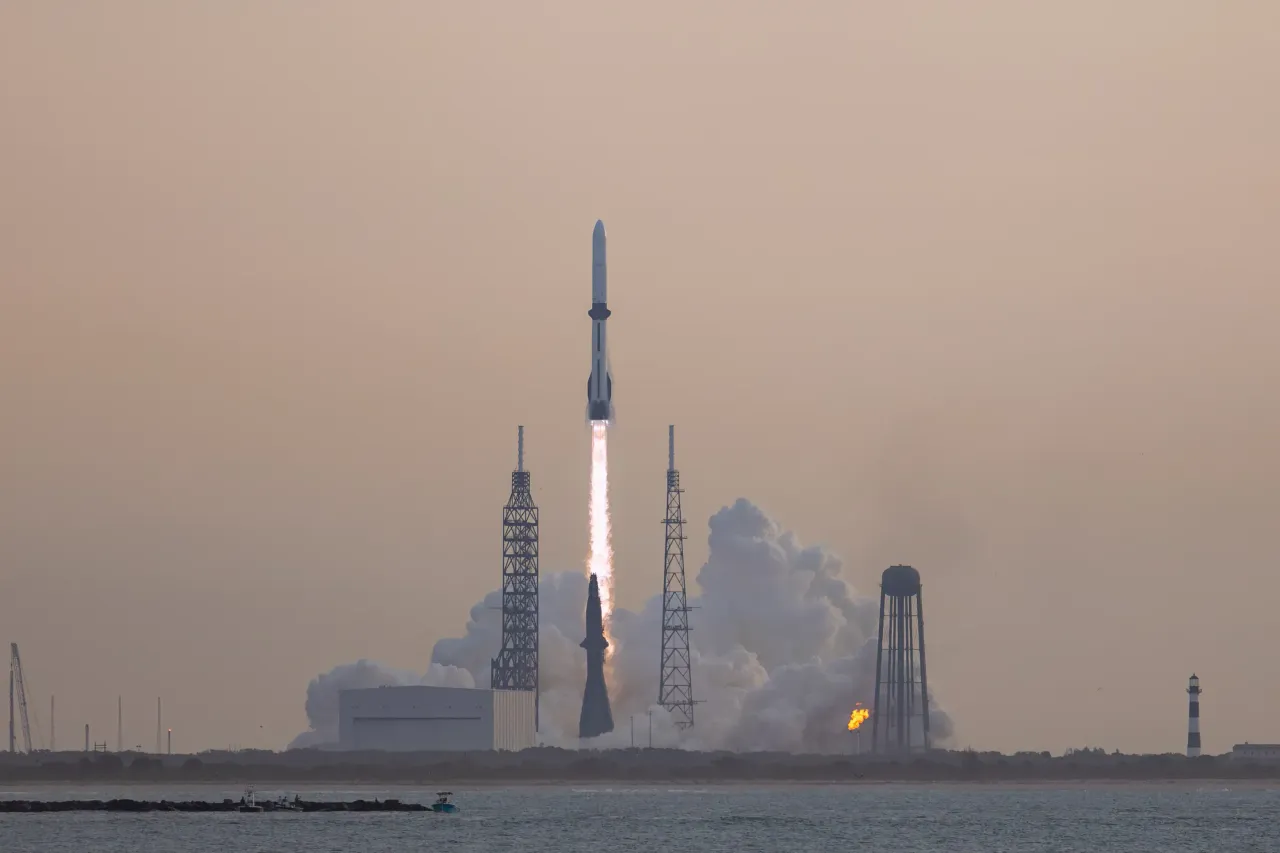


- Blue Origin said an "anomaly" occurred ahead of New Glenn's planned fourth mission, which was expected to launch Amazon's Project Kuiper satellites.
- ASTS signed a multi-launch agreement with Blue Origin in 2024 for future Block 2 BlueBird deployments.
- Meanwhile, ASTS' BlueBirds 8, 9 and 10 have arrived at Cape Canaveral ahead of a mid-June Falcon 9 launch and are undergoing final processing and integration.
Advertisement|Remove ads.
Shares of AST SpaceMobile (ASTS) slumped 7% in overnight trading heading into Friday as the company's aggressive satellite rollout plans returned to the spotlight after a Blue Origin New Glenn rocket exploded during testing, marking the second major setback involving the launch vehicle in less than two months.
ASTS stock jumped nearly 3% on Thursday, with shares on track for their fourth straight week of gains and their best month in almost a year.

Blue Origin Confirms New Glenn Anomaly
Blue Origin confirmed on X late Thursday that an "anomaly" occurred during a hotfire test of New Glenn at Cape Canaveral, Florida, ahead of the rocket's anticipated fourth mission. The launch was expected to carry Amazon's Project Kuiper internet satellites. The company said that all personnel were accounted for.
Advertisement|Remove ads.
The incident also drew reactions from SpaceX CEO Elon Musk, whose company dominates the commercial launch market. Responding to Blue Origin's statement, Musk said on X: "Sorry to see this, I hope you recover quickly." In a separate post, he added: "Most unfortunate. Rockets are hard."
NASA Administrator Jared Isaacman said on X that the agency was aware of the anomaly at Launch Complex 36 and would work with its partners to support a thorough investigation. "Spaceflight is unforgiving, and developing new heavy-lift launch capability is extraordinarily difficult," Isaacman said on X, adding that NASA would assess any near-term mission impacts and provide updates on potential effects to its Artemis and Moon Base programs.
Blue Origin founder Jeff Bezos also addressed the incident on X, saying all personnel were safe and that it was too early to determine the root cause. "Very rough day, but we'll rebuild whatever needs rebuilding and get back to flying. It's worth it," Bezos said.
Advertisement|Remove ads.
From BlueBird 7 To Another Setback
The latest incident comes only weeks after New Glenn's third mission suffered an upper-stage anomaly that prevented AST SpaceMobile's BlueBird 7 satellite from reaching its intended orbit.
Although the rocket's reusable booster successfully completed the mission and landed, the upper-stage failure caused the satellite to be lost. AST previously said that the mission was insured, limiting the direct financial impact. The Federal Aviation Administration (FAA) had cleared New Glenn to resume flights last week after Blue Origin completed its investigation into that failure.
The upcoming fourth mission was scheduled to be the first of 24 launches Blue Origin is contracted to perform for Amazon's Project Kuiper broadband network. The company had also planned to conduct as many as 12 New Glenn launches this year as it ramps up commercial and government missions.
Advertisement|Remove ads.
New Glenn is still a relatively young rocket. Its maiden flight took place in January 2025, followed by a successful second mission that launched a NASA spacecraft to Mars and achieved Blue Origin's first booster recovery. The third mission showed booster reusability but ended with the loss of BlueBird 7 after a cryogenic upper-stage failure.
Why ASTS Investors Are Watching
AST SpaceMobile signed a multi-launch agreement with Blue Origin in late 2024 to deploy future Block 2 BlueBird satellites aboard New Glenn. The heavy-lift rocket's 7-meter payload fairing is particularly suited for AST's larger next-gen satellites and could potentially carry multiple BlueBird spacecraft on a single launch.
Meanwhile, AST has emphasized earlier that it is not dependent on a single launch provider. The company maintains relationships with multiple launch providers, including SpaceX, and has indicated that New Glenn would complement Falcon 9 missions as it scales its constellation. The latest incident drew heightened investor attention after BlueBird 7 was lost during New Glenn Mission 3 last month.
Advertisement|Remove ads.
However, AST SpaceMobile continues advancing its next deployment campaign. Earlier this week, the company said that BlueBirds 8, 9 and 10 had arrived at Cape Canaveral ahead of a Falcon 9 mission expected in mid-June. In a post on X, AST said "Convoy complete," confirming that BlueBird 9 had arrived in Florida after departing the company's Midland, Texas, manufacturing facility. The company said all three satellites have entered final processing and integration ahead of launch.
Can ASTS Hit 45 Satellites?
The latest developments come as ASTS stands by its deployment targets. During a recent CNBC interview, CEO Abel Avellan said the company remains "on target" to deploy 45 satellites this year despite launch risks and increasing competition in the direct-to-device satellite market.
"Today we're shipping in a batch of satellites in the launch pad," Avellan said, adding that launches are expected "approximately every month." The CEO also highlighted the company's previous demonstrations involving satellite voice calls, 5G connectivity and broadband transmissions directly to smartphones. He also said AST and its partners now control access to nearly 100 MHz of spectrum while the company holds more than 3,800 patents.
Advertisement|Remove ads.
However, ASTS’ aggressive targets depend heavily on launch execution. Satellite communications analyst Tim Farrar has previously said AST's deployment assumptions likely require a significant number of launches from both New Glenn and Falcon 9 to meet year-end constellation goals.
ASTS President Scott Wisniewski sought to reassure investors saying that the company expects "a handful" of launches from both Blue Origin and SpaceX, or equivalent providers, and believes the company has sufficient contracted launch capacity to support its deployment roadmap.
How Do Retail Traders Feel About ASTS?
On Stocktwits, retail sentiment for ASTS was ‘extremely bullish’ amid ‘high’ message volume.
Advertisement|Remove ads.

One user said, “Sold at $125. This doesn’t really affect the thesis as they don’t use blue origin or this rocket exclusively but hopefully everyone over reacts so I can buy my shares back at $70 again.”
Another user said, “not trying to twist this just my honest take, this is more good for us than bad because this delays Amazon Leo more than anything. Not that they are actually a competition anyways”
Advertisement|Remove ads.
ASTS stock has surged 437% over the past year.
For updates and corrections, email newsroom[at]stocktwits[dot]com.
Advertisement|Remove ads.
Read Next: TSLA Stock Slips After-Hours: Waymo's Massive Robotaxi Lead Casts New Shadow Over Tesla's FSD Push
Comments posted here will also appear on symbol pages.

Latest News
/filters:format(webp)https://news.stocktwits-cdn.com/large_Getty_Images_2296204501_14a84e5451.jpg)
/filters:format(webp)https://news.stocktwits-cdn.com/unnamed_jpg_9dff551b50.webp) Anan Ashraf·10m ago
Anan Ashraf·10m ago/filters:format(webp)https://news.stocktwits-cdn.com/large_Getty_Images_2271714842_jpg_e9329f8e11.webp) Anan Ashraf·38m ago
Anan Ashraf·38m ago/filters:format(webp)https://news.stocktwits-cdn.com/gettyimages_131113971_594x594_18605564f3.jpg)
/filters:format(webp)https://news.stocktwits-cdn.com/1707726834303_jpg_11f20a9aa9.webp) Shashank Nayar·52m ago
Shashank Nayar·52m ago/filters:format(webp)https://news.stocktwits-cdn.com/large_IBM_jpg_db5b7d0908.webp) Shashank Nayar·2h ago
Shashank Nayar·2h ago/filters:format(webp)https://news.stocktwits-cdn.com/Getty_Images_2258302119_jpg_de7ca8145a.webp) Anan Ashraf·2h ago
Anan Ashraf·2h ago/filters:format(webp)https://news.stocktwits-cdn.com/large_Getty_Images_2296215726_e82f86b85a.jpg) Shashank Nayar·3h ago
Shashank Nayar·3h ago