


Advertisement|Remove ads.
Galaxy Research Head Says ‘Banks Are Wrong’ About GENIUS Act— Stablecoins Will Boost US Credit, Not Drain It



- According to Galaxy Research, offshore markets will account for 60%-70% of the development of the GENIUS Act stablecoin.
- In a bull-case scenario, the report predicts that stablecoins could stimulate credit expansion by up to $1.2 trillion by 2030.
- According to analysts, potential savings for taxpayers from lower financing costs could be in the billions, as stablecoin growth could reduce Treasury bill yields by 3-5 basis points.
Advertisement|Remove ads.
A recent study from Galaxy (GLXY) casts doubt on the U.S. banking industry's argument that stablecoins issued under the GENIUS Act will pull deposits away from existing lenders, saying that the law will be net positive for U.S. credit growth.
Imported deposits from offshore will outweigh domestic deposit migration by about 2-to-1, Galaxy’s Alex Thorn wrote in a post on X, adding that “the banks are WRONG.”

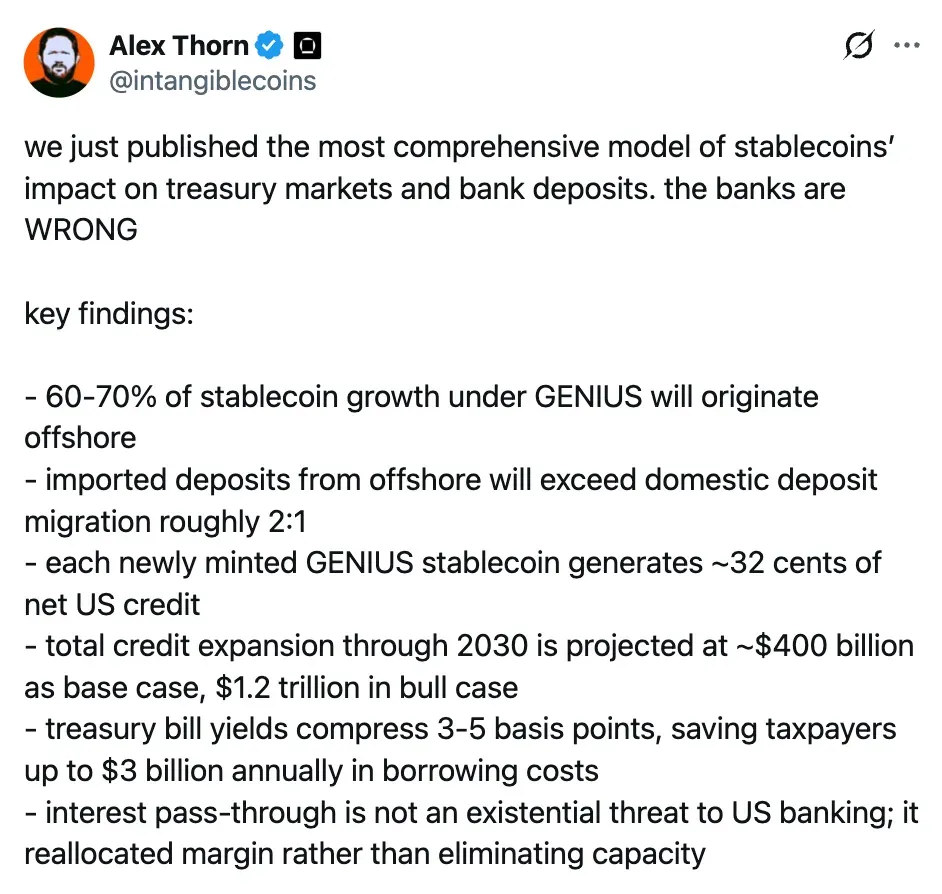
The analysis, which was issued after the GENIUS Act was signed into law on July 18, 2025, estimates that 60% to 70% of the stablecoin growth under the law will come from abroad. Galaxy forecasts that each new GENIUS-compliant stablecoin will generate nearly $0.32 in net U.S. credit, or roughly $400 billion in credit growth through 2030 in its base scenario, and $1.2 trillion in a bull case.
Advertisement|Remove ads.
GLXY’s stock was down 0.8% in after-hours. On Stocktwits, retail sentiment around GLXY remained in the ‘bullish’ zone, while chatter stayed at ‘normal’ levels over the past day.

Stablecoin Prediction
Galaxy’s prediction of a $1 trillion stablecoin supply by 2028 and $1.5 trillion by 2030 is on the cautious side of base-case forecasts from Citi (C), Standard Chartered, Coinbase (COIN), and J.P. Morgan (JPM). Among them, Standard Chartered has forecast that supply may hit $2 trillion by 2028.
Treasury markets are projected to absorb a structural bid from issuers, who are required under GENIUS to retain reserves in short-dated U.S. Treasuries, cash, and neighboring securities. Galaxy sees 85% to 95% of new reserves going into short-dated government debt, pushing 30-day bill yields 3 to 4.4 basis points lower through 2030.
Advertisement|Remove ads.
The GENIUS Act prohibits stablecoin issuers from paying interest directly to holders, but allows exchanges to offer rewards on stablecoin balances — and banks are now lobbying through the pending Clarity Act to close that loophole, making the Clarity Act the next legislative battleground over whether stablecoins can effectively compete with bank deposits.
The results come as a group of bank trade associations this week asked the Senate Banking Committee to modify a proposed compromise on stablecoin incentives, saying the present language would "enable evasion" of yield regulations, according to Punchbowl News, "killing competition from new technologies." The banks dubbed the letter their direst warning yet about the ramifications of the crypto market structure law, which may be marked up as soon as next week, according to Punchbowl News.

The lobbying campaign was an attempt at pushing back on X, Coinbase (COIN) Chief Legal Officer Paul Grewal said. He added, “That’s no narrow fix.” That’s killing competition from new technologies. Enough already.”
Advertisement|Remove ads.
The Senate Banking Committee could mark up the bill as soon as next week.
Read also: Strategy's Michael Saylor Crowns 'Bitcoin Per Share' As New Investor Yardstick
For updates and corrections, email newsroom[at]stocktwits[dot]com
Advertisement|Remove ads.
Comments posted here will also appear on symbol pages.

Latest News
/filters:format(webp)https://news.stocktwits-cdn.com/large_Getty_Images_2212423186_02cd0c43bd.jpg)
/filters:format(webp)https://news.stocktwits-cdn.com/shivani_photo_jpg_dd6e01afa4.webp) Shivani Kumaresan·58m ago
Shivani Kumaresan·58m ago/filters:format(webp)https://news.stocktwits-cdn.com/Getty_Images_2177851484_jpg_b969f68c05.webp)
/filters:format(webp)https://news.stocktwits-cdn.com/Aashika_Suresh_Profile_Picture_jpg_2acd6f446c.webp) Aashika Suresh·1h ago
Aashika Suresh·1h ago/filters:format(webp)https://news.stocktwits-cdn.com/large_trump_musk_e78f77abd7.jpg)
/filters:format(webp)https://news.stocktwits-cdn.com/IMG_8805_JPG_6768aaedc3.webp) Deepti Sri·1h ago
Deepti Sri·1h ago/filters:format(webp)https://news.stocktwits-cdn.com/large_Getty_Images_2293792040_7bede2537e.jpg) Aashika Suresh·2h ago
Aashika Suresh·2h ago/filters:format(webp)https://news.stocktwits-cdn.com/large_Getty_Images_2296204501_14a84e5451.jpg)
/filters:format(webp)https://news.stocktwits-cdn.com/unnamed_jpg_9dff551b50.webp) Anan Ashraf·3h ago
Anan Ashraf·3h ago/filters:format(webp)https://news.stocktwits-cdn.com/large_Getty_Images_2271714842_jpg_e9329f8e11.webp) Anan Ashraf·4h ago
Anan Ashraf·4h ago