


Advertisement|Remove ads.
BB Or NOK: Which Fallen Phone Giant’s Stock Is The Better AI Bet Right Now?


- Despite the rallies, analysts see downsides for both NOK and BB, according to Koyfin data.
- Nokia is benefiting from booming demand for AI networking, optical infrastructure and AI-RAN tech.
- BlackBerry's AI thesis centers on QNX, which powers safety-critical systems in 275 million vehicles worldwide.
Advertisement|Remove ads.
The smartphone era may be long over for BlackBerry (BB) and Nokia (NOK), but both have found a second act in AI. Now, investors face a key question: which former smartphone giant offers the bigger upside as AI spending expands beyond data centers and into the physical world?
Both companies were casualties of the smartphone revolution. Nokia sold its handset business to Microsoft in 2014 and reinvented itself as a telecom infrastructure company, while BlackBerry exited smartphones and rebuilt itself around software, cybersecurity and embedded operating systems.
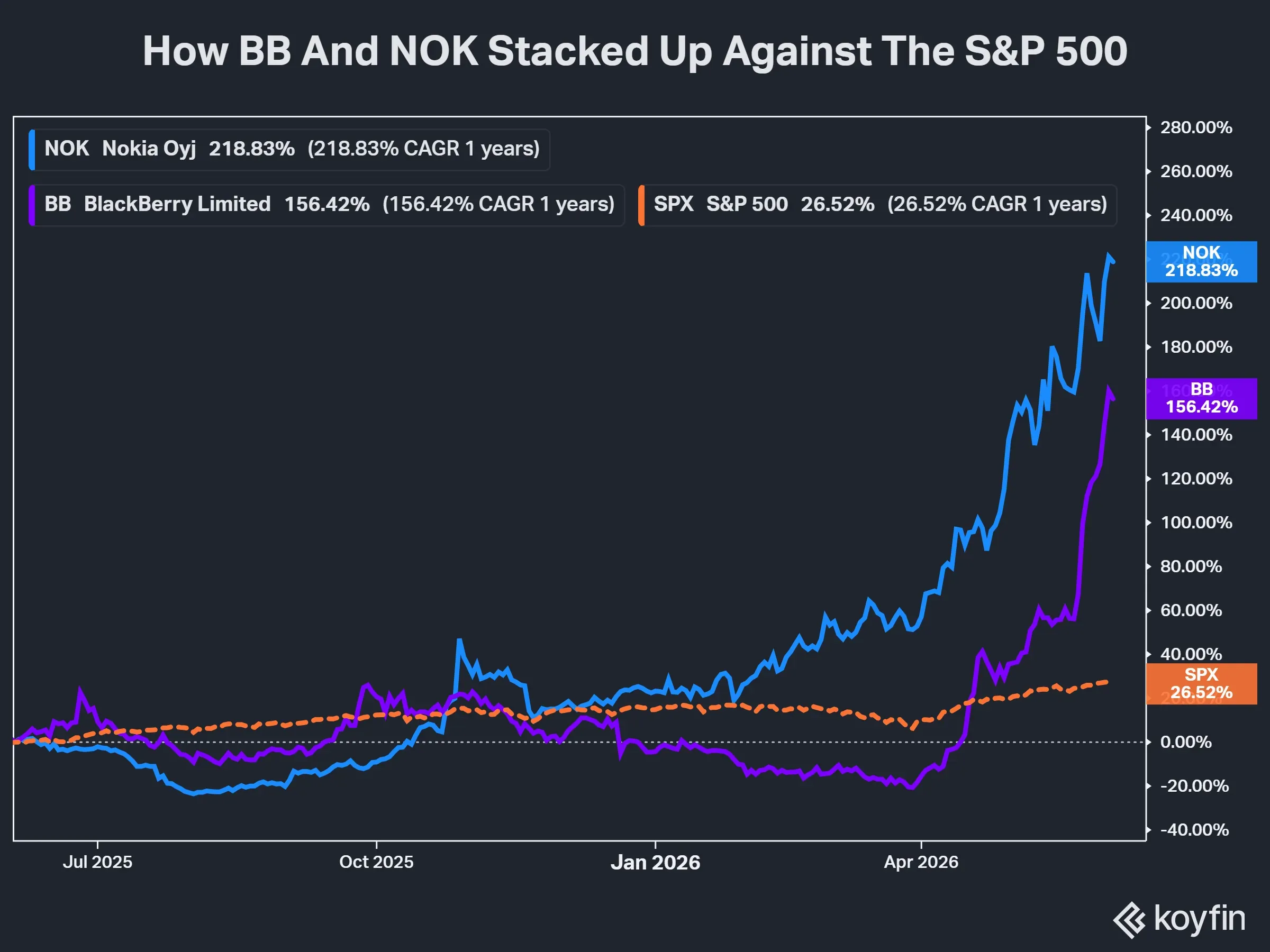
Today, both have become unlikely AI winners. NOK shares have gained 219% over the past year, while BB has surged 156%, both outperforming the S&P 500’s 27% rise.
Advertisement|Remove ads.
BB Vs. NOK: What Wall Street Thinks
Despite the strong rallies, Wall Street remains cautious on both stocks. According to Koyfin data, Nokia's average analyst price target stands at $11.38, implying a 34% downside from current levels. Among 23 analysts covering the stock, ratings include three 'Strong Buy', eight 'Buy', six 'Hold', three 'Sell' and three 'Strong Sell'.
Analysts are even more skeptical of BlackBerry. The stock's average price target of $4.18 implies a 59% downside. Among the eight analysts covering the company, one rates it a 'Buy', six rate it a 'Hold' and one rates it a 'Sell'.
Advertisement|Remove ads.
Most recently, on Wednesday, Northland raised its price target on NOK to $20 from $13, while maintaining an 'Outperform' rating. The brokerage said recent comments from Nvidia CEO Jensen Huang helped fuel optimism across AI infrastructure stocks, while strong AI data-center demand reported by HPE and capital spending commitments from Alphabet "bode well for the space."
Nokia's AI Infrastructure Push
Nokia's comeback has been driven by booming demand for AI networking infrastructure. The company has benefited from hyperscaler spending on optical networking, IP routing, and AI connectivity, while its acquisition of Infinera boosted its optical portfolio, and its partnership with Nvidia has positioned it as a key player in AI-RAN, which integrates AI into wireless networks.
In the first quarter of 2026, Nokia booked 1 billion euros in AI and cloud orders, while AI and cloud revenue rose 49% from the previous year. At JPMorgan's Global Technology Conference last month, CEO Justin Hotard said: "What I anticipate is that as we see more orders come in this year, we're going to continue to see some of the timeline elongate," noting that customers are placing commitments that stretch into 2027. He added that the company is seeing stronger demand for 800-gig networking products used inside AI clusters.
Advertisement|Remove ads.
"The only risk we really have is on supply chain. It's not on demand," Hotard said. "If we had additional supply, we could probably fulfill that given the demand that we have."
The company is also expanding production of indium phosphide, a key material used in advanced optical systems. Hotard noted that demand for indium phosphide may need to increase by "100x to 1,000x" compared with just a few years ago.
BlackBerry's Bet On Physical AI
BlackBerry’s AI thesis centers around QNX, the real-time operating system that powers ADAS, digital cockpits and autonomous driving platforms in 275 million vehicles worldwide. At the CIBC Technology & Innovation Conference last month, QNX President John Wall said he struggled for years to define an AI angle for the business until industry partners called QNX "the foundation of physical AI."
Advertisement|Remove ads.
"When you think about autonomous drive for cars, it's really a robot on wheels," Wall said, noting that the same safety, reliability and security requirements needed in autonomous vehicles will also be required in robots and AI. He also highlighted that Nvidia's IGX robotics platform uses QNX and that chipmakers are adapting automotive software for robotics.
BlackBerry also believes QNX's business is difficult to replicate: "Our competitor is Linux," Wall said, adding that BlackBerry has yet to see "a compelling Linux solution that makes any sense for the carmakers" in safety-critical applications. Meanwhile, the company’s royalty backlog stands at $950 million, with CFO Tim Foote saying it added twice as much backlog as it recognized in revenue last year. "For me, that's a really strong indication of future growth," Foote added.
The company is also optimistic about Alloy Core, a platform to simplify complex vehicle software. Foote said that Alloy Core could eventually generate royalties 4x to 6x larger than traditional QNX deployments, though major production programs are expected closer to the 2029 and 2030 model years.
Advertisement|Remove ads.
BB is set to report earnings on June 25. According to Koyfin estimates, revenue is expected to decline to $140 million from $156 million in the previous quarter. Adjusted earnings per share are projected to fall to $0.03 from $0.06, while Earnings Before Interest, Taxes, Depreciation, and Amortization (EBITDA) is expected to decline to $19.7 million from $36.1 million.
How Do Retail Traders Feel About BB And NOK?
On Stocktwits, retail sentiment for BB has been 'extremely bullish' over the past week, while NOK carried a 'bullish' rating over the same period. Message volume has surged 1,365% for BB and 2,954% for NOK over the past three months. BB's watcher base has increased 5% over the past year, while NOK's watcher base has grown 9%.
One user said, “$BB loving BB, rising like a phoenix from the ashes the post handheld waste land.”
Advertisement|Remove ads.
Another user said, “$NOK $BB every AI company with a market value < 500 B is very very very very very …. very cheap in my eyes.”
Advertisement|Remove ads.
Both former smartphone giants have posted similar gains so far this year, with BB rallying 169% and NOK rising 160%.
For updates and corrections, email newsroom[at]stocktwits[dot]com.
Advertisement|Remove ads.
Comments posted here will also appear on symbol pages.

Latest News
/filters:format(webp)https://news.stocktwits-cdn.com/large_musk_jpg_a119402ac5.webp)
/filters:format(webp)https://news.stocktwits-cdn.com/IMG_8805_JPG_6768aaedc3.webp) Deepti Sri·17m ago
Deepti Sri·17m ago/filters:format(webp)https://news.stocktwits-cdn.com/large_Getty_Images_2252639150_jpg_443c4f690e.webp)
/filters:format(webp)https://news.stocktwits-cdn.com/IMG_9209_1_d9c1acde92.jpeg) Yuvraj Malik·22m ago
Yuvraj Malik·22m ago/filters:format(webp)https://news.stocktwits-cdn.com/large_Getty_Images_2275396018_jpg_a205b2aecb.webp)
/filters:format(webp)https://news.stocktwits-cdn.com/Aashika_Suresh_Profile_Picture_jpg_2acd6f446c.webp) Aashika Suresh·46m ago
Aashika Suresh·46m ago/filters:format(webp)https://news.stocktwits-cdn.com/large_spacex_81af9a3176.jpg) Deepti Sri·1h ago
Deepti Sri·1h ago/filters:format(webp)https://news.stocktwits-cdn.com/large_Getty_Images_2294892901_dc38b09521.jpg)
/filters:format(webp)https://news.stocktwits-cdn.com/shivani_photo_jpg_dd6e01afa4.webp) Shivani Kumaresan·1h ago
Shivani Kumaresan·1h ago/filters:format(webp)https://news.stocktwits-cdn.com/large_Burry_getty_jpg_434ff548d5.webp) Yuvraj Malik·2h ago
Yuvraj Malik·2h ago