


Advertisement|Remove ads.
The Best-Performing ETF This Year Has Nothing To Do With AI Or Bitcoin — It's Linked To Crude Tanker Futures And Is Up 2,900%
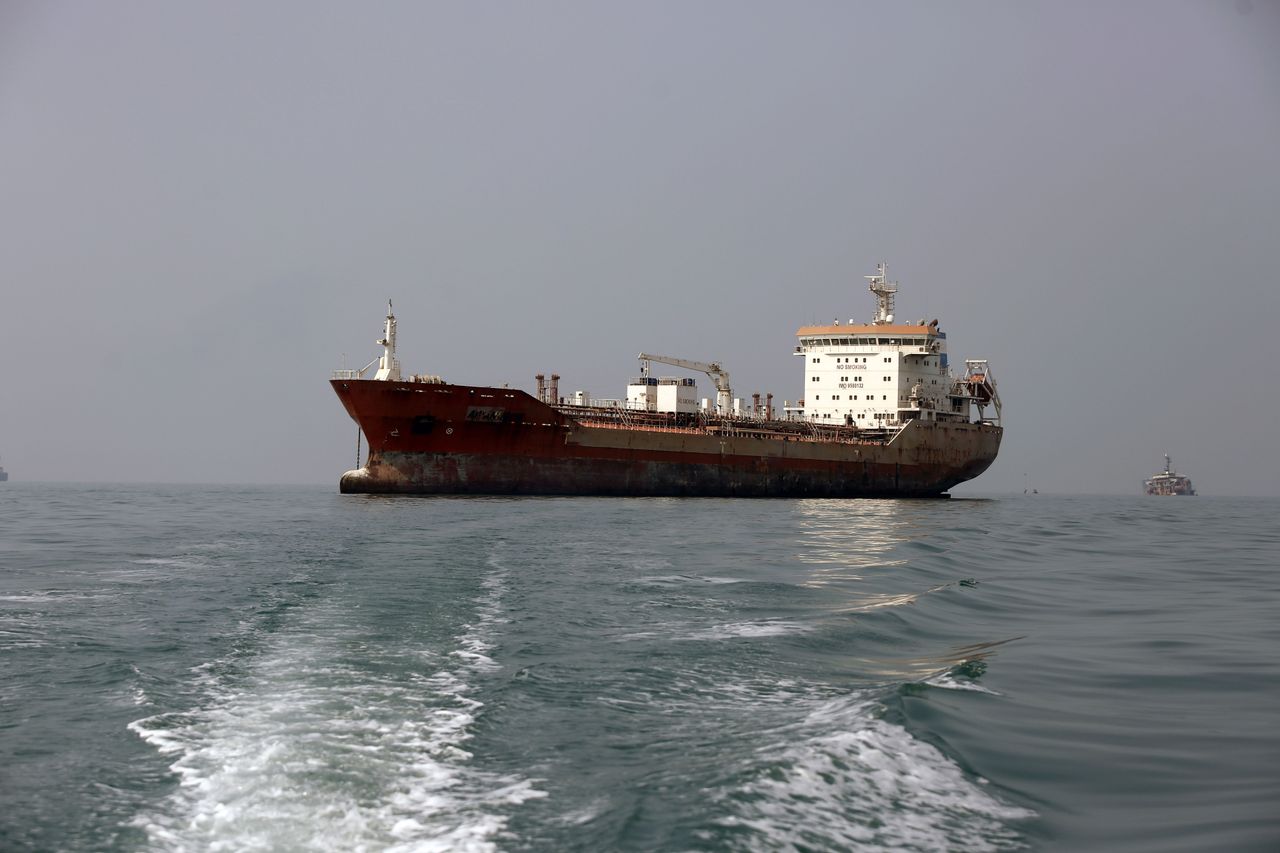


- BWET holds crude-tanker freight futures rather than oil, ships or shipping-company shares.
- Hormuz disruption drove some tanker rates from $75,000-$100,000 per day to nearly $470,000.
- Failed reopening efforts and renewed tanker attacks have kept vessels scarce and freight costs elevated.
Advertisement|Remove ads.
One of 2026’s biggest investment winners does not own technology stocks, cryptocurrency or even crude oil. However, it does track the cost of getting oil onto a ship and through increasingly dangerous waters.
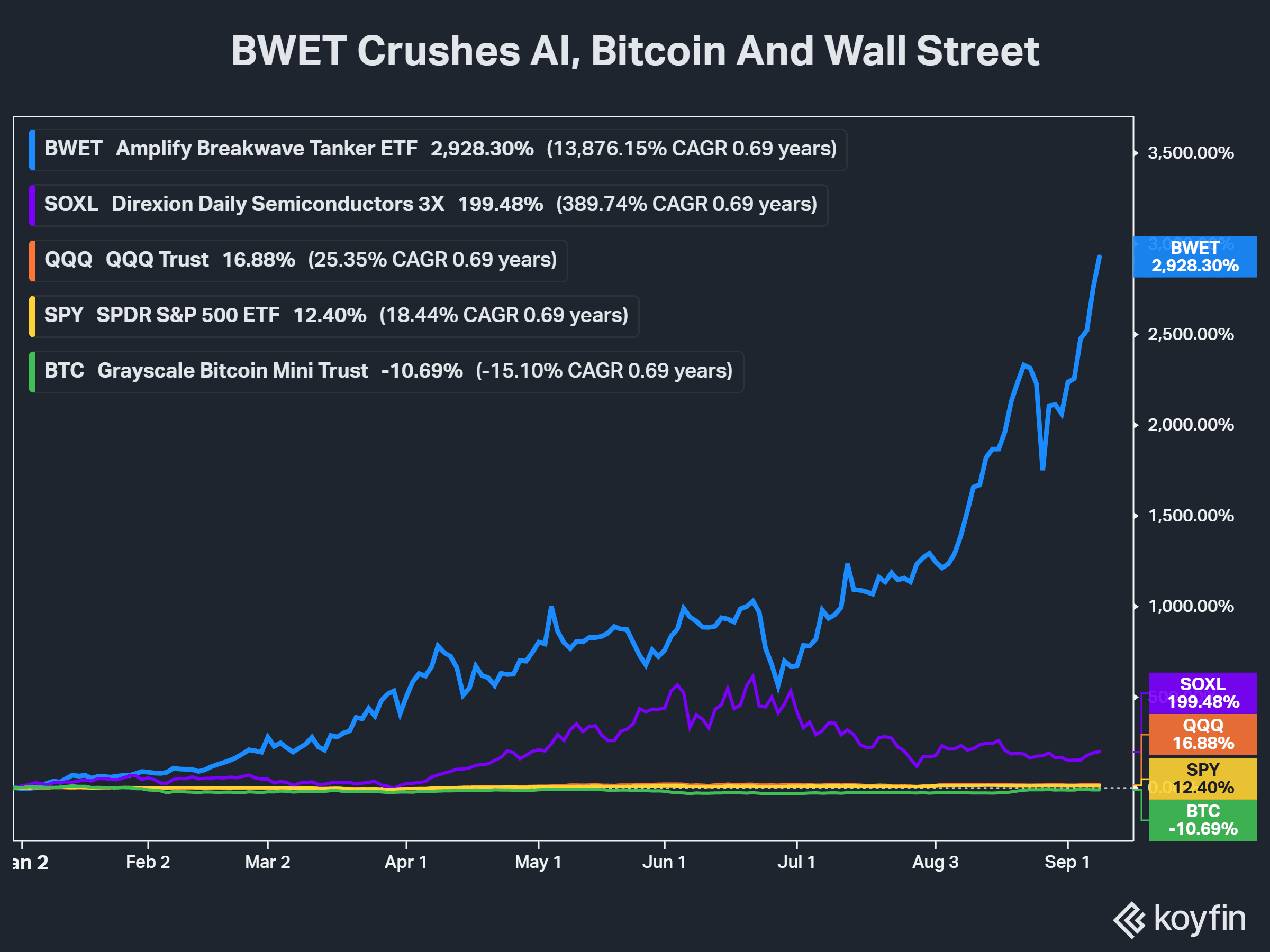
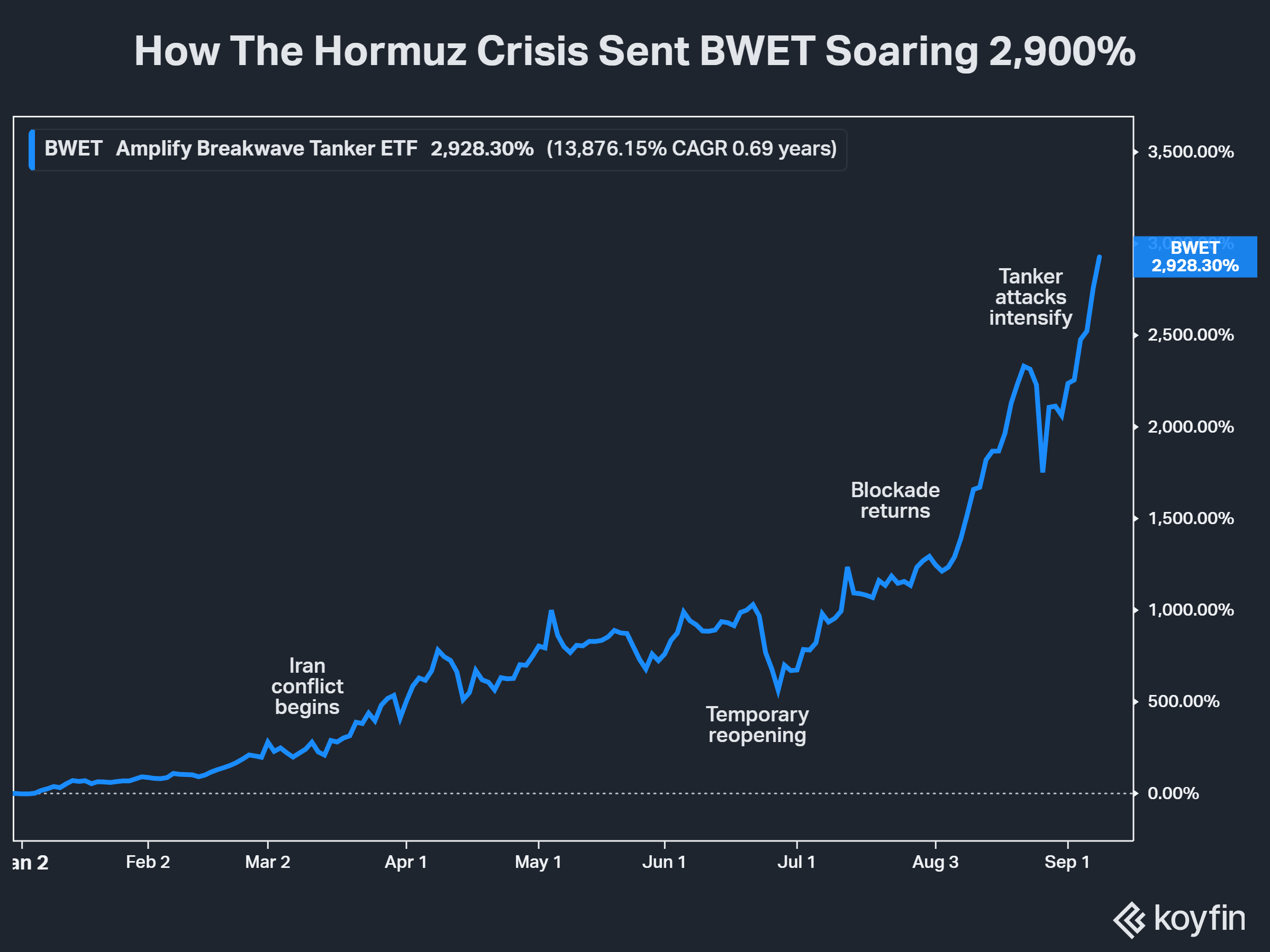
The Breakwave Tanker Shipping ETF (BWET) has surged 2,928% this year as months of disruption around the Strait of Hormuz sent freight costs soaring, eclipsing even leveraged bets on semiconductor and energy stocks.
BWET Leaves Rival ETFs Behind
BWET’s year-to-date percentage gain is nearly 12 times the 244% advance in the MicroSectors U.S. Big Oil Index 3X ETN (NRGU) and almost 15 times the 199% rise in the Direxion Daily Semiconductor Bull 3X Shares ETF (SOXL).
Advertisement|Remove ads.
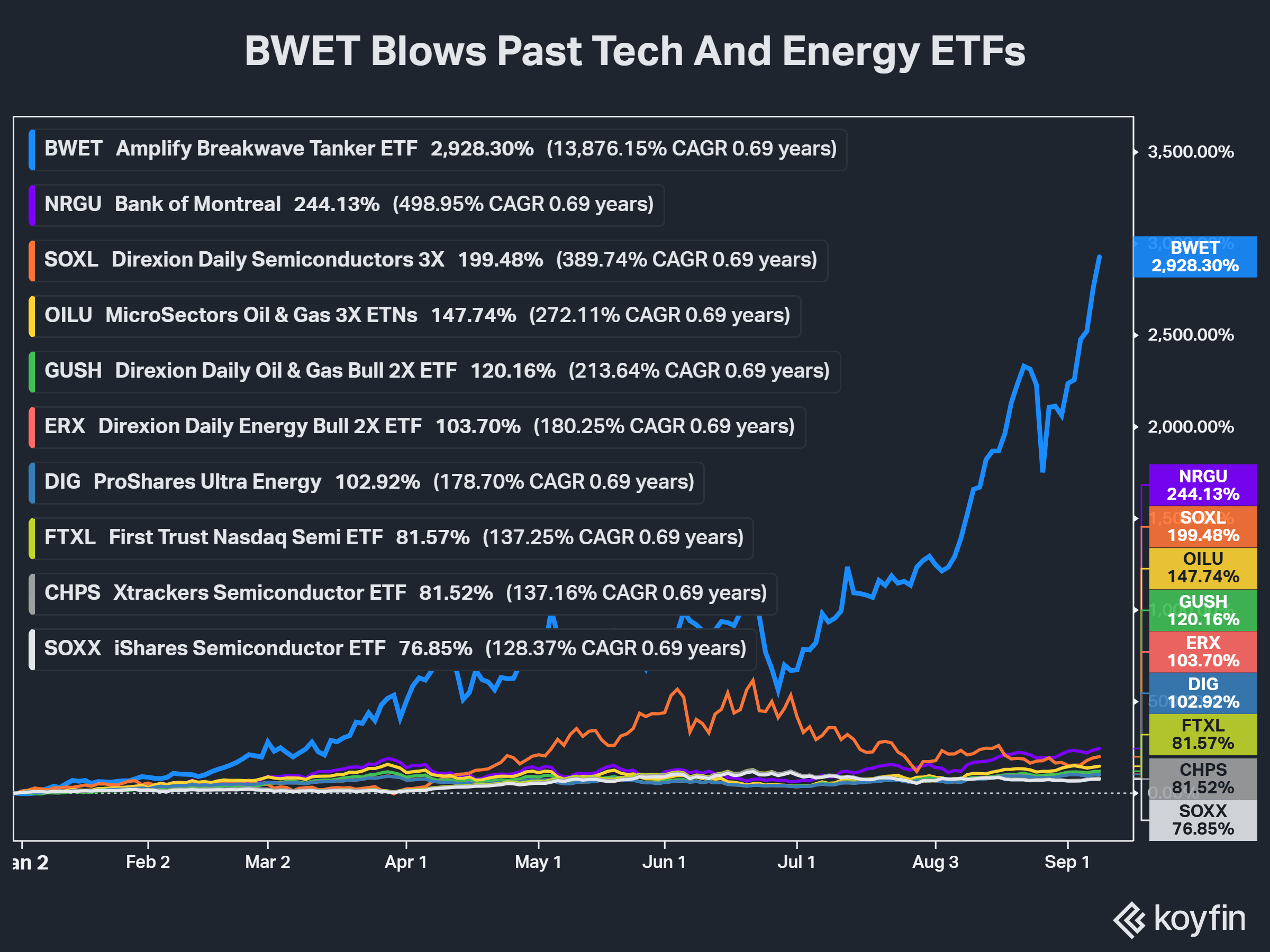
Other strong energy performers lag far behind. The MicroSectors Oil & Gas Exploration & Production 3X Leveraged ETN (OILU) has gained about 148%, while the Direxion Daily S&P Oil & Gas Exploration & Production Bull 2X Shares ETF (GUSH) has risen 119%.
Among semiconductor ETFs, the First Trust Nasdaq Semiconductor ETF (FTXL) has advanced 82% and the iShares Semiconductor ETF (SOXX) about 77%. The S&P 500, tracked by SPY, had gained 12% through Wednesday, while the Nasdaq Composite was up 13%.
Advertisement|Remove ads.
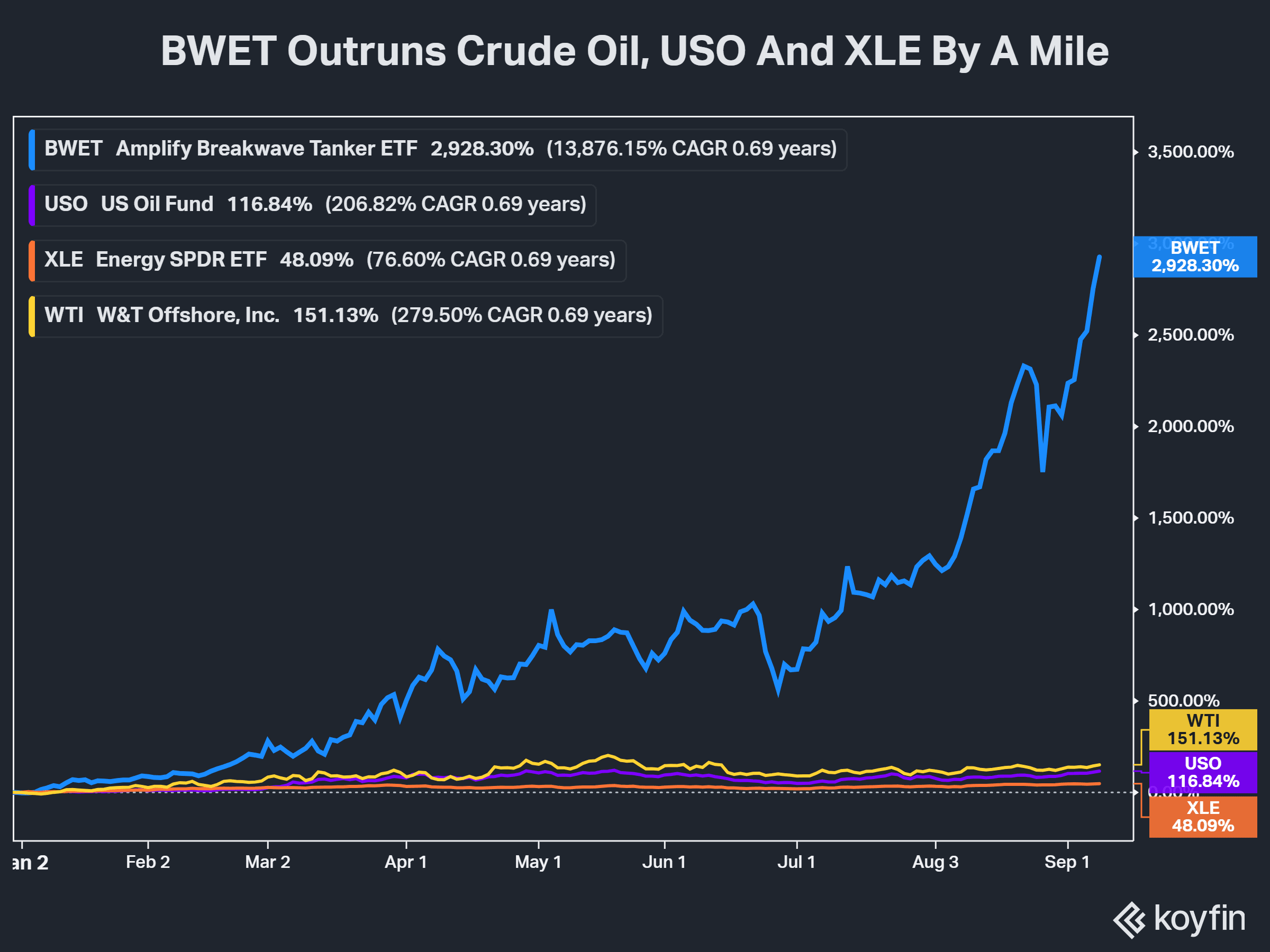
BWET has also dwarfed the wider energy rally. Its 2,928% gain is about 19 times WTI crude’s 151% advance, 25 times the United States Oil Fund (USO) 's 117% return, and 61 times the Energy Select Sector SPDR Fund (XLE) 's 48% gain.
Advertisement|Remove ads.
Inside BWET’s Freight Bet
Launched in May 2023, BWET is a specialized commodity-pool ETF that holds near-dated crude-tanker freight futures rather than oil, shipping stocks, or physical vessels. Its exposure is concentrated in the Baltic Exchange’s TD3C route: very large crude carriers hauling oil from the Middle East Gulf to China. A smaller allocation tracks Suezmax shipments from West Africa to Europe.
The Gulf-to-China route passes through Hormuz, making the fund particularly sensitive to the availability of ships willing to cross the strait. Higher freight futures can lift BWET even when oil prices fall. Conversely, an easing of shipping constraints can hurt the fund without requiring a comparable decline in crude.
Shipping Shortage Fuels BWET
The disruption began after the U.S.-Israeli strikes on Iran in February when Tehran effectively closed Hormuz to most commercial traffic. Before the war, about 125 large commercial ships crossed daily. Gulf supertanker hire rates were around $75,000 to $100,000 a day.
Advertisement|Remove ads.
By late June, tanker rates for voyages through Hormuz had surged to nearly $470,000 a day, while rates outside the strait jumped to $190,500 from $106,500 in just one week. The problem wasn't just demand for oil. Ships were stranded, owners were refusing voyages, and the vessels available to carry remaining cargo commanded exceptional prices.
Insurance is another hurdle. At the APPEC industry conference on Wednesday, Emirates National Oil Company (ENOC) said transit costs ran from $10 million to $20 million per voyage, and cargo-insurance bills hit nearly $10 million. Additional war-risk coverage for leaving the Gulf, previously negligible, could reach “10 percent of the cargo.”
Advertisement|Remove ads.
BWET does not track insurance costs directly. However, higher war-risk premiums can discourage ships from entering the Gulf, tighten available capacity and increase the freight rates underlying the fund’s futures.
BWET Swings On Hormuz Hopes
June briefly offered a way out. The U.S. lifted its blockade of Iranian ports on June 18 under an agreement that promised 60 days of toll-free passage and the restoration of commercial traffic within 30 days. Some stranded tankers escaped. But mines, rival transit corridors and renewed attacks kept the route far from normal.
Middle East-to-China VLCC rates fell to about $287,000 a day by June 30 from more than $500,000 before the peace announcement. The ceasefire subsequently broke down, and Washington reimposed its blockade in mid-July. BWET had already shown how quickly diplomacy could reverse the trade. The ETF fell about 13% at the open on April 9 after Iran said it would allow safe passage, then rebounded when tanker traffic was halted again.
Advertisement|Remove ads.
Hormuz Tanker Attacks Revive Freight Risk
The latest round of violence has further narrowed the pool of willing operators. U.S. forces said they destroyed five Iranian crude tankers on Tuesday following attempted missile attacks on an American warship, after striking three tankers days earlier. Iran’s Revolutionary Guard separately claimed attacks on two U.S. vessels and eight oil tankers.
The violence has also threatened shuttle vessels carrying Gulf crude to larger tankers waiting outside Hormuz, which is a workaround to keep risk-averse ships away from the strait. Only six tracked commodity ships crossed the strait on Tuesday, far below the 125 daily transits recorded before the war. The tally excludes vessels operating with tracking systems switched off, but major shipping companies are reluctant to return.
Mitsui O.S.K. Lines, Japan’s second-largest shipping company with a fleet of more than 900 vessels, said normal operations were unlikely to resume soon. CEO Jotaro Tamura said it was “difficult to see operations resuming in any form by the end of the year.”
Advertisement|Remove ads.
How Do Retail Traders Feel About BWET?
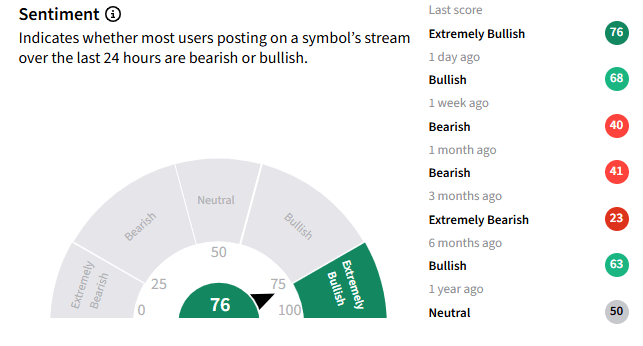
On Stocktwits, retail sentiment for BWET flipped dramatically to ‘extremely bullish’ from ‘extremely bearish’ levels three months ago amid a 900% surge in message volume over the past month. The ticker’s watcher base has also jumped 45% over the past month and 75% in the last quarter, indicating healthy retail interest in the ETF.
One user said, “$BWET anything can happen from here. $1000 or $100 would not suprise me.”
Advertisement|Remove ads.
Another user said, “BWET has been the best performing non-leveraged ETF this year even beating SanDisk as far as percentage wise. It will dramatically decline in price when the war ends or another fake ceasefire but right now it just keeps climbing.”
For updates and corrections, email newsroom[at]stocktwits[dot]com.
Advertisement|Remove ads.
Read Next: RKLB, ASTS, SPCX, PL In Focus: New Trump Task Force Targets 10,000 Annual Space Operations By 2035
Comments posted here will also appear on symbol pages.

Latest News
/filters:format(webp)https://news.stocktwits-cdn.com/large_Getty_Images_2290038559_c6f6528203.jpg)
/filters:format(webp)https://news.stocktwits-cdn.com/Revised_Profile_JPG_0e0afdf5e2.webp) Preeti Ayyathurai·2h ago
Preeti Ayyathurai·2h ago/filters:format(webp)https://news.stocktwits-cdn.com/large_Getty_Images_2281342449_4ba8c3779f.jpg)
/filters:format(webp)https://news.stocktwits-cdn.com/shivani_photo_jpg_dd6e01afa4.webp) Shivani Kumaresan·2h ago
Shivani Kumaresan·2h ago/filters:format(webp)https://news.stocktwits-cdn.com/large_orcl_3549509c2a.jpg)
/filters:format(webp)https://news.stocktwits-cdn.com/IMG_8805_JPG_6768aaedc3.webp) Deepti Sri·2h ago
Deepti Sri·2h ago/filters:format(webp)https://news.stocktwits-cdn.com/large_shipping_8730d7fbd7.jpg) Deepti Sri·3h ago
Deepti Sri·3h ago/filters:format(webp)https://news.stocktwits-cdn.com/large_Getty_Images_2294430499_794c933fc0.jpg)
/filters:format(webp)https://news.stocktwits-cdn.com/Aashika_Suresh_Profile_Picture_jpg_2acd6f446c.webp) Aashika Suresh·3h ago
Aashika Suresh·3h ago/filters:format(webp)https://news.stocktwits-cdn.com/large_Getty_Images_2265501433_jpg_cbad060739.webp) Shivani Kumaresan·3h ago
Shivani Kumaresan·3h ago