


Advertisement|Remove ads.
Dow, S&P 500, Nasdaq Futures Slip As Hormuz Risk Deepens In Fifth Week Of Conflict: Why ANNA, MSFT, MLTX, ONDS, RDDT Are In Spotlight
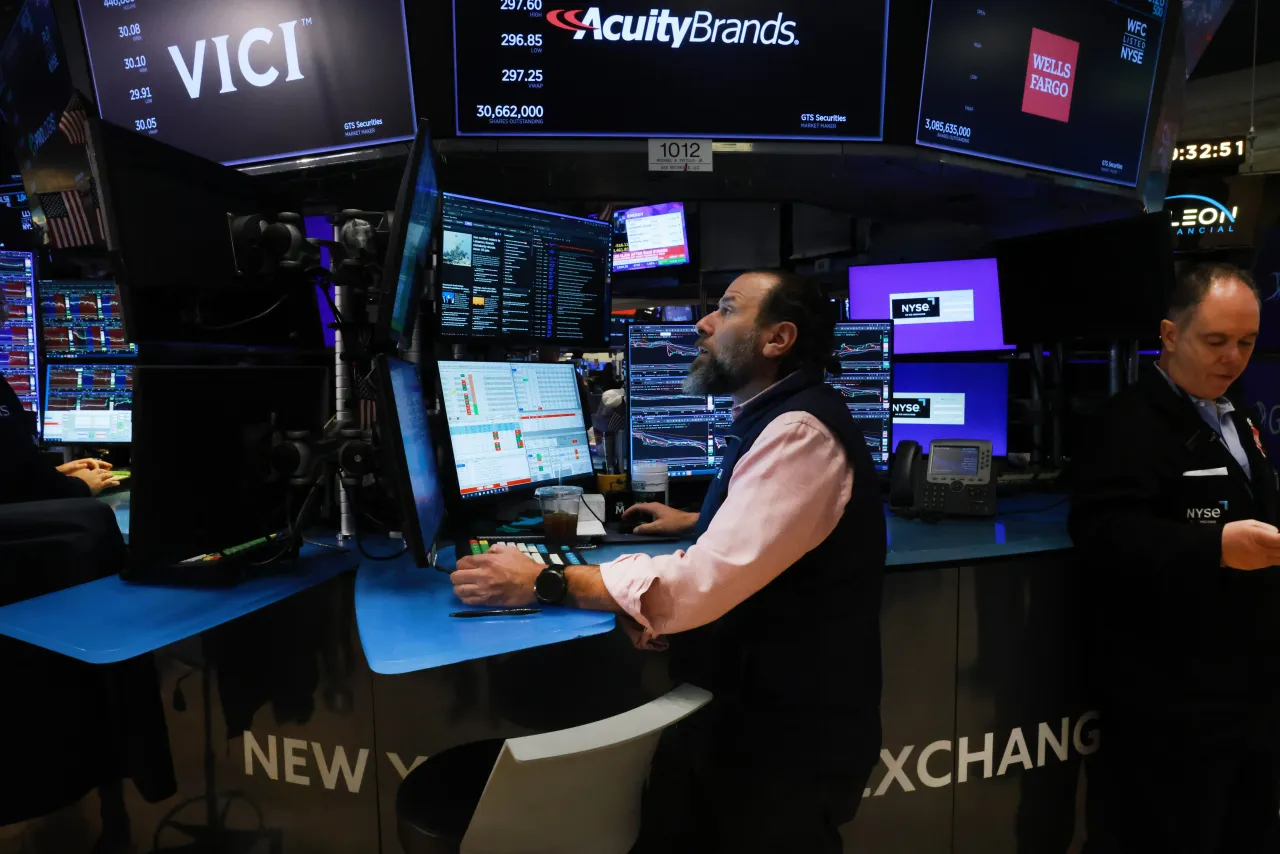


- Middle East tensions entered a fifth week, with new Houthi involvement and additional U.S. troop deployments raising fears of broader escalation.
- Iran warned ships transiting the Strait of Hormuz could face a “harsh response,” while vessels were reportedly turned away and a cargo ship struck in the waterway.
- The Dow entered correction territory on Friday as major U.S. indexes extended losses and the S&P 500 posted its fifth straight weekly decline.
Advertisement|Remove ads.
U.S. stock futures slipped late Sunday as escalating tensions in the Middle East and renewed threats to global oil supply kept investors cautious after the Dow entered correction territory and Treasury yields pushed toward fresh highs.
As of 9.15 p.m. ET, Dow and Nasdaq 100 futures were down 0.7%, while S&P 500 futures were down by 0.6%.
On Stocktwits, retail sentiment toward the SPDR S&P 500 ETF Trust (SPY) and Invesco QQQ Trust (QQQ) was ‘extremely bearish’ amid ‘high’ message volume, while sentiment toward the SPDR Dow Jones Industrial Average ETF Trust (DIA) was ‘bearish’ amid ‘high’ message volume.
Advertisement|Remove ads.
US Market Drivers
Markets reacted to intensifying Middle East tensions as the conflict entered its fifth week, with Iran-backed Houthi militants joining the fight and 3,500 additional U.S. troops arriving in the region. Israel struck Tehran again over the weekend while Saudi Arabia intercepted nearly a dozen drones.
Iran’s Revolutionary Guard said movement through the Strait of Hormuz would face a “harsh response,” while Chinese vessels were reportedly turned away, and a Thai-flagged cargo ship struck in the waterway ran aground. The chokepoint typically handles roughly one-fifth of the global oil supply.
Tehran has also decided to formalize control over traffic through the strait by restricting passage to most vessels while allowing only limited shipments from select countries.
Advertisement|Remove ads.
Brent crude previously settled at $112.57 per barrel and West Texas Intermediate crude at $99.64, their highest close since July 2022. Oil later surged above $116 in early Monday trading after Houthi forces launched missiles at Israel and warned operations would continue until attacks on Iran cease.
The Houthis’ entry into the conflict raised concerns the Red Sea and Bab el-Mandeb corridor could become additional pressure points for global shipping routes, potentially tightening supply further. Macquarie analysts warned oil could reach $200 per barrel if the conflict extends through June while the Strait of Hormuz remains shut.
Gary Black, managing partner at The Future Fund, said on X that Saudi Arabia’s East-West Yanbu pipeline is currently operating at its full 7 million barrels-per-day capacity, partially offsetting the roughly 15 million barrels per day that typically transit Hormuz. He added that the Houthis’ entry into the war increases the risk the Red Sea could become “a new front in the conflict.”
Advertisement|Remove ads.
U.S. equities extended their recent slide on Friday, with all three major indexes posting sharp losses as the Dow entered correction territory and the S&P 500 marked a seven-month low, capping a fifth straight weekly decline for the benchmark:
| Index | Move | Close |
| Dow Jones Industrial Average | −1.73% | 45,166.64 |
| S&P 500 | −1.67% | 6,368.85 |
| Nasdaq Composite | −2.15% | 20,948.36 |
Investor sentiment remained cautious even after U.S. President Donald Trump extended a deadline for potential strikes on Iran’s energy infrastructure to April 6 while signaling negotiations were continuing.
John Spencer, executive director of the Urban Warfare Institute, said on X that expectations that the conflict would require a full-scale ground invasion of Tehran reflect “shallow thinking rooted in outdated and often biased mental models of war,” adding that the campaign is focused on degrading Iran’s military capability and forcing behavioral change rather than occupying the capital.
Advertisement|Remove ads.
Trending Stocks To Watch On NYSE, Nasdaq
AleAnna (ANNA): Shares jumped nearly 20% overnight late Sunday as Middle East tensions disrupted global LNG flows and pushed European gas prices higher, drawing attention to the company’s expanding Po Valley reserves as Europe faces tighter storage levels ahead of winter.
Microsoft (MSFT): Shares are on track for their sixth straight month in the red as analysts warned next-generation PlayStation and Xbox consoles could launch near the $1,000 level amid rising memory costs and tariff-related pricing pressure.
MoonLake Immunotherapeutics (MLTX): Shares rose more than 4% in overnight trading after the company reported strong Phase 3 trial results for its lead skin disease drug Sonelokimab, with about 62% of patients showing major symptom improvement and no new safety concerns reported.
Advertisement|Remove ads.
Ondas Holdings (ONDS): Shares fell to their lowest levels in three months on Friday amid broader market weakness, while Barclays highlighted autonomous drone swarms and “Physical AI” as a major long-term growth shift in defense tech.
Reddit (RDDT): Shares fell to their lowest levels since June 2025 after JPMorgan flagged slowing U.S. visitor growth in third-party data and warned geopolitical tensions could weigh on digital advertising spending.
How Global Markets Are Performing Today
In broader markets, the yield on the benchmark 10-year U.S. Treasury note ended last week near 4.44% after rising as high as 4.48%, its highest level since July 2025, as traders reassessed expectations for Federal Reserve policy.
Advertisement|Remove ads.
The Kobeissi Letter said on X that the bond market is approaching crisis levels last seen during “Liberation Day” in April 2025 and warned yields could push above 4.5% without intervention, adding that history suggests some form of “attempted bond market intervention is coming.”
The publication added that global long-term bonds saw $4.7 billion in weekly outflows, the second-largest on record, while high-yield funds logged a third straight weekly withdrawal totaling $13.5 billion.
Meanwhile, gold traded near $4,490 per ounce. The Kobeissi Letter said on X that 95% of stocks in the VanEck Gold Miners ETF (GDX) are now in a bear market, the highest since April 2023, adding that gold miners have “rarely been this oversold.” They also flagged that a similar setup in October 2023 preceded a 346% rally into March 2026.
Advertisement|Remove ads.
Asian markets were weaker, with the MSCI Asia Pacific Index excluding Japan down 0.3%, while shares in Australia and Japan opened lower.
Among Monday’s catalysts, investors will watch remarks from Federal Reserve Chair Jerome Powell and New York Fed President John Williams for signals on the policy outlook.
For updates and corrections, email newsroom[at]stocktwits[dot]com.
Advertisement|Remove ads.
Comments posted here will also appear on symbol pages.

Latest News
/filters:format(webp)https://news.stocktwits-cdn.com/large_Getty_Images_2271717794_jpg_28ceb33bd7.webp)
/filters:format(webp)https://news.stocktwits-cdn.com/Rounak_Author_Image_7607005b05.png) Rounak Jain·24m ago
Rounak Jain·24m ago/filters:format(webp)https://st-everywhere-cms-prod.s3.us-east-1.amazonaws.com/large_nvidia_jensen_huang_resized_d0dc826ae7.jpg)
/filters:format(webp)https://news.stocktwits-cdn.com/Prabhjote_DP_67623a9828.jpg) Prabhjote Gill·1h ago
Prabhjote Gill·1h ago/filters:format(webp)https://news.stocktwits-cdn.com/large_Verizon_resized_jpg_83ced6c446.webp) Rounak Jain·1h ago
Rounak Jain·1h ago/filters:format(webp)https://news.stocktwits-cdn.com/large_Getty_Images_2267825783_jpg_1b90bf709b.webp)
/filters:format(webp)https://news.stocktwits-cdn.com/vivekkrishnanphotography_58_jpg_0e45f66a62.webp) Arnab Paul·2h ago
Arnab Paul·2h ago/filters:format(webp)https://news.stocktwits-cdn.com/large_circle_stablecoins_original_jpg_b238d12be8.webp) Prabhjote Gill·2h ago
Prabhjote Gill·2h ago/filters:format(webp)https://news.stocktwits-cdn.com/large_paul_krugman_jpg_fb6f48bdf8.webp) Rounak Jain·3h ago
Rounak Jain·3h ago