


Advertisement|Remove ads.
'Einstein Of Wall Street' On NYSE Trading Floor Warns Investors Are Growing Impatient With AI Trades: 'Feelings Aren't Facts'
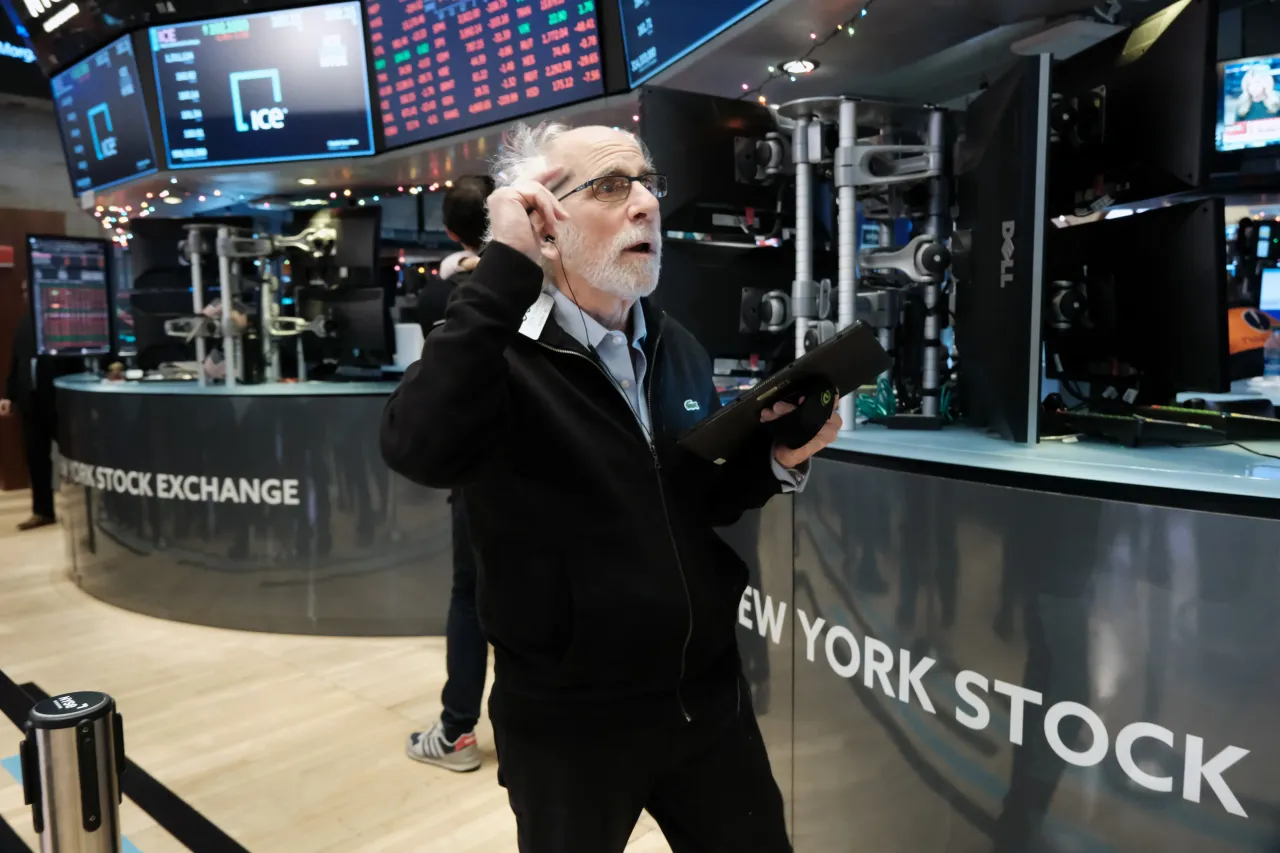


- Peter Tuchman noted that the S&P 500 briefly tested 7,000 last week before pulling back, while the Dow has hovered near 50,000.
- He said pressure on technology stocks shows investor impatience over AI investment timelines, even as companies stick to existing strategies.
- Investors are now looking ahead to a heavy slate of U.S. data due Tuesday.
Advertisement|Remove ads.
Veteran NYSE floor trader Peter Tuchman, also known as the "Einstein of Wall Street", highlighted a growing divide across U.S. market indexes and said investors are growing impatient with returns on artificial intelligence plays as U.S. mega-cap tech firms table spending plans the size of some countries' entire economies.
Market 'Bifurcation' Between S&P 500 And Dow Jones
In his X video on Monday, Tuchman recapped the session in which all major indexes (Dow Jones, S&P 500, and Nasdaq) closed higher. He pointed to what he described as a "bifurcation" in the market, with the S&P 500 weighed down by its heavy exposure to technology stocks while the Dow Jones Industrial Average has shown relative resilience.
The Dow Jones Industrial Average (DJIA) tracks just 30 large blue-chip companies, hand-selected by a committee to represent major segments of the U.S. economy, excluding transportation and utilities. The S&P 500, by contrast, includes 500 large-cap U.S. companies and provides a broader view of large-cap performance across all major sectors. One key distinction is weighting: the Dow is price-weighted, while the S&P 500 is market-cap-weighted. As a result, the S&P 500's top three stocks by weight are Nvidia, Apple, and Microsoft, while the Dow's largest components are Goldman Sachs, Caterpillar, and Microsoft.
Advertisement|Remove ads.
Tuchman's Thesis About U.S. Markets
Tuchman said, "What's really happening is this: We do see tech under pressure. We do see that a lot of the investors are saying, 'Wait a minute, everybody ... we put all this money into tech and all this money into AI. Then we know that AI has been the catalyst of the market. We are impatient. You promised us that we're going to start seeing results right away. I know it's five years out to build these data centers and all that, but you promised us all this stuff, and now it's not happening fast enough.'"
"So the bottom line is: Feelings aren't facts. At the end of the day, just because the investors are getting impatient and the companies are not changing their position in any way, they're still putting that capex out, they're still getting behind everything they promised but it's not happening in the timeline that investors want," he said.
Tuchman, who has been trading on the NYSE floor for over four decades, has been more active on social media recently, posting market commentary and urging investors to educate themselves further.
Advertisement|Remove ads.
What S&P 500, Nasdaq & Dow Futures Point To
As of 12.48 a.m. ET, Nasdaq 100 futures were down about 0.02%, while S&P 500 futures gained 0.03%. Dow futures were modestly higher. All major indexes closed higher on Monday after actress Sydney Sweeney rang the opening bell at the New York Stock Exchange.
On Stocktwits, retail sentiment toward SPDR S&P 500 ETF Trust (SPY) and Invesco QQQ Trust (QQQ) was 'bearish' amid 'high' message volume, and sentiment toward the SPDR Dow Jones Industrial Average ETF Trust (DIA) was 'bullish' amid 'extremely high' message volume.
Big Tech's Massive AI Spending Plan
Google parent Alphabet on Monday said it would raise about $20 billion through a U.S. dollar bond offering, exceeding earlier expectations. Capital expenditures for the four largest U.S. technology companies are forecast to reach roughly $650 billion in 2026.
Advertisement|Remove ads.
Despite shifting sentiment, Tuchman said companies have not changed their strategic direction, adding that business plans remain on the same trajectory even as markets react to short-term frustration.
He added that the S&P 500 added more than $250 billion in market capitalization and now sits less than 1% away from a new record high.
Macro Signals And Market Drivers In Focus
White House economic adviser Kevin Hassett said U.S. job gains could slow in the coming months due to weaker labor force growth and higher productivity, which could weigh on market sentiment.
Advertisement|Remove ads.
Investors are now looking ahead to a heavy slate of U.S. data due Tuesday, including the NFIB optimism index, the employment cost index, import prices, retail sales and business inventories, along with remarks from Cleveland Fed President Beth Hammack and Dallas Fed President Lorie Logan.
Major U.S. Q4 Earnings On Tap
Earnings season remains in focus, with Coca-Cola scheduled to report before the open on Tuesday, followed by results from Hasbro and Spotify.
In broader markets, the yield on the benchmark 10-year U.S. Treasury note hovered near 4.2%. Gold and silver declined as investors took profits, while WTI crude traded slightly lower. Asian markets advanced for a second straight session, led by Japan, where the Nikkei 225 rose to a fresh record high.
Advertisement|Remove ads.
For updates and corrections, email newsroom[at]stocktwits[dot]com.
Comments posted here will also appear on symbol pages.

Latest News
/filters:format(webp)https://news.stocktwits-cdn.com/large_Getty_Images_2295226888_dcdb8e346d.jpg)
/filters:format(webp)https://news.stocktwits-cdn.com/1707726834303_jpg_11f20a9aa9.webp) Shashank Nayar·4m ago
Shashank Nayar·4m ago/filters:format(webp)https://st-everywhere-cms-prod.s3.us-east-1.amazonaws.com/large_novartis_stock_resized_978faa13aa.jpg)
/filters:format(webp)https://news.stocktwits-cdn.com/unnamed_jpg_9dff551b50.webp) Anan Ashraf·25m ago
Anan Ashraf·25m ago/filters:format(webp)https://news.stocktwits-cdn.com/large_Getty_Images_2240705289_c6a2c346cc.jpg) Anan Ashraf·2h ago
Anan Ashraf·2h ago/filters:format(webp)https://news.stocktwits-cdn.com/large_stock_chart_falling_resized_jpg_c0ce61eff2.webp) Shashank Nayar·2h ago
Shashank Nayar·2h ago/filters:format(webp)https://news.stocktwits-cdn.com/large_skydance_decde45b1e.jpg) Shashank Nayar·2h ago
Shashank Nayar·2h ago/filters:format(webp)https://news.stocktwits-cdn.com/large_omeros_jpg_4769b8d291.webp) Anan Ashraf·3h ago
Anan Ashraf·3h ago