


Advertisement|Remove ads.
El-Erian Flags ‘Fascinating’ Market Shift As Dow, S&P 500 Catch Up To Nasdaq


- Mohamed El-Erian, chief economic adviser at Allianz, highlighted the trend in a post on X.
- El-Erian noted in his post that the narrowing performance gap has now begun a debate about whether it is a healthy broadening, an excessive convergence, or a cautionary sign.
- Concerns over the escalating cost of the AI buildout has triggered a selloff in technology and semiconductor stocks in recent weeks.
Advertisement|Remove ads.
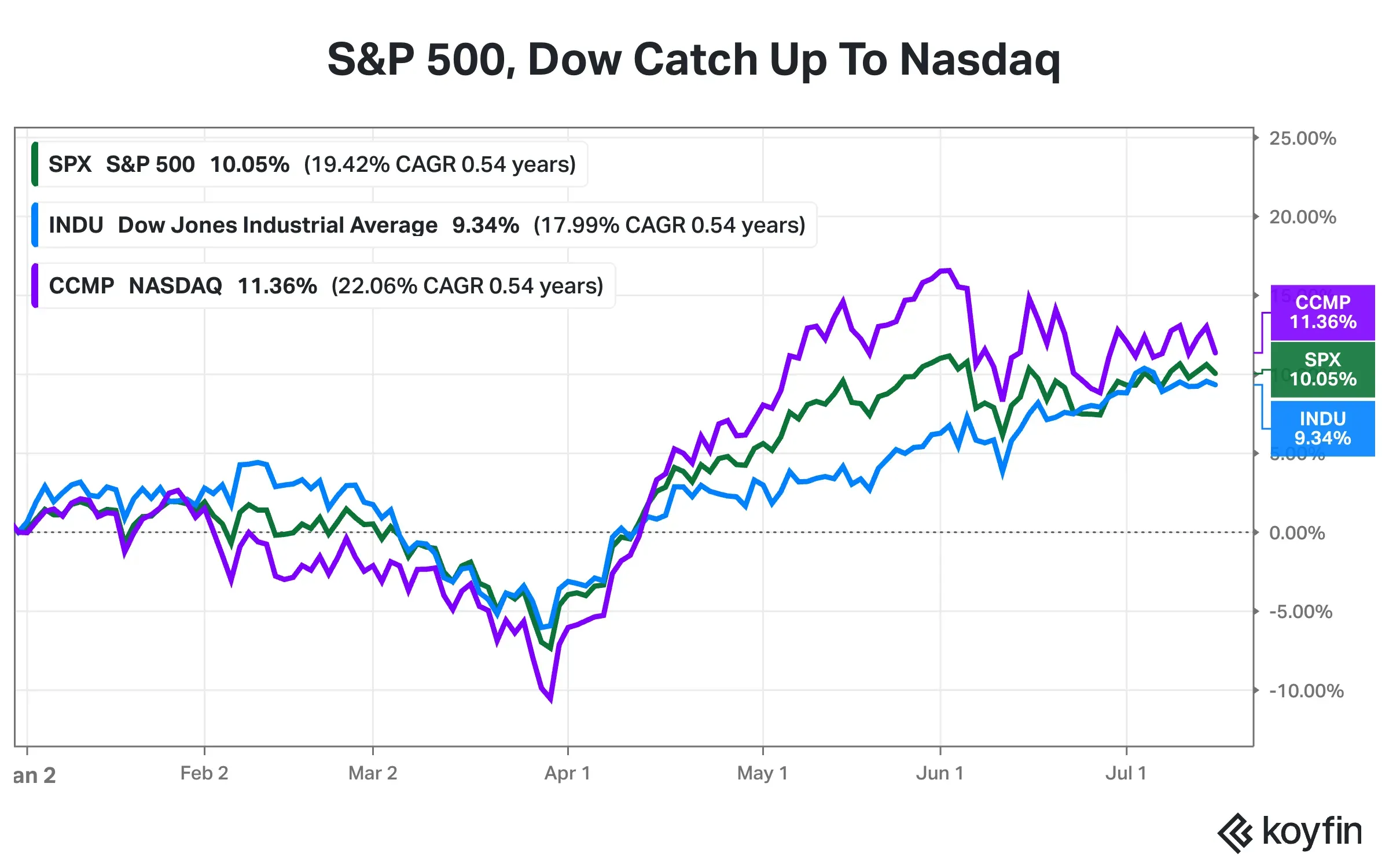
The performance gap between the three major U.S. stock indexes has narrowed sharply in recent weeks, with a pullback in AI-driven technology stocks allowing the S&P 500 and Dow Jones Industrial Average to catch up to the Nasdaq Composite.
Mohamed El-Erian, chief economic adviser at Allianz, highlighted the trend in a post on X, saying, “Fascinating to see the extent to which the three major indices—and especially the Dow and the Nasdaq—have converged in recent weeks.”
The Dow is up about 9% year-to-date, while the Nasdaq has gained roughly 11%, and the S&P 500 is up about 10%, narrowing the gap from earlier this year.
Advertisement|Remove ads.
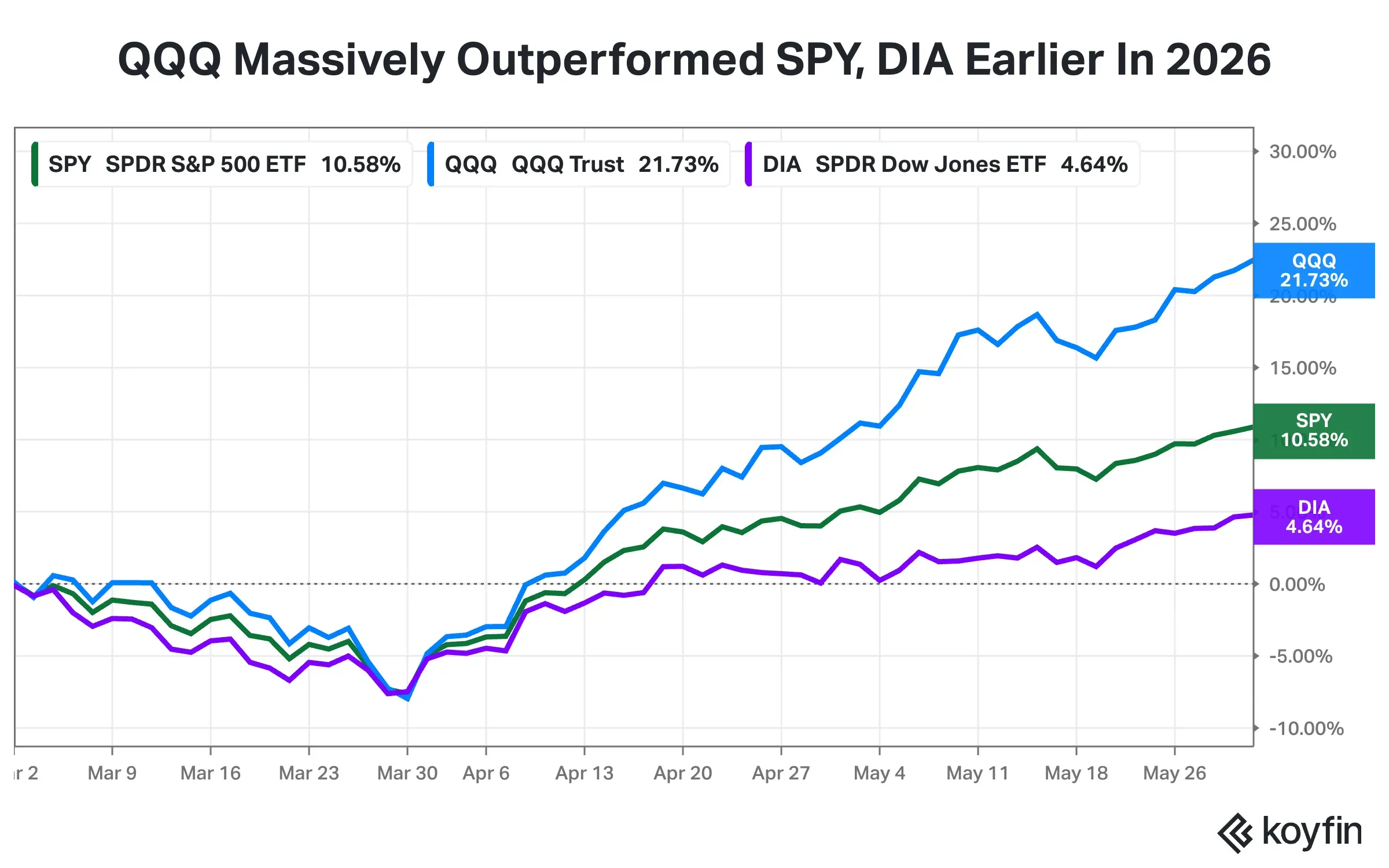
According to Koyfin data, from March through end of at, Invesco QQQ Trust (QQQ), which tracks the performance of Nasdaq-100, surged nearly 22%, compared with gains of about 10.5% for the SPDR S&P 500 ETF (SPY) and less than 5% for the SPDR Dow Jones Industrial Average ETF (DIA).
What Does This Mean?
The outperformance earlier this year was driven largely by investor enthusiasm surrounding AI infrastructure spending, semiconductor demand and mega-cap technology companies.
However, this has shifted in recent weeks. The narrowing gap has sparked debate among market participants about what the convergence actually means.
Advertisement|Remove ads.
El-Erian noted in his post that the narrowing performance gap has now begun a debate about whether it is a healthy broadening, an excessive convergence, or a cautionary sign.
"Convergence like this can come from laggards catching up, leaders slowing down, or both. The returns alone don't answer that," Future Wealth Group wrote in response to El-Erian's post on X.
AI Concerns Have Clawed Back Tech Gains
Concerns over the escalating cost of the AI buildout has triggered a selloff in technology and semiconductor stocks in recent weeks. The rout intensified after Taiwan Semiconductor Manufacturing (TSM) raised its 2026 capital expenditure forecast to $60 billion-$64 billion, up from its prior $52 billion-$56 billion range, fueling worries that AI infrastructure spending may be becoming increasingly expensive.
Advertisement|Remove ads.
The weakness extends a recent pullback in chip stocks, which have come under pressure as investors reassess lofty valuations, rising AI-related spending commitments and whether the pace of earnings growth can justify the sector's massive rally over the past year. The VanEck Semiconductor ETF (SMH) is down nearly 9% in the past month alone.
What’s Retail Sentiment Like?
At the time of writing, retail sentiment around SPY and DIA was ‘neutral,’ while it was ‘bullish’ for QQQ and SMH.
One user noted, “Money is coming out of crowded tech trades, & going into defensive, value sectors of industrials, energy, and consumer staples.”
Advertisement|Remove ads.
On SMH, another user said, “buy when others are fearful - Warren buffet.”
Advertisement|Remove ads.
For updates and corrections, email newsroom[at]stocktwits[dot]com.
Comments posted here will also appear on symbol pages.

Latest News
/filters:format(webp)https://news.stocktwits-cdn.com/large_tom_lee_OG_2_jpg_9ae5c049c3.webp)
/filters:format(webp)https://news.stocktwits-cdn.com/Anushka_Basu_make_me_smile_in_the_picture_b92832aa_af59_4141_aacc_4180d2241ba8_1_2_png_1086e0ed8c.webp) Anushka Basu·48m ago
Anushka Basu·48m ago/filters:format(webp)https://news.stocktwits-cdn.com/large_Getty_Images_1757401303_e51e9c74d8.jpg) Anushka Basu·2h ago
Anushka Basu·2h ago/filters:format(webp)https://news.stocktwits-cdn.com/large_U_S_trade_resized_jpg_2526b45902.webp)
/filters:format(webp)https://st-everywhere-cms-prod.s3.us-east-1.amazonaws.com/i_OS_App_Icon_1_8054f2a2fe.png) Stocktwits News Desk·2h ago
Stocktwits News Desk·2h ago/filters:format(webp)https://news.stocktwits-cdn.com/large_Getty_Images_1922677353_03926a10de.jpg) Anushka Basu·3h ago
Anushka Basu·3h ago/filters:format(webp)https://news.stocktwits-cdn.com/large_Getty_Images_2217001038_5b553235bd.jpg) Stocktwits News Desk·4h ago
Stocktwits News Desk·4h ago/filters:format(webp)https://news.stocktwits-cdn.com/large_Tom_Lee_c6db3cdfe4.webp) Anushka Basu·5h ago
Anushka Basu·5h ago