


Advertisement|Remove ads.
‘Forget AI, Fed Is The Story Now’ – 'Bond King' Jeffrey Gundlach Says Kevin Warsh Faces A 1970s-Style Inflation Challenge
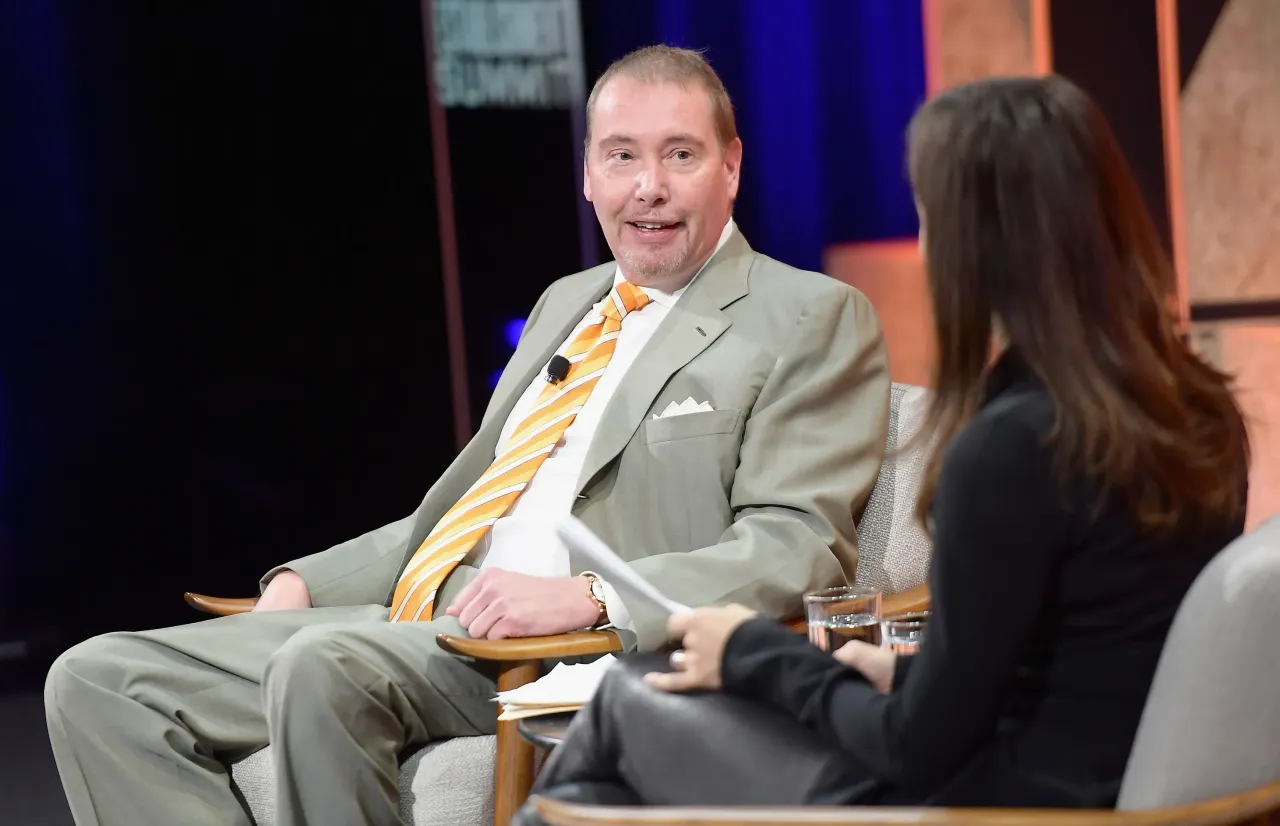


- Jeffrey Gundlach said, "AI is not the top story. It is the Fed," after Kevin Warsh's first policy decision as Fed chair.
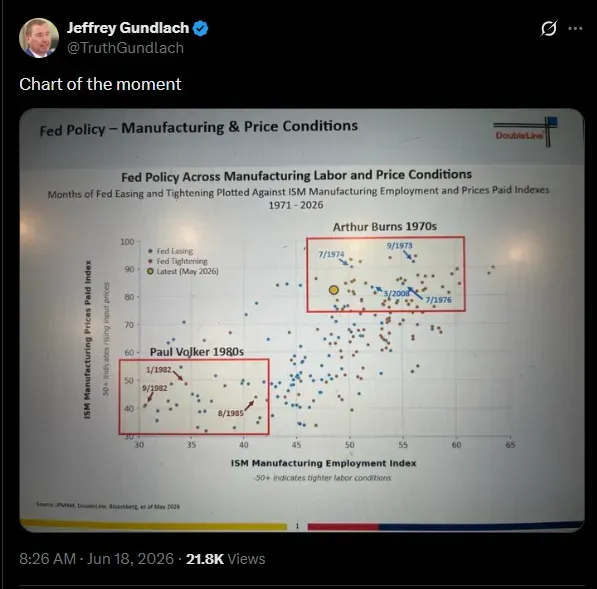
- Gundlach flagged manufacturing data that he believes looks more like the inflation of the 1970s than the Volcker era of the 1980s.
- The bond investor said Warsh sounded more committed to fighting inflation than markets expected when he was selected by Trump.
Advertisement|Remove ads.
The artificial intelligence (AI) trade took a back seat, with investors turning their attention to a different force driving Wall Street: the Federal Reserve. Veteran bond investor Jeffrey Gundlach said on Thursday that inflation risks were now the market's most important story, adding that economic conditions resembled those of the 1970s and could define Kevin Warsh's tenure as Fed chair.
On Wednesday, the major U.S. indexes closed lower, with the SPDR S&P 500 ETF Trust (SPY), Invesco QQQ Trust (QQQ), and SPDR Dow Jones Industrial Average ETF Trust (DIA) each falling about 1%.
'Bond King' Flags 1970s-Style Inflation Signals
"This is the first day in a long time AI is not the top story. It is the Fed," Gundlach said on X. The DoubleLine Capital CEO also shared his "chart of the moment" after Warsh's first policy decision as Federal Reserve chair. The chart compared two key manufacturing indicators: ISM Prices Paid, a measure of inflation pressures facing businesses, and ISM Employment, a gauge of labor-market conditions. The latest reading sits much closer to the era associated with former Fed Chair Arthur Burns in the 1970s than the Paul Volcker times in the early 1980s.
Advertisement|Remove ads.
For Gundlach, that is a warning sign. Inflation remained persistently high during the Burns years, while the Volcker era is widely known for the Fed's forceful campaign to curb price pressures.
Gundlach Sees Tougher Inflation Stance Under Warsh
Gundlach said the new Fed chair sounded more focused on inflation than markets anticipated when U.S. President Donald Trump selected him to lead the central bank. “He is absolutely telling you that he plans on delivering on price stability. So that means... we’re not going to have such easy money policy as everybody thought maybe Chairman Warsh would do back in the first quarter of this year, when everyone was counting on rate cuts,” Gundlach told CNBC.
The comments came after the Fed's policy statement declared that the Committee will deliver price stability. "The commitment to deliver is strong, unanimous, and unambiguous, and that's I think an important message we've missed for five years, and we're going to fix that," Warsh said during his press conference. Warsh also opted not to publish an individual rate forecast in the Fed's closely watched dot plot and indicated that the central bank's communications strategy could be due for a broader review.
Advertisement|Remove ads.
Warsh's Hawkish Tone Boosts Bond Bull Case
The veteran bond investor said Warsh's stance improves the outlook for long-dated U.S. Treasuries: "I think there's a greater reason to own long-term Treasuries today now that the new sheriff is in town." Gundlach said that Warsh has effectively put his credibility on stake to bring inflation under control, reducing the likelihood of excessively accommodative policy that could reignite price pressures. "If he doesn't deliver on something that can be characterized as price stability, he's basically announced today that he would be considered a failure," the bond investor said.
That commitment, Gundlach believes, lowers the risk of over-easing and supports longer-duration bonds.
How Do Retail Traders Feel About The US Market?
On Stocktwits, retail sentiment for SPY and QQQ was 'bullish' amid 'normal' message volume, while DIA was also 'bullish' but drew 'high' message volume.
Advertisement|Remove ads.
One user said, “$SPY Volcker is here to finally do what coward Powell refuses to do. Powell made the biggest policy error in almost 50 years cutting too soon”
Another user said, “I think we actually see one of the worst trading days for the Nasdaq tomorrow. Start hot then fade hard. Markets are closed Friday with so much “uncertainty.” Fed said the word uncertainty more than once today.”
Advertisement|Remove ads.
Over the past year, QQQ has led the major index ETFs with a 37% gain, while SPY and DIA have risen 25% and 24%, respectively.
For updates and corrections, email newsroom[at]stocktwits[dot]com.
Advertisement|Remove ads.
Read Next: TSLA Stock Eyes Red Week: Elon Musk Says Tesla’s FSD Could Soon Take Directions Like An Uber Driver
Comments posted here will also appear on symbol pages.

Latest News
/filters:format(webp)https://news.stocktwits-cdn.com/large_Getty_Images_2162497795_jpg_c07f3aa255.webp)
/filters:format(webp)https://news.stocktwits-cdn.com/vivekkrishnanphotography_58_jpg_0e45f66a62.webp) Arnab Paul·19m ago
Arnab Paul·19m ago/filters:format(webp)https://news.stocktwits-cdn.com/large_Getty_Images_2250139725_0ccee3701a.jpg)
/filters:format(webp)https://news.stocktwits-cdn.com/unnamed_jpg_9dff551b50.webp) Anan Ashraf·1h ago
Anan Ashraf·1h ago/filters:format(webp)https://news.stocktwits-cdn.com/large_Getty_Images_1390829031_d0ceb471aa.jpg) Anan Ashraf·1h ago
Anan Ashraf·1h ago/filters:format(webp)https://news.stocktwits-cdn.com/large_Getty_Images_2288503385_05d85c70be.jpg)
/filters:format(webp)https://news.stocktwits-cdn.com/1707726834303_jpg_11f20a9aa9.webp) Shashank Nayar·2h ago
Shashank Nayar·2h ago/filters:format(webp)https://news.stocktwits-cdn.com/large_Trader_jpg_9995fd8262.webp) Shashank Nayar·2h ago
Shashank Nayar·2h ago/filters:format(webp)https://news.stocktwits-cdn.com/large_Getty_Images_2269895640_582993daf5.jpg) Anan Ashraf·2h ago
Anan Ashraf·2h ago