


Advertisement|Remove ads.
Jeremy Siegel Warns US Stocks May Slide Further If Hormuz Crisis Drags On – Dow Is Already Down Nearly 3,800 Points Since Iran War Began
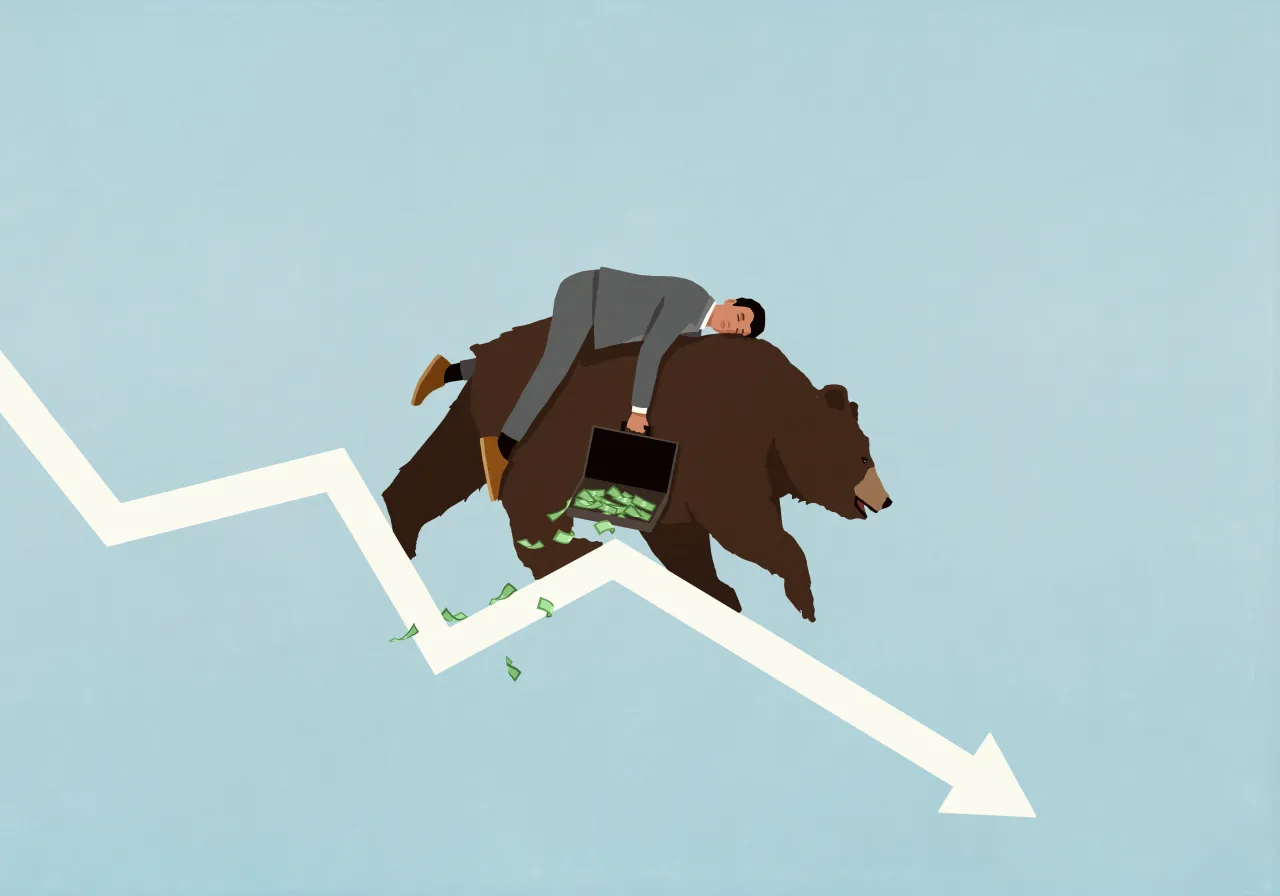


- Siegel added that caution regarding U.S. equities is warranted in the short term.
- He noted that as long as the Strait of Hormuz remains unresolved, he does not see a basis for a sustained rally in the U.S. stock market.
- Crude oil prices have soared since the beginning of the Iran war, with WTI crude futures surging nearly 57%.
Advertisement|Remove ads.
Jeremy Siegel, professor emeritus of finance at the University of Pennsylvania’s Wharton School of Business, on Tuesday warned that U.S. stocks could fall further if the Strait of Hormuz crisis remains unresolved.
“I think the path of least resistance is still lower. We have already been in correction territory in parts of the market, and further downside is entirely plausible if the energy shock persists for months rather than weeks,” he said.
Since the beginning of the Iran war on Feb. 28, 2026, the Dow Jones Industrial Average (DJIA) is down about 3,800 points, while the S&P 500 and Nasdaq Composite indexes are both down nearly 8%.
Advertisement|Remove ads.
Meanwhile, according to an estimate by the Center for American Progress, a non-partisan policy institute, the Iran war is estimated to have cost $25 billion. A New York Times report states that the Pentagon informed Congress that the first week of the war cost the U.S. more than $11.3 billion.
Caution Warranted In The Short Term, Says Siegel
The economist added that caution with respect to U.S. equities is warranted in the short term. He noted that as long as the Strait of Hormuz remains unresolved, he does not see a basis for a sustained rally in the U.S. stock market.
“A prolonged closure could push the S&P 500 into the mid-teens drawdown zone from its highs, but I would still stop short of assuming a 20% decline in the U.S. absent a broader global escalation,” Siegel warned.
Advertisement|Remove ads.
The economist added that while he does not expect the Federal Reserve to hike interest rates, the room for further cuts is a lot less than earlier.
On Monday, Fed Chair Jerome Powell said during an interview at Harvard University’s Principles of Economics class on Monday that the central bank is not facing the question of the impact of the Iran war-induced oil supply shock yet. He added that the Fed will be mindful of the broader context when it makes a monetary policy decision.
Siegel added that markets cannot ignore rising energy-related costs, fertilizer pressures, and the broader inflation impulse that can follow from a prolonged supply disruption. He stated that while this is not a setup for a Fed hike, it is a situation where cuts become less likely in the short run.
Advertisement|Remove ads.
Mohamed El-Erian, Chief Economic Advisor at Allianz, on Monday warned during an interview that there could be financial instability if the shocks to the U.S. economy due to the Iran war continue to escalate.
The economist stated that the inflation shock from the Iran war could lead to reduced spending, particularly among low-income households.
Trump Dials Back On Strait Of Hormuz Reopening Mission, Says Report
According to a report by The Wall Street Journal, President Trump told his aides about his willingness to end the war without getting Iran to reopen the strait following an assessment that this mission would result in prolonging the conflict beyond the four to six-week timeline.
Advertisement|Remove ads.
President Trump also told aides that while the U.S. will focus on its goals of destroying Iran’s missile stockpile and winding down the war, he would put pressure on the country diplomatically to reopen the strait, according to the report.
Crude Oil Prices Soar Since The Start Of The Iran War
Crude oil prices have soared since the beginning of the Iran war, with WTI and Brent crude futures surging nearly 57% and 49%, respectively.
On Tuesday, U.S. West Texas Intermediate (WTI) crude futures maturing in May were up nearly 2%, hovering around $105 a barrel. Brent crude futures expiring in June rose about 1% to hover around $108 a barrel.
Advertisement|Remove ads.
Meanwhile, U.S. equities declined in Tuesday’s pre-market trade. At the time of writing, the SPDR S&P 500 ETF (SPY), which tracks the S&P 500 index, was down 0.1%; the Invesco QQQ Trust ETF (QQQ) fell 0.05%; and the SPDR Dow Jones Industrial Average ETF Trust (DIA) declined 0.17%. Retail sentiment on Stocktwits regarding the S&P 500 ETF was in the ‘extremely bearish’ territory.
Also See: ARTL, BFRG, HKIT Among Stocks Soaring Before The Bell — Top Pre-Market Gainers Today
For updates and corrections, email newsroom[at]stocktwits[dot]com.
Advertisement|Remove ads.
Comments posted here will also appear on symbol pages.

Latest News
/filters:format(webp)https://news.stocktwits-cdn.com/large_aon_resized_jpg_400fc507b9.webp)
/filters:format(webp)https://news.stocktwits-cdn.com/Prabhjote_DP_67623a9828.jpg) Prabhjote Gill·9m ago
Prabhjote Gill·9m ago/filters:format(webp)https://news.stocktwits-cdn.com/large_Meta_e96fb8cd42.webp) Prabhjote Gill·1h ago
Prabhjote Gill·1h ago/filters:format(webp)https://news.stocktwits-cdn.com/large_Getty_Images_2282113047_jpg_61e21d8052.webp)
/filters:format(webp)https://news.stocktwits-cdn.com/vivekkrishnanphotography_58_jpg_0e45f66a62.webp) Arnab Paul·1h ago
Arnab Paul·1h ago/filters:format(webp)https://news.stocktwits-cdn.com/large_bitcoin_8e0f82ceb5.webp) Prabhjote Gill·2h ago
Prabhjote Gill·2h ago/filters:format(webp)https://news.stocktwits-cdn.com/large_tether_OG_2_jpg_9ea5c86cb6.webp)
/filters:format(webp)https://news.stocktwits-cdn.com/Anushka_Basu_make_me_smile_in_the_picture_b92832aa_af59_4141_aacc_4180d2241ba8_1_2_png_1086e0ed8c.webp) Anushka Basu·2h ago
Anushka Basu·2h ago/filters:format(webp)https://news.stocktwits-cdn.com/large_iren_OG_jpg_ba842dd11a.webp) Prabhjote Gill·3h ago
Prabhjote Gill·3h ago