


Advertisement|Remove ads.
Powell Says Fed ‘Not Really Facing’ Policy Decision Yet Amid Iran Oil Shock – Adds Central Bank Will Be ‘Mindful Of The Broader Context’
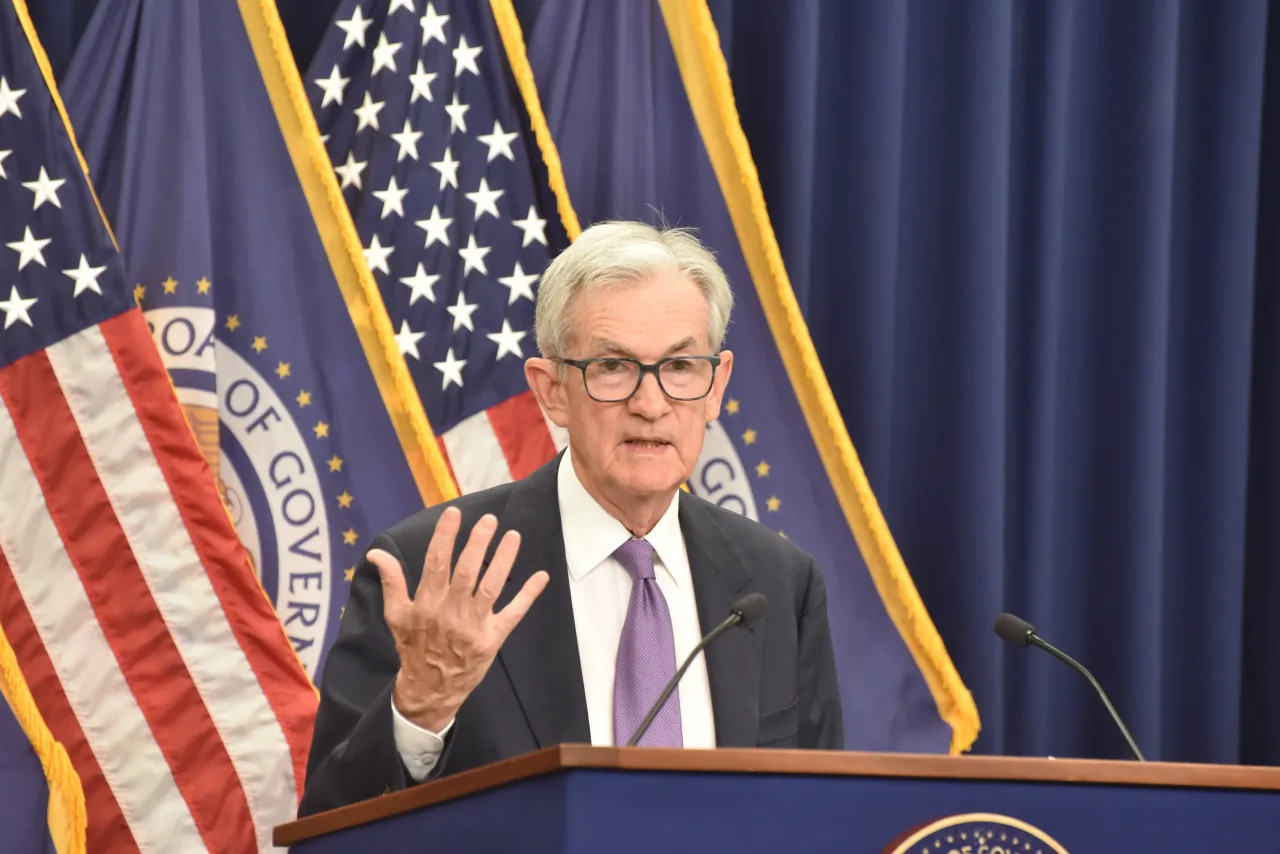


- The Fed Chair added that the central bank’s rate decisions have a lagged impact on the economy, so hiking rates now will not help tame inflation due to the war in Iran.
- Powell added that while it is too early to assess the impact of the energy price shock on the U.S. economy, the Fed’s monetary policy is well-positioned to address it.
- According to the CME FedWatch tool, the probability of the Fed keeping interest rates in the current 3.5% to 3.75% range throughout 2026 ranged from 76% to 97%.
Advertisement|Remove ads.
Federal Reserve Chair Jerome Powell said during an interview at Harvard University’s Principles of Economics class on Monday that the central bank is not facing the question of the impact of the Iran war-induced oil supply shock yet, while adding that the Fed will be mindful of the broader context when it makes a monetary policy decision.
“Inflation expectations do appear to be well anchored beyond the short term, but nonetheless, it's something we will eventually maybe face the question of what to do here. We're not really facing it yet, because we don't know what the economic effects will be,” he said, adding that it is too soon to know how the Iran war will impact the U.S. economy amid a rise in energy prices.

Powell Says Need To Monitor Inflation Expectations
Powell noted that the Fed’s primary tool for controlling interest rates affects demand, not supply. He added that the rise in oil prices is a supply-side shock, while acknowledging that it could affect inflation expectations.
Advertisement|Remove ads.
“You have to carefully monitor inflation expectations because you can have a series of these supply shocks and that can lead the public generally… businesses, price setters, households… lead them to start expecting higher inflation over time,” he added.
Last week, the Organization for Economic Co-operation and Development forecast all-items inflation in the U.S. at 4.2% for 2026, a sharp increase from its previous forecast of 2.8%. The global policy group cited the ongoing war in Iran and President Donald Trump’s tariffs as reasons for its increase in inflation projections.
“The breadth and duration of the conflict are very uncertain, but a prolonged period of higher energy prices will add markedly to business costs and raise consumer price inflation, with adverse consequences for growth,” the OECD stated.
Advertisement|Remove ads.
It expects core inflation, which excludes energy and food prices, to be at 3% in 2026 and 2.4% in 2027.
Fed’s Rate Decisions Have A Lagged Impact On Economy, Says Powell
The Fed Chair added that the central bank’s rate decisions have a lagged impact on the economy, so hiking rates now will not help tame inflation due to the war in Iran.
“By the time the effects of a tightening in monetary policy take effect, the oil price shock is probably long gone, and you’re weighing on the economy at a time when it’s not appropriate. So the tendency is to look through any kind of supply shock,” he added.
Advertisement|Remove ads.
Powell added that while it is too early to assess the impact of the energy price shock on the U.S. economy, the Fed’s monetary policy is well-positioned to address it.
According to the CME FedWatch tool, the probability of the Fed keeping interest rates in the current 3.5% to 3.75% range through 2026 ranged from 76% to 97% across the remaining Federal Open Market Committee (FOMC) meetings this year.
Crude Oil Continues To Inch Up
Crude oil prices gained on Monday, hovering above the $100 a barrel level.
Advertisement|Remove ads.
U.S. West Texas Intermediate (WTI) crude futures maturing in May gained about 4% to hover around $103 per barrel. Brent crude futures expiring in June rose more than 2% to $108 per barrel.
The United States Oil Fund ETF (USO) rose 4%, while the ProShares Ultra Bloomberg Crude Oil ETF (UCO) was up more than 1% at the time of writing.
Meanwhile, U.S. equities were mixed in Monday’s midday trade. At the time of writing, the SPDR S&P 500 ETF (SPY), which tracks the S&P 500 index, was up 0.17%; the Invesco QQQ Trust ETF (QQQ) declined 0.15%; and the SPDR Dow Jones Industrial Average ETF Trust (DIA) gained 0.58%. Retail sentiment on Stocktwits regarding the S&P 500 ETF was in the ‘extremely bearish’ territory.
Advertisement|Remove ads.
For updates and corrections, email newsroom[at]stocktwits[dot]com.
Comments posted here will also appear on symbol pages.

Latest News
/filters:format(webp)https://news.stocktwits-cdn.com/Getty_Images_2228900888_jpg_338103de79.webp)
/filters:format(webp)https://news.stocktwits-cdn.com/Anushka_Basu_make_me_smile_in_the_picture_b92832aa_af59_4141_aacc_4180d2241ba8_1_2_png_1086e0ed8c.webp) Anushka Basu·5h ago
Anushka Basu·5h ago/filters:format(webp)https://news.stocktwits-cdn.com/large_Getty_Images_1767602875_jpg_db2e050c08.webp) Anushka Basu·6h ago
Anushka Basu·6h ago/filters:format(webp)https://news.stocktwits-cdn.com/large_new_york_stock_exchange_jpg_e1f85c0d8c.webp)
/filters:format(webp)https://st-everywhere-cms-prod.s3.us-east-1.amazonaws.com/i_OS_App_Icon_1_8054f2a2fe.png) Stocktwits News Desk·6h ago
Stocktwits News Desk·6h ago/filters:format(webp)https://news.stocktwits-cdn.com/large_grayscale_OG_jpg_c35dc5b1a2.webp) Anushka Basu·7h ago
Anushka Basu·7h ago/filters:format(webp)https://news.stocktwits-cdn.com/large_Google_Office_in_New_York_City_2ff844002a.jpg) Stocktwits News Desk·7h ago
Stocktwits News Desk·7h ago/filters:format(webp)https://news.stocktwits-cdn.com/large_mark_rubio_original_jpg_1e75e0c7f2.webp) Stocktwits News Desk·8h ago
Stocktwits News Desk·8h ago