


Advertisement|Remove ads.
LLY, NVO Stocks Led May’s GLP-1 Rally — But This Smaller ‘Differentiated Player’ Got A Bold 160% Upside Call


- Truist assumed coverage on VKTX with a ‘Buy’ rating and an $83 price target, implying an upside of 162% from current levels.
- Lilly also expanded beyond obesity drugs this week through vaccine deals worth up to $3.8 billion, while late-stage data for Retatrutide showed up to 28% weight loss.
- Meanwhile, Novo Nordisk CEO Mike Doustdar pushed back against the market’s focus on pure weight-loss percentages.
Advertisement|Remove ads.
Eli Lilly (LLY) and Novo Nordisk (NVO) continued dominating the weight loss trade in May, but a fresh bullish analyst call is putting a smaller “differentiated player” back on investors’ radar.
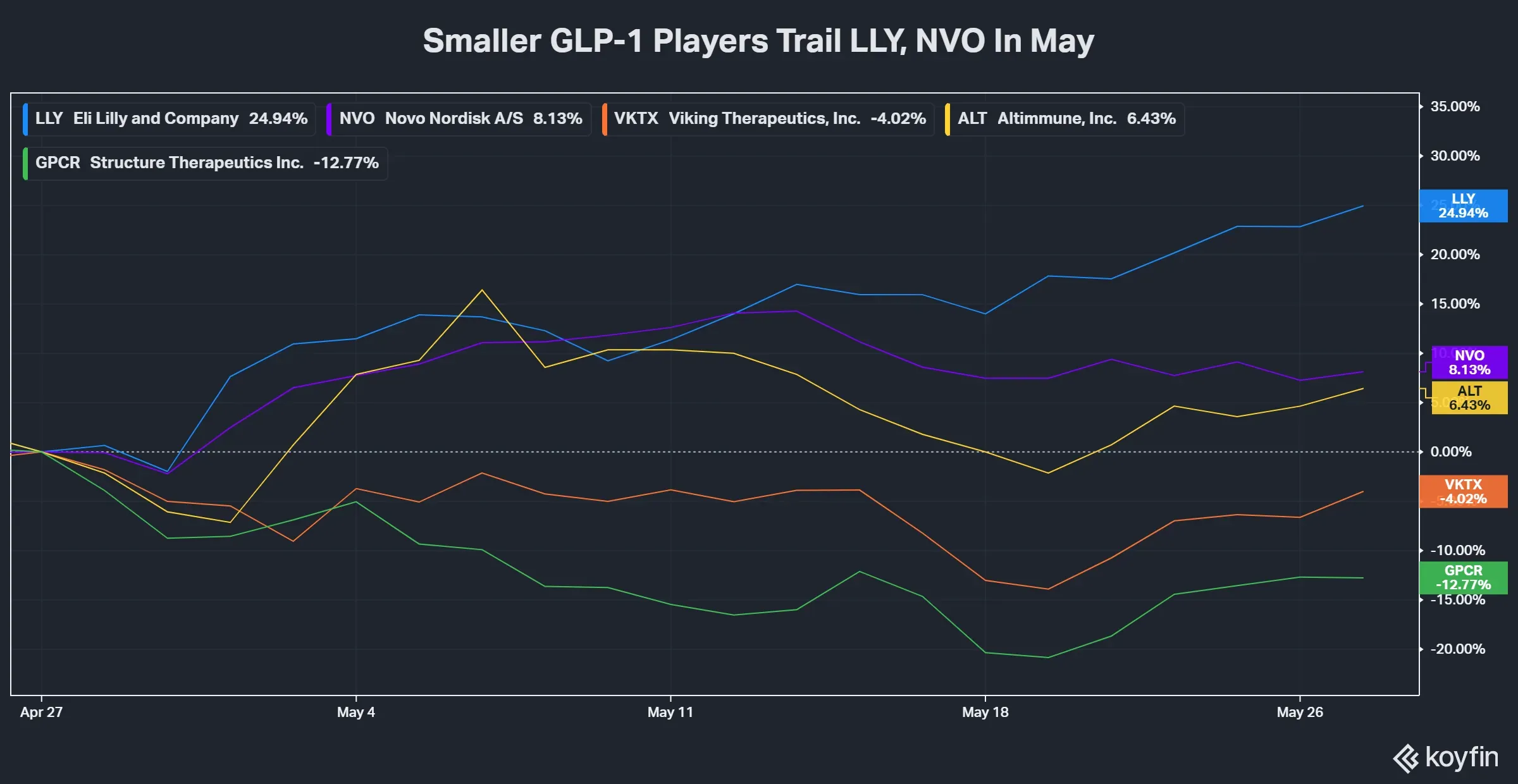
Smaller Obesity Stocks Lag GLP-1 Giants In May
Shares of LLY climbed nearly 25% over the past month, making it the strongest-performing among major obesity-drug stocks as investors continued rewarding the company’s expanding GLP-1 dominance. NVO also jumped 8% during the same period as enthusiasm returned around the company’s obesity pipeline and rapidly growing oral Wegovy rollout.
Smaller obesity-focused players lagged far behind. Viking Therapeutics (VKTX) fell about 4% over the past month, while Structure Therapeutics (GPCR ) dropped 13%. Altimmune (ALT) and Terns Pharmaceuticals (TERN) bucked the trend with gains of 6% and 1%, respectively.
Advertisement|Remove ads.
Now, Viking is now attracting fresh Wall Street attention after Truist assumed coverage with a ‘Buy’ rating and an $83 price target, implying an upside of 162% from current levels.
Truist Sees Viking As A ‘Differentiated Player’
Truist called Viking as a “differentiated player” in what it a “highly saturated” and competitive obesity market. The brokerage said that Viking’s obesity pipeline could help address two major challenges facing next-generation GLP-1 therapies: speed of efficacy and long-term patient adherence.
Advertisement|Remove ads.
Viking’s flagship obesity candidate is VK2735, a dual GLP-1/GIP receptor agonist being developed in both injectable and oral formulations for obesity and metabolic disorders. According to Truist, Viking’s therapies have demonstrated the ability to drive 14.7% weight loss in just 13 weeks, with patients still continuing to lose weight rather than hitting a slowdown point. The firm also said Viking’s plan to develop both injectable and pill-based versions of its treatment could help the company serve a wider range of patients and make long-term treatment easier to maintain.
Truist also highlighted Viking’s flexible dosing and titration strategy, which the firm believes could enable greater personalization while potentially reducing gastrointestinal side effects that continue to affect discontinuation rates across obesity therapies.
Investors Reward LLY’s GLP-1 Momentum
Investor sentiment across the obesity-drug sector remained heavily tilted toward Lilly after another wave of bullish developments from its expanding weight loss franchise. The company briefly crossed the $1 trillion market cap milestone on Wednesday after continuing to benefit from surging demand for Zepbound and Mounjaro.
Advertisement|Remove ads.
Lilly recently raised its 2026 sales outlook after first-quarter revenue jumped 56% to $19.8 billion. CFO Lucas Montarce also said that Lilly plans to continue global obesity-drug launches despite uncertainty around the Trump administration’s proposed Most-Favored-Nation (MFN) drug pricing policy, Bloomberg noted.
Montarce said that obesity competition with Novo is helping expand the broader treatment market rather than simply shifting share between companies. “It would be harder to have only Lilly moving this large class,” Montarce said. “We feel actually having a competitor as well helps to mobilize more patients.”
Attention has additionally shifted toward Lilly’s oral obesity pill Foundayo after the drug received FDA approval in April. Montarce said more than 80% of current demand is coming from new patients rather than existing obesity-drug users.
Advertisement|Remove ads.
This week, Lilly announced deals worth up to $3.8 billion to acquire three vaccine developers as it expands deeper into infectious diseases and long-term healthcare infrastructure. Investor interest for Lilly’s pipeline also intensified after the company’s triple-acting obesity drug Retatrutide showed up to 28% weight loss in late-stage data, potentially setting a new efficacy benchmark across the industry.
Novo Pushes Back Against LLY’s GLP-1 Lead
Novo Nordisk CEO Mike Doustdar Mike Doustdar acknowledged during a recent Wall Street Journal interview that Lilly’s Zepbound gained momentum partly because it pushed efficacy levels beyond earlier obesity therapies.
Still, Doustdar said that the industry’s long-term focus will eventually shift away from pure weight-loss percentages toward broader health outcomes for cardiovascular disease, kidney health and liver conditions.
Advertisement|Remove ads.
“When is the last time you found a single person anywhere that you know of that died from obesity?” Doustdar said. “You die from heart attack. You die from kidney failure. You die from fatty liver.” The Novo CEO also defended the company’s obesity strategy by saying that investors may currently be overfocused on small efficacy differences between competing drugs.
“While today everyone is obsessed with the magnitude of weight loss and 1% or 2% up and down on that moves people's share prices dramatically, I will promise you that five years from now that will be part of the dialogue and not the main part,” Doustdar said.
Novo has increasingly leaned into oral obesity drugs as a major competitive advantage after the launch of its Wegovy pill generated more than 1.3 million prescriptions during the first quarter. Doustdar called Novo the “pill leader in the world” while stressing that many obesity patients prefer pills over injections.
Advertisement|Remove ads.
“There are people that have been waiting and waiting and maybe with envy,” Doustdar said. “They simply didn't want an injection.” The company also announced major U.S. price reductions for Wegovy and Ozempic from next year as Novo attempts to defend market share, while broadening access.
Additionally, Doustdar said that Novo’s obesity pipeline will remain highly competitive, pointing to the company’s triple-agonist candidate UBT251 and saying that early comparative data appear favorable against Lilly’s Retatrutide.
How Do Retail Traders Feel About LLY, NVO, VKTX?
On Stocktwits, retail sentiment around LLY, NVO and VKTX was broadly ‘bearish’, with LLY seeing ‘normal’ message volume, while NVO and VKTX recorded ‘low’ chatter.
Advertisement|Remove ads.
One user said, “Healthcare is going to converge towards s&p and LLY is going up with a multiple. Plenty of up in store!”
Another user said, “$VKTX Officially converted from buyout to gia club. There is simply to much potential here to take 20-30b and call it a day. Especially if we are nearing reta like efficiency with bic tolerability.”
Advertisement|Remove ads.
Over the past year, LLY jumped 50%, while VKTX gained about 16%. NVO, however, fell nearly 35%.
For updates and corrections, email newsroom[at]stocktwits[dot]com.
Advertisement|Remove ads.
Comments posted here will also appear on symbol pages.

Latest News
/filters:format(webp)https://news.stocktwits-cdn.com/large_cathiewood_OG_jpg_a3c8fddb3f.webp)
/filters:format(webp)https://st-everywhere-cms-prod.s3.us-east-1.amazonaws.com/i_OS_App_Icon_1_8054f2a2fe.png) Stocktwits News Desk·48m ago
Stocktwits News Desk·48m ago/filters:format(webp)https://news.stocktwits-cdn.com/Getty_Images_2237643016_jpg_17a9a7eb9d.webp) Stocktwits News Desk·2h ago
Stocktwits News Desk·2h ago/filters:format(webp)https://news.stocktwits-cdn.com/large_trump_putin_jpg_eb42a46830.webp) Stocktwits News Desk·3h ago
Stocktwits News Desk·3h ago/filters:format(webp)https://news.stocktwits-cdn.com/large_Getty_Images_2286326398_84fc8215c8.jpg)
/filters:format(webp)https://news.stocktwits-cdn.com/Prabhjote_DP_67623a9828.jpg) Prabhjote Gill·3h ago
Prabhjote Gill·3h ago/filters:format(webp)https://news.stocktwits-cdn.com/large_Getty_Images_2162497795_jpg_c07f3aa255.webp)
/filters:format(webp)https://news.stocktwits-cdn.com/vivekkrishnanphotography_58_jpg_0e45f66a62.webp) Arnab Paul·5h ago
Arnab Paul·5h ago/filters:format(webp)https://news.stocktwits-cdn.com/large_Getty_Images_2250139725_0ccee3701a.jpg)
/filters:format(webp)https://news.stocktwits-cdn.com/unnamed_jpg_9dff551b50.webp) Anan Ashraf·6h ago
Anan Ashraf·6h ago