


Advertisement|Remove ads.
Meta Lost Its Mojo This Year — Can Zuckerberg Restore Investor Trust In 2026?



- Massive data-center investments underpin Meta’s AGI ambitions, yet lagging LLM performance and rising capex continue to test investor patience.
- Despite underperforming most Magnificent Seven peers, Meta trades at a relative discount.
- Wall Street is broadly bullish even as retail sentiment stays cautious.
Advertisement|Remove ads.
As Meta Platforms, Inc.’s (META) challenging year draws to a close, investors also hope its struggles will finally come to an end. Despite the high-profile launch of its Super Intelligence division and aggressive poaching of elite artificial intelligence (AI) talent, Meta failed to assuage investor doubts over the payoff from its heavy AI spending. Market chatter about the company padding its financials by extending the shelf life of its data center assets exacerbated the weakness.
Even though Meta’s stock is up nearly 13% this year, it trails five of its Magnificent Seven peers—outperforming only Amazon (AMZN) and Apple (AAPL). For a stock that ranked as the second-best performer behind Nvidia in 2024 with a 64% gain, that relative showing is underwhelming.

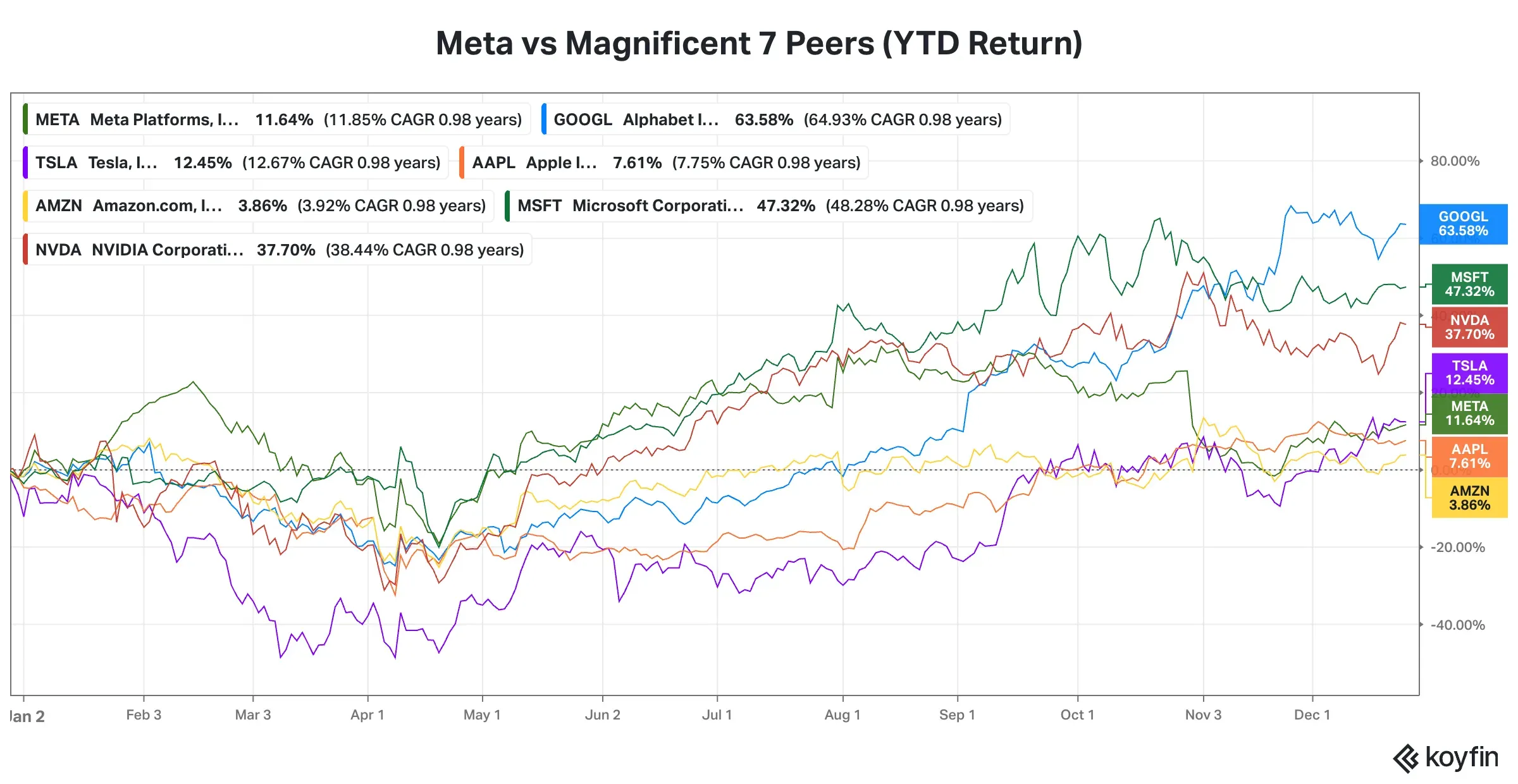 Source: Koyfin
Advertisement|Remove ads.
Where Meta Erred
The Mark Zuckerberg-led company continued to grow revenue at a pace that invariably exceeded market expectations as the ad market recovery took a firm hold. The first quarter saw a deceleration in the year-over-year (YoY) revenue growth, but since then, the topline has grown at an accelerated rate. The third quarter’s revenue marked a record number for Meta.
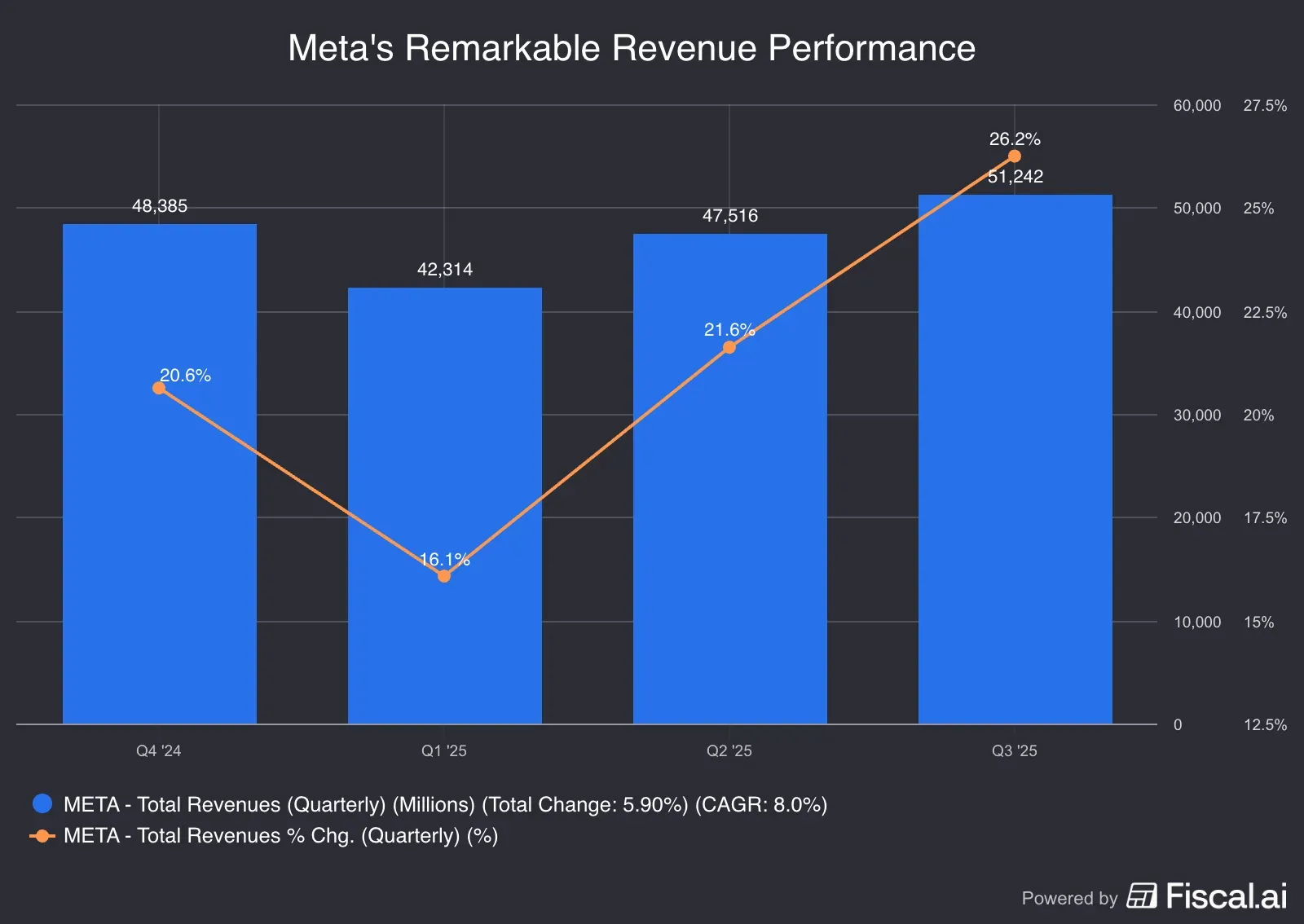
Source: Fiscal.ai
Advertisement|Remove ads.
After growing at a reasonably healthy rate, the bottom line plummeted in the September quarter, dropping 82.7%, dragged by the impact of President Donald Trump’s “One Big Beautiful” tax bill—this visibly upset investors. After disclosing the quarterly results, the stock shed a whopping 11% in a single session. This is despite the company appeasing investors by stating that additional provisioning will significantly reduce its tax bill for the remainder of 2025 and the subsequent years.
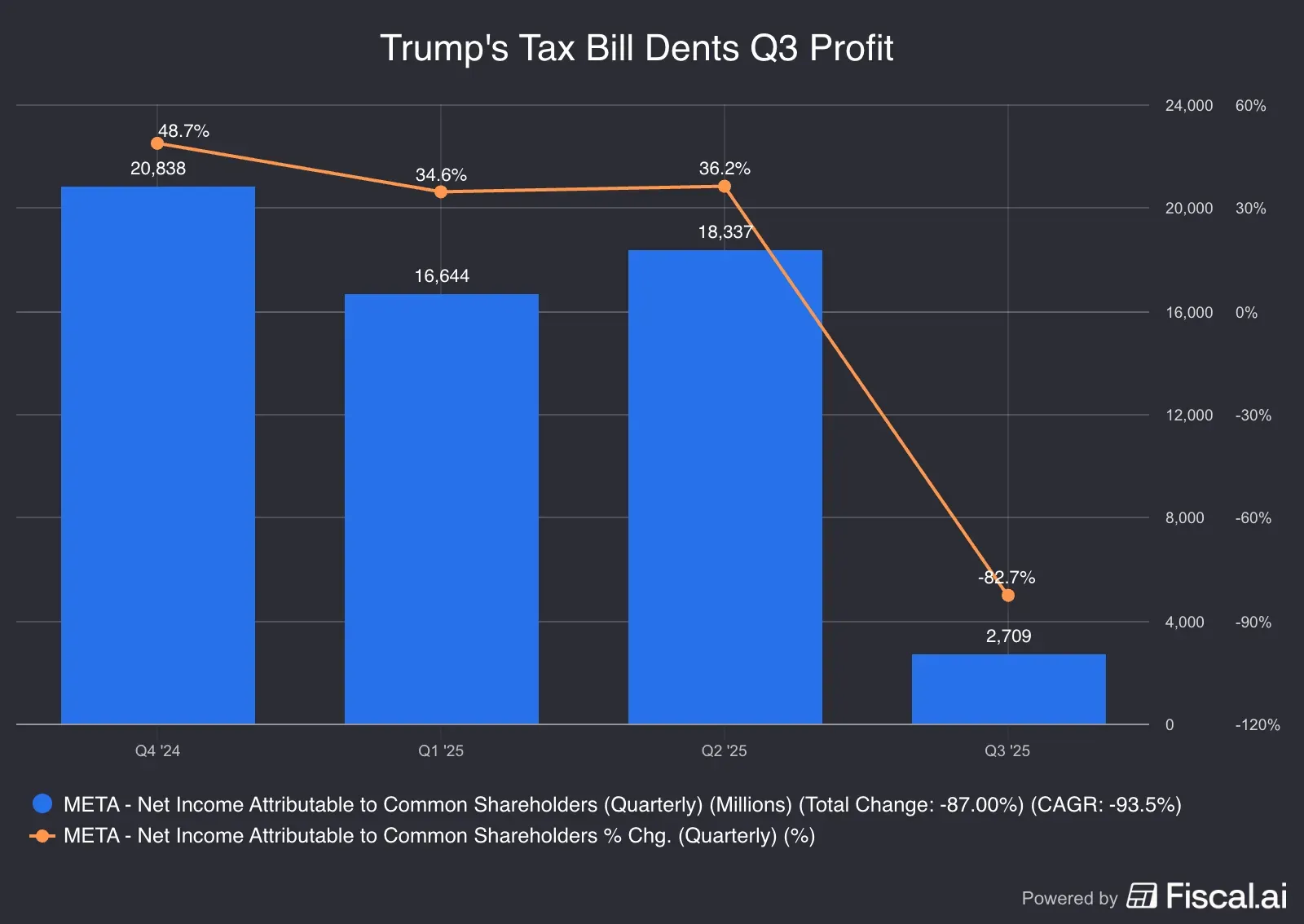
Source: Fiscal.ai.
Advertisement|Remove ads.
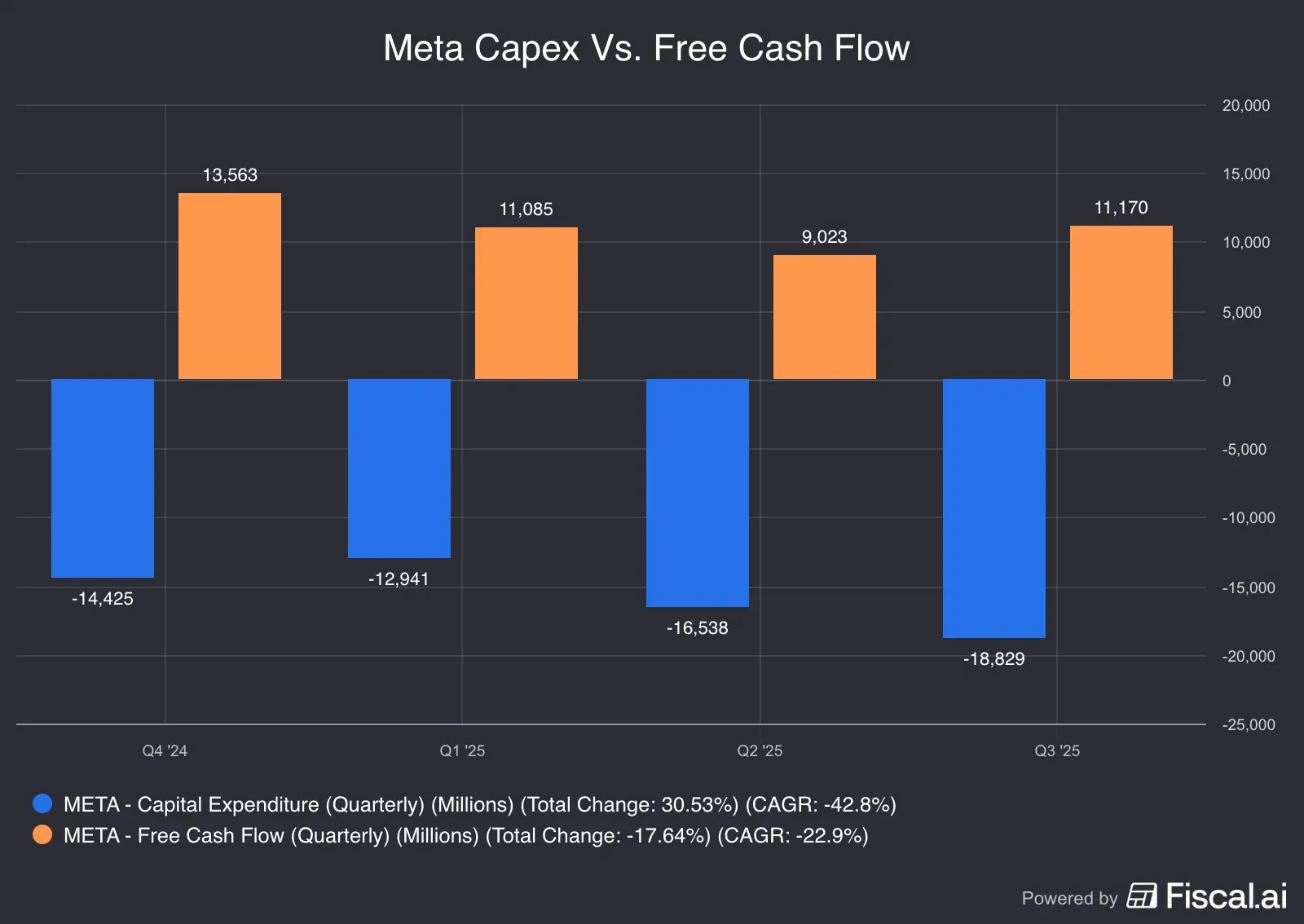
More concerning for investors is Meta’s capital spending, which is rising as it invests in data centers. For 2025, the company expects capex to surge to $70 billion to $72 billion. Zuckerberg has committed to investing at least $600 billion in the U.S. toward building data centers. According to its website, Meta operates 30 data centers, including one each in Ireland and Denmark.
Heavy investment in data centers is critical to staying competitive in the artificial intelligence race, particularly for training large language models, as Meta pursues its longer-term goal of achieving artificial general intelligence (AGI). The company’s in-house llama LLM, although initially creating a splash, has lagged behind offerings from rivals such as Alphabet.
Advertisement|Remove ads.
Source: Fiscal.ai
Meta Cheapest Among Mag 7s
The year’s lackadaisical showing has made Meta’s stock attractive within the Magnificent Seven group. Its forward price-earnings (P/E) multiple is at 22.69.
Advertisement|Remove ads.
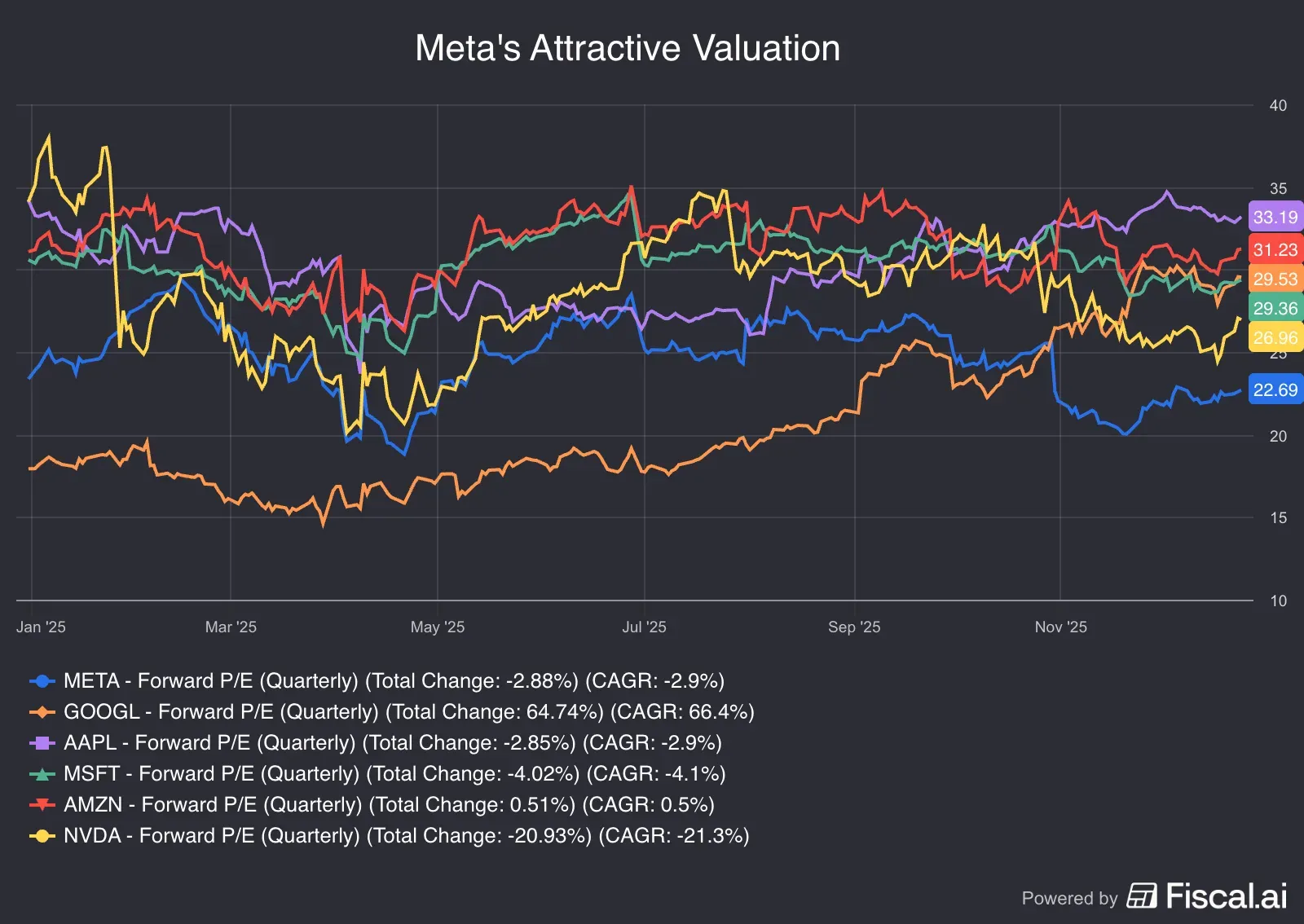
Source: Fiscal.ai
Morgan Stanley analyst Brian Nowak, who has an ‘Overweight’ rating and $750 price target for the stock, outlined three catalysts that underpin the bullish thesis for Meta stock. Revenue revisions, a 2026 operating expenses under $155 billion, and models & monetization nodes from the Superintelligence team will drive outperformance, he said.
Advertisement|Remove ads.
Nowak believes that investors are underappreciating the company’s revenue runway and innovation.
“META remains one of a handful of companies that can leverage its leading data, distribution and investments in AI to drive earnings power and tech leadership.”
Wedbush analysts also echoed a similar sentiment. In a note released earlier this month, the analysts said additional cost discipline could provide upside. Nevertheless, Meta is the firm’s top advertising pick for 2026, as it remains well positioned to benefit from resilient digital ad trends, strong adoption of Advantage+, and monetization of new channels.
What Retail Feels About META
Despite Meta now trading at more affordable levels, retail investors are a little jittery about the stock prospects. On Stockwits, retail sentiment toward the stock was ‘bearish’ as of early Friday. The mood has remained downbeat for much of the year.
Advertisement|Remove ads.
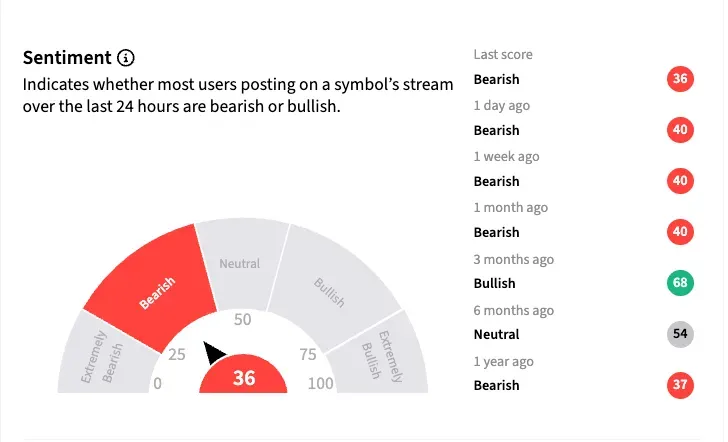
According to Koyfin, 90% of the 67 analysts covering the stock have Buy-equivalent ratings, while the remaining analysts are on the sidelines. The average analyst price target for the stock is $837.15, implying roughly 25% upside from current levels.
For updates and corrections, email newsroom[at]stocktwits[dot]com.
Read Next: Lucid’s Moment Of Truth: Luxury EV Hype Meets A Brutal Market — Is The Low-Price Pivot Enough?
Advertisement|Remove ads.
Comments posted here will also appear on symbol pages.

Latest News
/filters:format(webp)https://st-everywhere-cms-prod.s3.us-east-1.amazonaws.com/large_broadcom_hq_resized_8d2f55c61f.jpg)
/filters:format(webp)https://news.stocktwits-cdn.com/Harshita_3cfe02022c.jpg) Harshita Tyagi·21m ago
Harshita Tyagi·21m ago/filters:format(webp)https://news.stocktwits-cdn.com/large_spacex_jpg_0ee570830f.webp)
/filters:format(webp)https://news.stocktwits-cdn.com/vivekkrishnanphotography_58_jpg_0e45f66a62.webp) Arnab Paul·25m ago
Arnab Paul·25m ago/filters:format(webp)https://news.stocktwits-cdn.com/large_circle_stablecoins_original_jpg_b238d12be8.webp)
/filters:format(webp)https://news.stocktwits-cdn.com/Anushka_Basu_make_me_smile_in_the_picture_b92832aa_af59_4141_aacc_4180d2241ba8_1_2_png_1086e0ed8c.webp) Anushka Basu·30m ago
Anushka Basu·30m ago/filters:format(webp)https://news.stocktwits-cdn.com/gettyimages_2206659974_594x594_40ea0c533e.jpg) Harshita Tyagi·1h ago
Harshita Tyagi·1h ago/filters:format(webp)https://news.stocktwits-cdn.com/large_Getty_Images_2237640344_jpg_bc97a7240c.webp) Anushka Basu·2h ago
Anushka Basu·2h ago/filters:format(webp)https://news.stocktwits-cdn.com/large_Getty_Images_2290038559_c6f6528203.jpg)
/filters:format(webp)https://news.stocktwits-cdn.com/Whats_App_Image_2026_05_11_at_09_45_43_1_jpeg_a08c0cf251.webp) Aveek Bhowmik·2h ago
Aveek Bhowmik·2h ago