


Advertisement|Remove ads.
META’s Zuckerberg, Wang Push Back On Calls To Slow AI Progress: ‘Alignment’ Could Set Leaders Apart
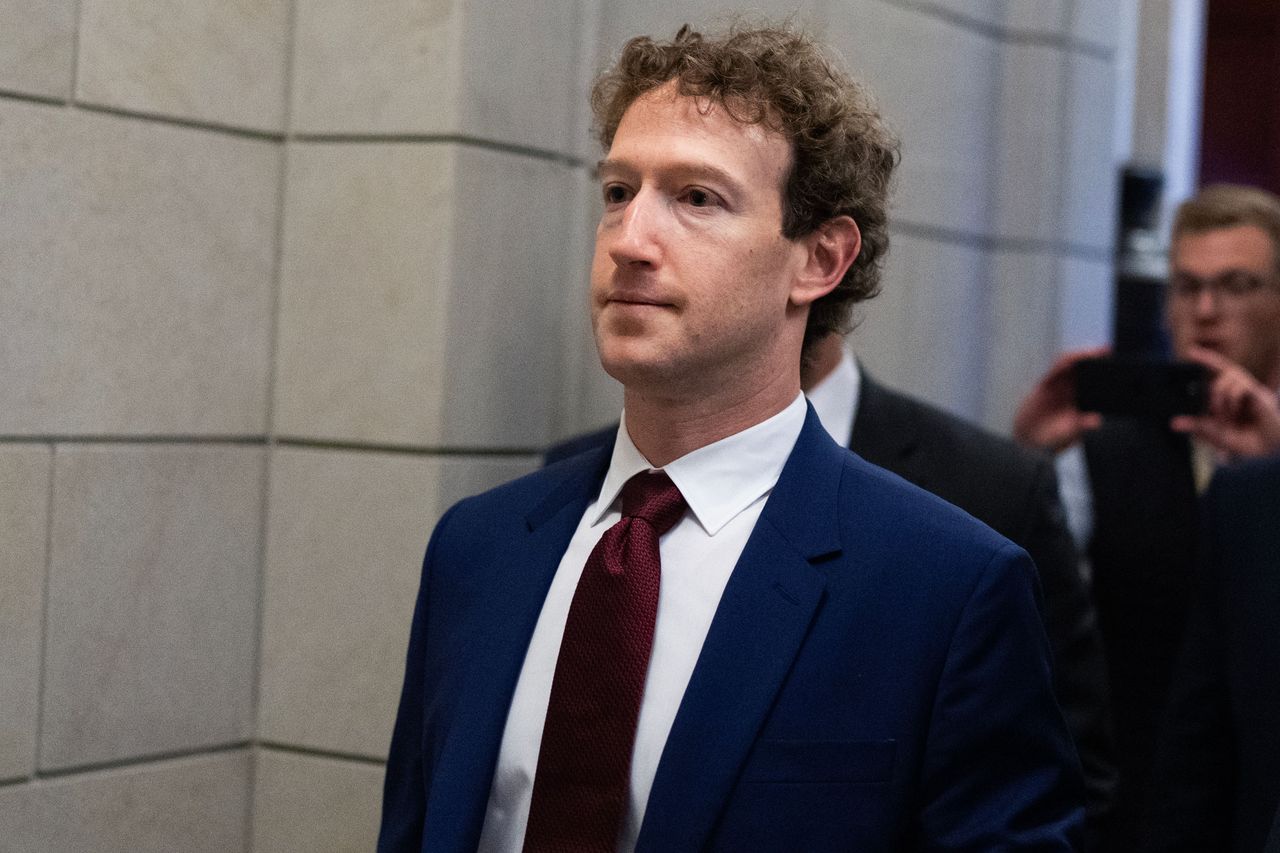

- Mark Zuckerberg said safety and alignment can become competitive advantages for AI labs.
- Meta backed independent oversight and stronger governance as models grow more capable.
- Meta said directing compute toward serving users, rather than recursive self-improvement, can reduce risks.
Advertisement|Remove ads.
Meta Platforms CEO Mark Zuckerberg and AI chief Alexandr Wang weighed in on the growing debate over how quickly AI development should proceed, arguing that AI labs should continue advancing while building stronger safeguards around increasingly capable models.
Their comments, posted on X, come amid a broader industry debate over whether AI capability development should be slowed until the industry makes more progress on AI safety — ensuring AI systems reliably follow human intentions and values.
META shares climbed for three straight sessions through Tuesday, rising 4.2%, and rose marginally in the overnight session. On Stocktwits, the retail sentiment for the stock was ‘extremely bearish’ at the last check.
Advertisement|Remove ads.
Zuckerberg Says Labs Have Incentives To Build Safer AI
Zuckerberg said AI companies already have strong commercial and legal incentives to make their models safe and aligned with users.
“People won’t want to use agents that are misaligned with them and that don’t do what they ask,” Zuckerberg wrote. “Any lab that doesn’t focus on alignment will fall behind.”
He argued that alignment itself is becoming an important competitive capability rather than simply a constraint on AI development. “My view is that trust and alignment are quickly becoming the most important capabilities that will differentiate agents and models,” he said.
Advertisement|Remove ads.
Zuckerberg also pointed to Meta’s decision to delay the release of its Muse model for several months while the company worked on safety and security.
Meta Backs External Oversight
Both Zuckerberg and Wang called for greater use of independent evaluators and external oversight as AI models become more powerful.
“Engaging independent evaluators and advisors is industry best practice,” Zuckerberg said, arguing that a larger and more diverse ecosystem of evaluators would improve AI safety work.
Advertisement|Remove ads.
Wang similarly said AI labs should maintain “a strong governance framework across training and deployment,” including external evaluators and independent oversight over safety criteria for model launches.
Wang added: “Every lab will need to operate within institutional protections of democratic countries… This means labs face significant liability if their models cause harm.”
Meta Defends Compute Allocation Strategy
A key part of the executives’ arguments was Meta’s decision to direct most of its computing resources toward serving users rather than accelerating recursive self-improvement, or RSI.
Advertisement|Remove ads.
“Committing the significant majority of compute towards serving people rather than racing towards recursive self-improvement is one of the best ways to ensure we develop this technology safely,” Zuckerberg said.
The concern is that RSI could allow AI systems to rapidly improve their own capabilities, potentially outpacing human oversight and increasing the risk of losing control over powerful models.
Wang similarly described racing toward RSI as “one of the riskiest pathways for potential loss of control to powerful models.”
Advertisement|Remove ads.
AI Pacing Debate Leaves Tech Industry Polarized
The AI pacing debate has broadly split between Anthropic CEO Dario Amodei, who is calling for frontier AI development to be slowed so safety mechanisms can catch up, and OpenAI CEO Sam Altman, Microsoft CEO Satya Nadella and SpaceX’s Elon Musk, who support more deliberate, safety-focused progress without stopping development.
On the other side, President Donald Trump has argued against slowing the U.S. AI race because of the risk of China pulling ahead, while former Trump AI adviser David Sacks says companies should control their own risks rather than seek government restrictions and has challenged Anthropic’s safety warnings.
Investor Michael Burry questioned whether calls for slower development are partly self-serving because they could protect incumbent AI companies from competition.
Advertisement|Remove ads.
For updates and corrections, email newsroom[at]stocktwits[dot]com.
Read Next: QCOM Stock Climbs To 2-Month High As AI Data Center Push Gains Momentum
Advertisement|Remove ads.
Comments posted here will also appear on symbol pages.

Latest News
/filters:format(webp)https://news.stocktwits-cdn.com/large_Getty_Images_2233517117_jpg_13b62b29bf.webp)
/filters:format(webp)https://news.stocktwits-cdn.com/IMG_9209_1_d9c1acde92.jpeg) Yuvraj Malik·32m ago
Yuvraj Malik·32m ago/filters:format(webp)https://news.stocktwits-cdn.com/large_fannie_may_freddie_mac_original_jpg_57a9af4a40.webp)
/filters:format(webp)https://news.stocktwits-cdn.com/IMG_8805_JPG_6768aaedc3.webp) Deepti Sri·52m ago
Deepti Sri·52m ago/filters:format(webp)https://news.stocktwits-cdn.com/large_Getty_Images_2271642541_ab87f34621.jpg)
/filters:format(webp)https://news.stocktwits-cdn.com/shivani_photo_jpg_dd6e01afa4.webp) Shivani Kumaresan·1h ago
Shivani Kumaresan·1h ago/filters:format(webp)https://news.stocktwits-cdn.com/large_Getty_Images_2236098091_188b3aa768.jpg)
/filters:format(webp)https://news.stocktwits-cdn.com/Aashika_Suresh_Profile_Picture_jpg_2acd6f446c.webp) Aashika Suresh·1h ago
Aashika Suresh·1h ago/filters:format(webp)https://news.stocktwits-cdn.com/large_Getty_Images_2267943764_c23e49e724.jpg) Yuvraj Malik·2h ago
Yuvraj Malik·2h ago/filters:format(webp)https://news.stocktwits-cdn.com/large_Getty_Images_2043993986_9bb32b86c7.jpg) Aashika Suresh·3h ago
Aashika Suresh·3h ago