


Advertisement|Remove ads.
NVDA Stock Hits Record High After Morgan Stanley Names Nvidia Top Pick, Says AI Trends Play To Its ‘Strengths’


- Morgan Stanley reinstated Nvidia as its ‘Top Pick’ in semiconductors after meetings with CEO Jensen Huang and CFO Colette Kress.
- Morgan Stanley noted Nvidia’s diverse customer base, including traditional hyperscalers and frontier AI labs, as well as its focus on increasing revenue per gigawatt of power deployed.
- The firm said developments around land, power, data center shells, financing and component constraints “all play to their strengths” and support Nvidia’s position in AI infrastructure.
Advertisement|Remove ads.
Nvidia (NVDA) shares gained in morning trade on Friday to hit a fresh record high after Morgan Stanley reinstated the stock as its ‘Top Pick’ in the semiconductor sector following investor meetings with CEO Jensen Huang and CFO Colette Kress, with analysts pointing to several trends that “all play to their strengths.”
Morgan Stanley maintained an ‘Overweight’ rating and a $300 price target on Nvidia in a note to investors cited by TheFly. The firm said meetings with Huang and Kress reinforced its view of Nvidia’s positioning across a rapidly expanding AI infrastructure market.

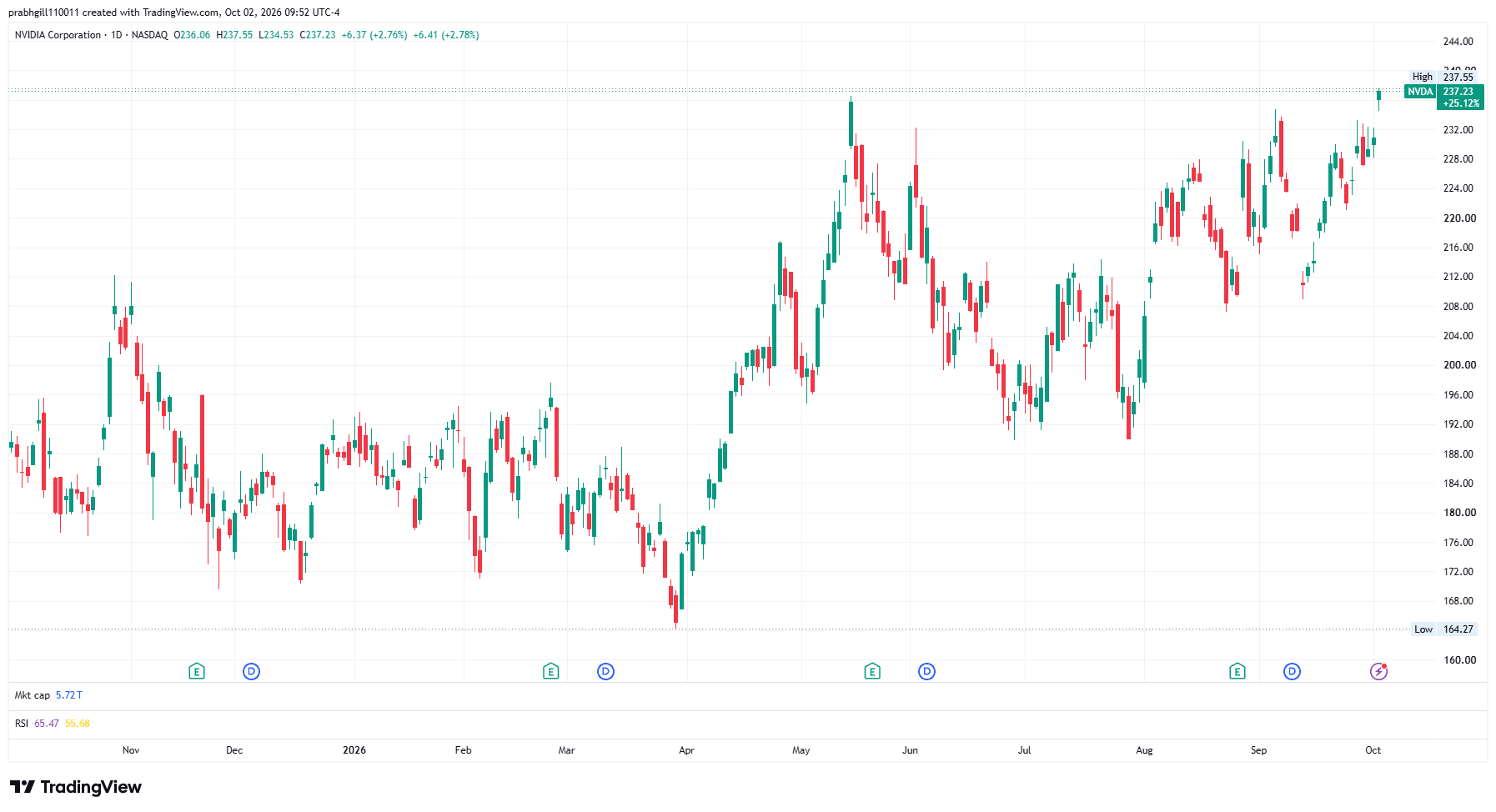
NVDA stock rose as much as 2.5% after the opening bell on Friday to hit an all-time high of over $237 and ranked among the top-trending tickers on Stocktwits. This is the stock's first new record high since May.
Advertisement|Remove ads.
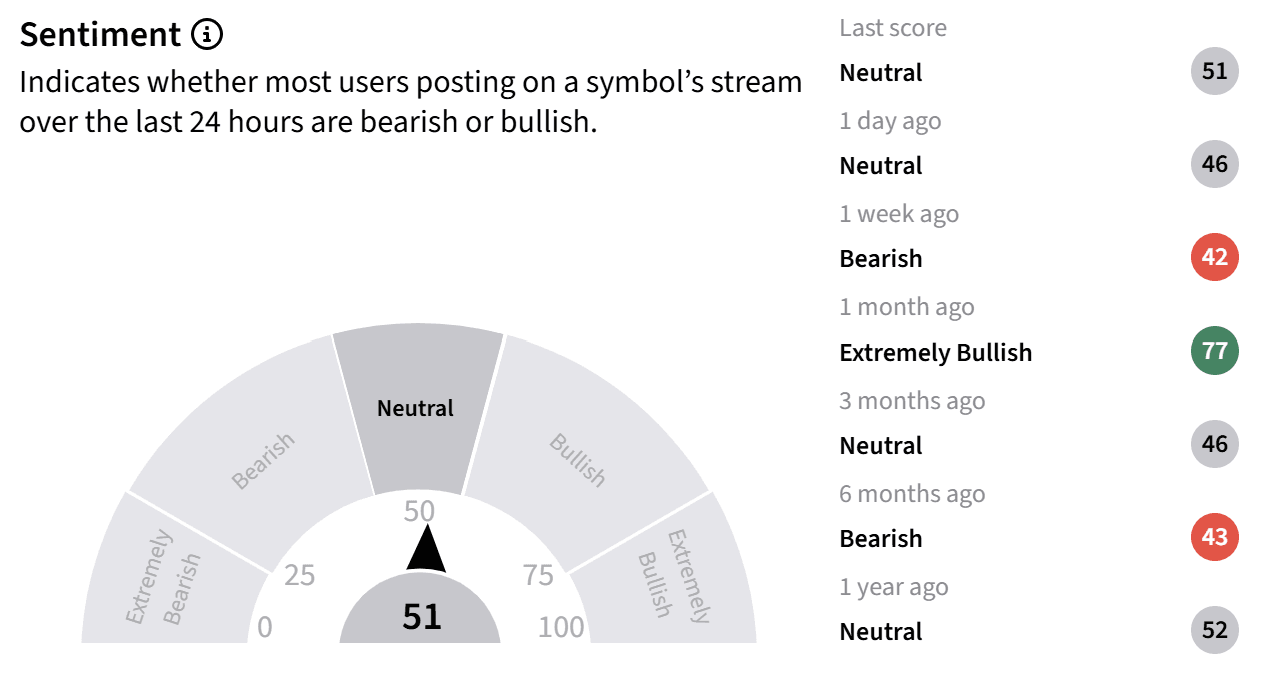
Retail sentiment around the AI bellwether trended in ‘neutral’ territory over the past day, accompanied by ‘normal’ levels of chatter.
Nvidia Sees Broader AI Customer Base
Morgan Stanley stated that one of the key takeaways from the investor meetings was the diversity of Nvidia’s customer base, with growth continuing among traditional hyperscalers and frontier AI labs. It added that Nvidia was also focused on increasing revenue generated from each gigawatt of power deployed for AI infrastructure.
Morgan Stanley pointed to recent developments across land, power and data center shells, along with financing and component constraints, as factors shaping the next phase of the AI infrastructure buildout.
Advertisement|Remove ads.
The firm said its broader view is that these developments “all play to their strengths,” supporting Nvidia’s position across the AI computing stack.
Barclays Points To $401B Nvidia Hyperscaler Revenue
On Thursday, Barclays analyst Tom O’Malley said Nvidia’s hyperscaler revenue could potentially run well above the firm’s current estimates, using “napkin math” based on Nvidia’s latest IT spending data.
His calculations point to roughly $237 billion in hyperscaler revenue in 2026 and $401 billion in 2027, compared with Barclays’ existing estimates of $206 billion and $370 billion, respectively. In an upside scenario, O’Malley sees revenue reaching $246 billion in 2026 and $417 billion in 2027.
Advertisement|Remove ads.
The calculation may also understate the potential opportunity because the capex comparison excludes SpaceX (SPCX), according to O’Malley. That means Nvidia’s implied hyperscaler revenue could be higher if SpaceX’s spending is included.
AI Spending Draws Strategic Capital
The scale of the AI buildout is also showing up in the amount of capital flowing into the companies driving demand for Nvidia’s infrastructure.
SoftBank (SFTBY) completed its final $10 billion investment in its $30 billion commitment to OpenAI’s latest funding round, according to The Information. Nvidia has also completed its final $10 billion investment, showcasing the size of the strategic capital backing OpenAI and its plans to expand AI infrastructure.
Advertisement|Remove ads.
The financing activity comes alongside new efforts to fund the growing cost of AI hardware. Amazon (AMZN) is reportedly exploring a structure that could involve roughly $8 billion of Nvidia chips, according to the Financial Times. The company has held discussions with investors about moving Grace Blackwell chips in its data centers into a special-purpose vehicle that would then lease the hardware back to Amazon.
The structure would allow Amazon to raise capital against AI infrastructure while continuing to use the Nvidia chips in its data centers.
NVDA stock has gained over 23% year-to-date.
Advertisement|Remove ads.
Read also: Micron CEO Says ‘We Cannot Fulfill The Demand’ As Supply Tightness Extends Through 2028
For updates and corrections, email newsroom[at]stocktwits[dot]com.
Comments posted here will also appear on symbol pages.

Latest News
/filters:format(webp)https://news.stocktwits-cdn.com/gettyimages_2228663934_594x594_97e3b13d04.jpg)
/filters:format(webp)https://news.stocktwits-cdn.com/Heera_1_1c30cb0170.PNG) Heera Hari·24m ago
Heera Hari·24m ago/filters:format(webp)https://news.stocktwits-cdn.com/large_Getty_Images_2294072315_5f0a29cff4.jpg)
/filters:format(webp)https://news.stocktwits-cdn.com/Prabhjote_DP_67623a9828.jpg) Prabhjote Gill·30m ago
Prabhjote Gill·30m ago/filters:format(webp)https://news.stocktwits-cdn.com/large_Getty_Images_2241292402_jpg_9661b0c852.webp)
/filters:format(webp)https://news.stocktwits-cdn.com/vivekkrishnanphotography_58_jpg_0e45f66a62.webp) Arnab Paul·1h ago
Arnab Paul·1h ago/filters:format(webp)https://news.stocktwits-cdn.com/gettyimages_2292585020_594x594_cb12bc8682.jpg)
/filters:format(webp)https://news.stocktwits-cdn.com/Harshita_3cfe02022c.jpg) Harshita Tyagi·2h ago
Harshita Tyagi·2h ago/filters:format(webp)https://st-everywhere-cms-prod.s3.us-east-1.amazonaws.com/large_american_airlines_resized_546ba616ea.jpg) Heera Hari·2h ago
Heera Hari·2h ago/filters:format(webp)https://news.stocktwits-cdn.com/large_Getty_Images_2300447831_383f41fb7f.jpg) Prabhjote Gill·2h ago
Prabhjote Gill·2h ago