


Advertisement|Remove ads.
Pentagon Hikes Iran War Cost Estimate To $29B So Far — Bernie Sanders Had Said It Could Spiral To Over $1 Trillion



- Secretary of War Pete Hegseth stated that the Department of War will share more formal accounting of the costs of the Iran war “when it’s relevant.”
- In response to a question from House Democratic Caucus Chair Pete Aguilar, Hegseth stated that the ceasefire with Iran remains in effect and that negotiations with the Iranian regime are ongoing to reach a settlement.
- He also said the U.S. could revive Project Freedom if necessary, a day after President Donald Trump said he was considering the move.
Advertisement|Remove ads.
The U.S. war on Iran has cost about $29 billion so far, according to a senior Pentagon official, representing an increase of $4 billion compared to an estimate provided at the end of April this year.
“At the time of the testimony, it was $25 billion. But the Joint Staff team and the Comptroller team are constantly looking at their estimates, and so now we think it’s close to $29 billion,” Jules Hurst, Under Secretary of Defense (Comptroller), Department of War, told lawmakers during a House Armed Services Committee hearing on Tuesday.
Hurst said the updated estimate reflects the revised repair and replacement costs for equipment, as well as general operational costs to keep personnel on duty.
Advertisement|Remove ads.
Hegseth Says Formal Numbers Will Be Shared ‘When It’s Relevant’
Secretary of War Pete Hegseth stated that the Department of War will share more formal accounting of the costs of the Iran war “when it’s relevant.”
In response to a question from House Democratic Caucus Chair Pete Aguilar, Hegseth stated that the ceasefire with Iran remains in effect and that negotiations with the Iranian regime are ongoing to reach a settlement.
He also said the U.S. could revive Project Freedom if necessary, a day after President Donald Trump said he was considering the move.
Advertisement|Remove ads.
“The theory of the entire case is to prevent Iran from having a nuclear weapon, and if that has to be done kinetically and militarily, the Department of War is locked and loaded and ready to do that,” he said.
Bernie Sanders Says Iran War Could Cost Over $1 Trillion
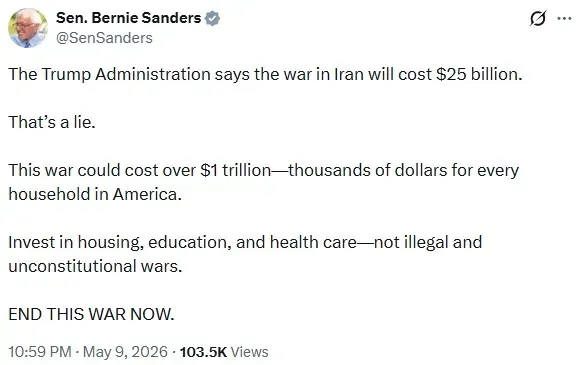
Meanwhile, Senator Bernie Sanders stated in a post on X last week that the Iran war could cost the U.S. more than $1 trillion, calling the Trump administration’s estimates a lie.
“This war could cost over $1 trillion—thousands of dollars for every household in America. Invest in housing, education, and health care—not illegal and unconstitutional wars,” Sanders said, while calling for an end to the Iran war.
Advertisement|Remove ads.
The Trump administration had previously estimated that the first six days of the war cost the U.S. $11.3 billion.
Crude Oil Prices Continue To Rise
Crude oil prices continued to rise on Tuesday following a surge the previous day. U.S. West Texas Intermediate (WTI) crude futures expiring in June were up nearly 4%, hovering around $102 a barrel. Brent crude futures expiring in July gained about 4% to hover around $108 a barrel.
The United States Oil Fund ETF (USO) rose about 4%, while the ProShares Ultra Bloomberg Crude Oil ETF (UCO) was up nearly 5%.
Advertisement|Remove ads.
Meanwhile, U.S. equities declined in Tuesday morning’s trade. At the time of writing, the SPDR S&P 500 ETF (SPY), which tracks the S&P 500 index, was down 0.58%; the Invesco QQQ Trust ETF (QQQ) fell 1.02%; and the SPDR Dow Jones Industrial Average ETF Trust (DIA) declined 0.6%. Retail sentiment on Stocktwits regarding the S&P 500 ETF was in the ‘bullish’ territory.
Also See: CPI Report: Annual Inflation Rate Comes In At 3.8% In April, Highest Since 2023
For updates and corrections, email newsroom[at]stocktwits[dot]com.
Advertisement|Remove ads.
Comments posted here will also appear on symbol pages.

Latest News
/filters:format(webp)https://news.stocktwits-cdn.com/large_Getty_Images_2203983775_jpg_74bdd5dd43.webp)
/filters:format(webp)https://st-everywhere-cms-prod.s3.us-east-1.amazonaws.com/i_OS_App_Icon_1_8054f2a2fe.png) Stocktwits News Desk·20m ago
Stocktwits News Desk·20m ago/filters:format(webp)https://news.stocktwits-cdn.com/large_michael_burry_cropped_b787ce89b4.jpg) Stocktwits News Desk·1h ago
Stocktwits News Desk·1h ago/filters:format(webp)https://news.stocktwits-cdn.com/large_Getty_Images_2183659586_0929f742b5.jpg)
/filters:format(webp)https://news.stocktwits-cdn.com/Anushka_Basu_make_me_smile_in_the_picture_b92832aa_af59_4141_aacc_4180d2241ba8_1_2_png_1086e0ed8c.webp) Anushka Basu·1h ago
Anushka Basu·1h ago/filters:format(webp)https://news.stocktwits-cdn.com/large_Federal_Reserve_a31f9e5606.jpg) Stocktwits News Desk·2h ago
Stocktwits News Desk·2h ago/filters:format(webp)https://news.stocktwits-cdn.com/large_circle_stablecoins_original_jpg_b238d12be8.webp) Anushka Basu·3h ago
Anushka Basu·3h ago/filters:format(webp)https://news.stocktwits-cdn.com/large_mohamed_el_erian_jpg_4608eef11b.webp) Stocktwits News Desk·3h ago
Stocktwits News Desk·3h ago