


Advertisement|Remove ads.
RKLB Stock Slips Overnight: Rocket Lab Protests Blue Origin’s $700M NASA Mars Deal, Calls Review ‘Punitive’


- The company said NASA’s assessment contained “incorrect assertions and conclusions” and called for procurement standards protecting fair competition.
- Blue Origin must deliver the single Mars communications orbiter by Dec.31, 2028, with operations expected by the end of 2030.
- Rocket Lab had highlighted its Explorer platform and NASA’s Escapade spacecraft as evidence of its ability to deliver the Mars mission.
Advertisement|Remove ads.
Shares of Rocket Lab (RKLB) slipped in overnight trading after the space company formally challenged NASA’s decision to select Blue Origin for the $700 million Mars Telecommunications Network, alleging that the award violated congressionally mandated eligibility criteria and followed an inconsistent, “punitive” technical review.
RKLB stock closed 2% higher at $62.95 on Friday but fell 2% for the week, marking its fifth consecutive weekly loss.
Rocket Lab Files NASA Protest
Rocket Lab said it filed a protest with the U.S. Government Accountability Office, arguing that NASA unfairly evaluated its proposal and may have disregarded eligibility rules set by Congress. “NASA’s award decision appears to be inconsistent with the eligibility criteria mandated by Congress,” Rocket Lab said on X. The company added that NASA’s “punitive review” of its technical submission resulted in “incorrect assertions and conclusions.”
Advertisement|Remove ads.
“Procurement standards exist to ensure fair competition and protect public investment,” it said. “We are pursuing this review to ensure those standards are upheld for critical infrastructure that will underpin American exploration at Mars for decades to come.”
Rocket Lab Questions Bid Rules
Congress appropriated $700 million in July 2025 for a high-performance Mars telecommunications orbiter. Eligible bidders had to be U.S. commercial providers that received NASA funding in fiscal 2024 or 2025 for a commercial Mars Sample Return study and proposed a separate, independently launched telecommunications orbiter.
Rocket Lab has said its lower-cost Mars Sample Return architecture included a dedicated communications orbiter and claimed it was the only commercial bidder to propose such a standalone spacecraft. Blue Origin also received NASA study funding, but the agency has not publicly released the companies’ full proposals or detailed how each bidder met the statutory conditions.
Advertisement|Remove ads.
Blue Origin Wins Mars Contract
NASA selected Blue Origin to design, build, launch and operate the Mars Telecommunications Network under a firm-fixed-price contract. The spacecraft must be delivered by Dec.31, 2028, with operations at Mars expected by the end of 2030.
Despite its name, the initial network will consist of a single orbiter providing communications and navigation services for future robotic missions, a potential Mars Sample Return campaign and eventual human exploration. The need is pressing since NASA’s primary Mars relay spacecraft are decades old: Mars Odyssey launched in 2001, while the Mars Reconnaissance Orbiter launched in 2005.
Rocket Lab Touts Mars Credentials
Rocket Lab proposed an orbiter built on its flight-proven Explorer spacecraft platform in March, featuring optical communications, an aerosynchronous orbit and vertically integrated components. It could have launched aboard Neutron or another medium- or heavy-lift rocket.
Advertisement|Remove ads.
Rocket Lab also cited the twin Escapade spacecraft it built for NASA as evidence of its ability to deliver interplanetary hardware on a fixed-price contract and tight schedule. Blue Origin launched those probes aboard New Glenn in November 2025, and they are expected to reach Mars in September 2027.
How Do Retail Traders Feel About RKLB?
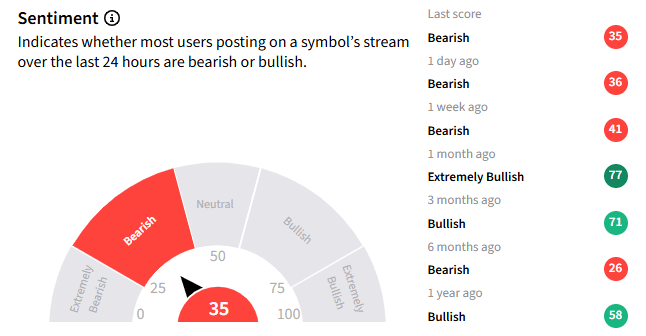
On Stocktwits, retail sentiment for RKLB has been ‘bearish’ over the past week amid ‘normal’ message volume.
One user said, “$RKLB this stock will be in the 40s soon. The neutron rocket is not even on the pad and still undergoing test. It will be well into next year before it is ready to be deployed with satellites.”
Advertisement|Remove ads.
Another user said, “$RKLB I like the company but weekly chart looks weak. Might take a while to settle before it turns up”
Advertisement|Remove ads.
RKLB stock has risen 30% over the past year.
For updates and corrections, email newsroom[at]stocktwits[dot]com.
Read Next: DFTX Stock Jumps Overnight As Investors Brace For Phase 3 Results From LSD-Based Anxiety Drug
Advertisement|Remove ads.
Comments posted here will also appear on symbol pages.

Latest News
/filters:format(webp)https://news.stocktwits-cdn.com/large_Getty_Images_2271718066_jpg_b22f3fd56c.webp)
/filters:format(webp)https://news.stocktwits-cdn.com/unnamed_jpg_9dff551b50.webp) Anan Ashraf·23m ago
Anan Ashraf·23m ago/filters:format(webp)https://news.stocktwits-cdn.com/large_Getty_Images_2215755847_59164c97ad.jpg)
/filters:format(webp)https://news.stocktwits-cdn.com/Anushka_Basu_make_me_smile_in_the_picture_b92832aa_af59_4141_aacc_4180d2241ba8_1_2_png_1086e0ed8c.webp) Anushka Basu·25m ago
Anushka Basu·25m ago/filters:format(webp)https://news.stocktwits-cdn.com/large_Getty_Images_2186006369_jpg_79a3167860.webp)
/filters:format(webp)https://news.stocktwits-cdn.com/1707726834303_jpg_11f20a9aa9.webp) Shashank Nayar·30m ago
Shashank Nayar·30m ago/filters:format(webp)https://news.stocktwits-cdn.com/Getty_Images_2227552516_jpg_55b091826e.webp)
/filters:format(webp)https://news.stocktwits-cdn.com/Harshita_3cfe02022c.jpg) Harshita Tyagi·52m ago
Harshita Tyagi·52m ago/filters:format(webp)https://news.stocktwits-cdn.com/large_Paramount_Skydance_f6bf88fbe3.jpg)
/filters:format(webp)https://news.stocktwits-cdn.com/Whats_App_Image_2026_05_11_at_09_45_43_1_jpeg_a08c0cf251.webp) Aveek Bhowmik·59m ago
Aveek Bhowmik·59m ago/filters:format(webp)https://news.stocktwits-cdn.com/large_bmnr_OG_jpg_83d4f3cc27.webp) Anushka Basu·2h ago
Anushka Basu·2h ago