


Advertisement|Remove ads.
S&P 500 Held Flat Last Month Despite Surging 10Y Treasury Yields — Wall Street's 'Dean Of Valuation' Says Risk Math Hasn't Changed


- The benchmark S&P 500 index rose about 0.1% in July even as 10-year Treasury yields climbed to about 4.74% at the end of the month.
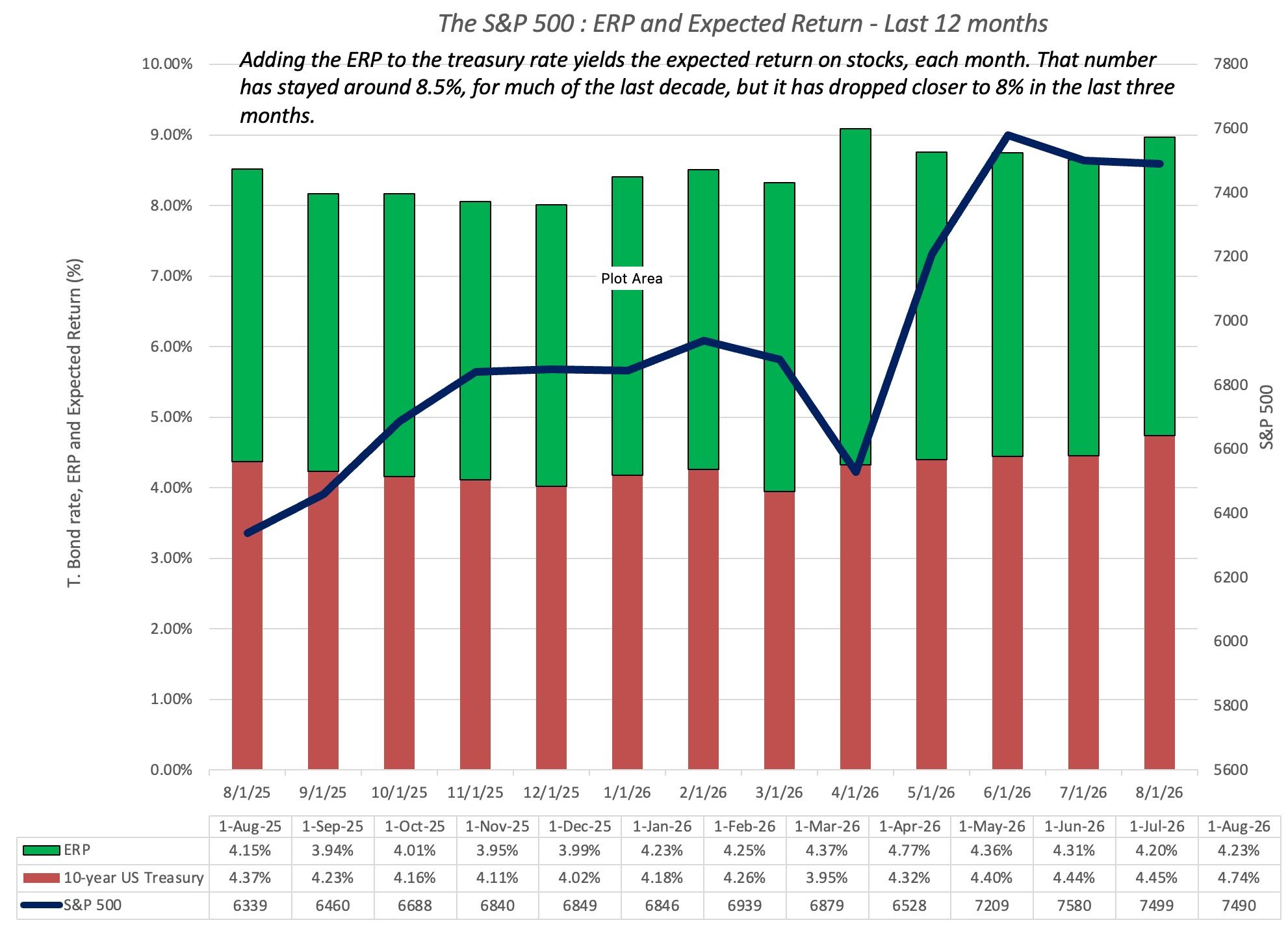
- The ERP for the index at the start of August 2026 stood at 4.23%, with expected return inching up to 8.97%, Damodaran said.
- As per data from his website, this compares with an implied expected return of about 8.65% at the start of July, with an ERP of 4.20% and the 10-year U.S. Treasury yield at 4.45%.
Advertisement|Remove ads.
The benchmark S&P 500 index rose about 0.1% in July even as 10-year Treasury yields climbed to about 4.74% at the end of the month. Meanwhile, the 30-year Treasury climbed over 5% to its highest level since 2007.
Despite the sharp increase in Treasury yields, the equity risk premium (ERP), the extra return investors expect from stocks over a safe investment like a government bond, especially during times of volatility, has largely stayed stable, according to Aswath Damodaran, a professor of finance at NYU Stern School of Business, widely known as Wall Street's “Dean of Valuation.”
The Equity-Bond Correlation
“The S&P 500 was flat for the month and the 10-year treasury rose from 4.45% to 4.74%, as tech and AI came under selling pressure, and fears of war and a slowing economy resurfaced,” Damodaran noted in a post on X.
Advertisement|Remove ads.
“The ERP for the index at the start of August 2026 stood at 4.23%, with expected return inching up to 8.97%,” he said.
As per data from his website, this compares with an implied expected return of about 8.65% at the start of July, with an ERP of 4.20% and the 10-year U.S. Treasury yield at 4.45%.
What’s The Bond Market Signaling?
Meanwhile, James E. Thorne, chief market strategist at Wellington-Altus Private Wealth, said in a post on X last week that the bond market is not necessarily sounding the alarm about rising risk, but is simply doing its job of “demanding compensation” with growing risk and uncertainty.
Advertisement|Remove ads.
“Current credit spreads are not signaling distress,” he said, adding that investment-grade spreads remain tight by historical standards, while high-yield markets are orderly and liquidity is ample. “There is no seizure in funding markets, no forced deleveraging and no meaningful contagion. What is changing is the price of capital at the margin, not its availability.”
“Credit markets are responding exactly as they should. Faced with rising issuance and uncertain returns, they are demanding compensation. That is not alarmism; it is discipline,” he added.
How Are Markets Reacting?
While the S&P 500 was down about 0.13% in July, the Dow Jones Industrial Average gained about 0.32%, while the Nasdaq lost more than 3% in the same time amid greater pressure from the AI selloff and technology weakness, according to data from Koyfin.
Advertisement|Remove ads.
Meanwhile, at the time of writing, the SPDR S&P 500 ETF (SPY), which tracks the S&P 500 index, was up 0.43% amid ‘bearish’ sentiment. The Invesco QQQ Trust ETF (QQQ) and the SPDR Dow Jones Industrial Average ETF Trust (DIA) were up 0.58% and 0.54%, respectively.
The iShares 20+ Year Treasury Bond ETF (TLT), which tracks long-term U.S. government debt with maturities greater than twenty years, was down 0.11% amid ‘bullish’ sentiment, and the iShares 7-10 Year Treasury Bond ETF (IEF) was also down 0.19% amid ‘bullish’ sentiment.
For updates and corrections, email newsroom[at]stocktwits[dot]com.
Advertisement|Remove ads.
Comments posted here will also appear on symbol pages.

Latest News
/filters:format(webp)https://news.stocktwits-cdn.com/gettyimages_2267701500_594x594_1cfbb8b517.jpg)
/filters:format(webp)https://news.stocktwits-cdn.com/1707726834303_jpg_11f20a9aa9.webp) Shashank Nayar·1h ago
Shashank Nayar·1h ago/filters:format(webp)https://news.stocktwits-cdn.com/large_Getty_Images_1503993596_8deb3f6bd9.jpg)
/filters:format(webp)https://news.stocktwits-cdn.com/unnamed_jpg_9dff551b50.webp) Anan Ashraf·1h ago
Anan Ashraf·1h ago/filters:format(webp)https://news.stocktwits-cdn.com/large_Getty_Images_2247481493_2752b5d809.jpg)
/filters:format(webp)https://news.stocktwits-cdn.com/Prabhjote_DP_67623a9828.jpg) Prabhjote Gill·2h ago
Prabhjote Gill·2h ago/filters:format(webp)https://news.stocktwits-cdn.com/large_Getty_Images_1411089032_84de9393bb.jpg) Shashank Nayar·2h ago
Shashank Nayar·2h ago/filters:format(webp)https://news.stocktwits-cdn.com/large_Getty_Images_507531870_jpg_6497bb5caf.webp)
/filters:format(webp)https://news.stocktwits-cdn.com/vivekkrishnanphotography_58_jpg_0e45f66a62.webp) Arnab Paul·2h ago
Arnab Paul·2h ago/filters:format(webp)https://news.stocktwits-cdn.com/large_Getty_Images_1358625679_989f4bbe75.jpg) Anan Ashraf·2h ago
Anan Ashraf·2h ago