


Advertisement|Remove ads.
SLS, IBRX Stocks Post August Gains: Eli Lilly’s Latest $2.9B Deal Has Retail Traders Bracing For An ‘M&A Rampage’


- Lilly agreed to acquire Merida for up to $2.875 billion despite its lead candidate remaining in Phase 1.
- Sellas’ Phase 3 Regal trial is two events away from triggering the final analysis of GPS in acute myeloid leukemia.
- ImmunityBio’s Anktiva is authorized across 34 countries, with an FDA decision on a broader U.S. bladder-cancer label due Jan.6, 2027.
Advertisement|Remove ads.
Shares of Sellas Life Sciences (SLS) and ImmunityBio (IBRX) are stepping into a fresh month following a solid showing in August as Eli Lilly’s rich valuation of Merida Biosciences reinforced retail confidence that Big Pharma remains willing to spend billions on novel approaches to immune-related diseases.
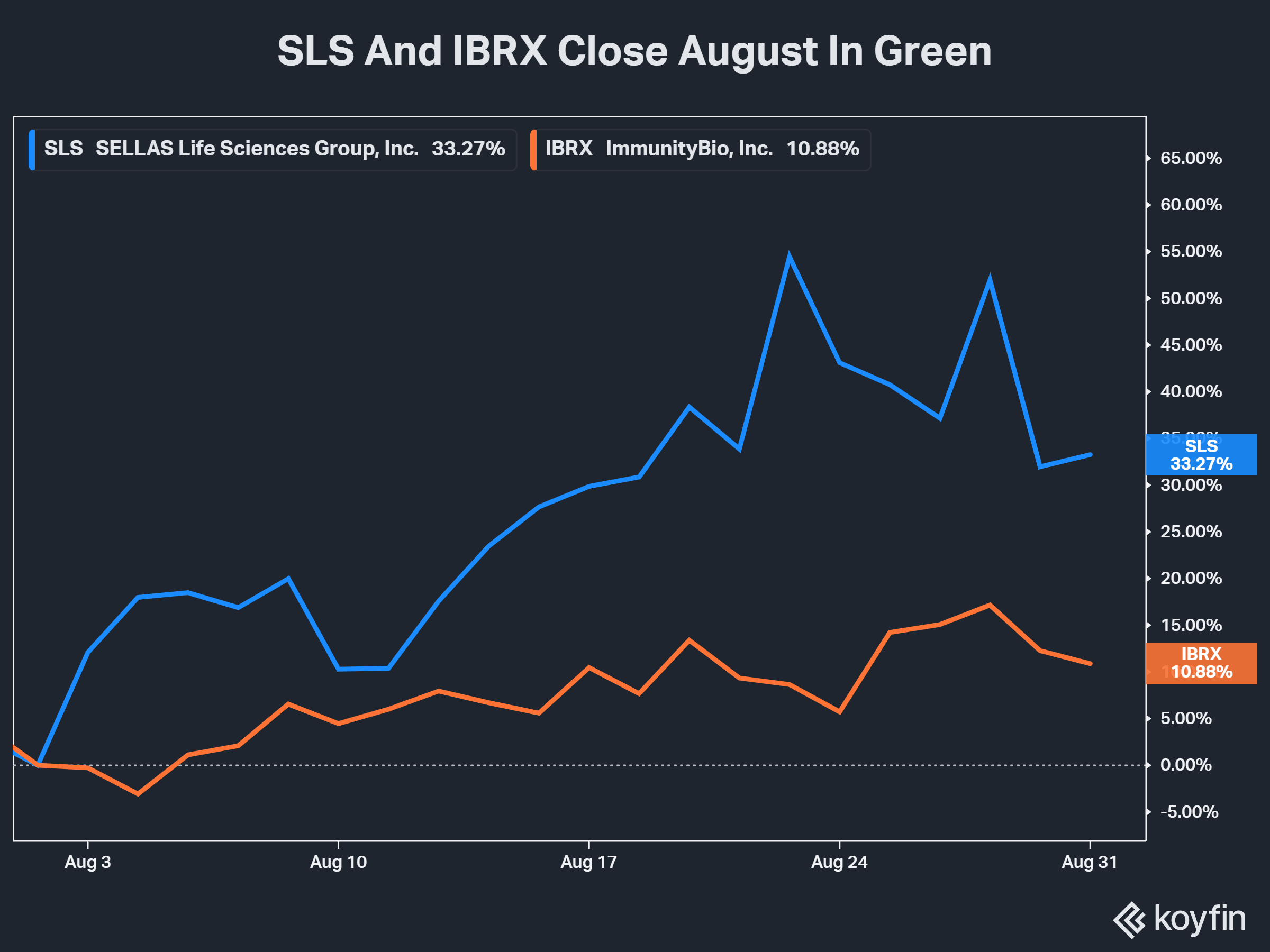
SLS shares gained 41% in August, while IBRX rose 14%. Lilly agreed Monday to acquire privately held Merida for up to $2.875 billion in cash, including an upfront payment and contingent milestones, even though the biotech’s lead candidate remains in Phase 1.
Advertisement|Remove ads.
SLS, IBRX Traders Flag Lilly’s Rich Premium
The Merida price tag became a reference point for retail investors assessing other companies with immune-focused platforms. Sentiment on Stocktwits for SLS and IBRX was ‘neutral,’ while message volume was ‘high’ for SLS and ‘normal’ for IBRX.
“Eli Lilly ponying up $3B for a private immunology company with a lead drug, MER511, only in Phase 1 should put a charge in biotechs,” one IBRX user said. “Eli Lilly going on an M&A rampage,” the user added, saying that its aggressive dealmaking could pressure rival pharma companies to pursue acquisitions.
Sellas traders made a more direct valuation comparison. “$SLS $LLY bought Merida Bio today for $2.85B (more than all of SLS) based on PH1B trial data ...,” one user said, contrasting Merida’s early-stage portfolio with Sellas’ approaching Phase 3 readout and second oncology asset.
Advertisement|Remove ads.
Another SLS watcher stressed that Merida was still at a “very early stage,” with only a Phase 1 candidate and research pipeline, highlighting Lilly’s willingness to pay up to $2.875 billion for promising immunology assets.
Lilly’s Immunology Deal Spree
Merida develops precision therapies that can remove disease-causing autoantibodies, while preserving protective antibodies and normal immune function. Its lead candidate, MER511, is in Phase 1 development for Graves’ disease and thyroid eye disease. Early data showed substantial reductions in thyroid-stimulating immunoglobulins, which are the autoantibodies driving both conditions, alongside a favorable preliminary safety profile.
Merida’s pipeline also includes preclinical candidate MER769 for food allergy, asthma and chronic spontaneous urticaria, as well as earlier programs targeting kidney and other antibody-driven diseases.
Advertisement|Remove ads.
The deal extends Lilly’s 2026 acquisition push, which includes its $1.2 billion purchase of Ventyx Biosciences and agreement to acquire Orna Therapeutics for up to $2.4 billion. Together, the deals expand Lilly across inflammasome inhibition, in vivo CAR-T and autoantibody degradation.
SLS, IBRX Target The Immune System
Sellas and ImmunityBio operate primarily in oncology rather than autoimmune disease, but both pursue targeted immune intervention.
Sellas’ lead candidate, Galinpepimut-S (GPS) activates CD4 and CD8 T-cell responses against WT1, a cancer antigen expressed in acute myeloid leukemia (AML) and other malignancies. Its Phase 3 Regal trial has recorded 78 of the 80 events required to trigger the final analysis. The study will be considered successful if GPS delivers a median overall survival of 12.6 months, versus eight months for the control arm, potentially supporting an FDA application.
Advertisement|Remove ads.
“As major clinical trial catalysts approach, market noise, speculation, and third-party commentary naturally intensify,” CEO Angelos Stergiou said in a recent LinkedIn post. He added that Sellas would allow “the rigorous, unblinded clinical data from REGAL to speak for itself.”
Sellas is also advancing SLS009, a selective CDK9 inhibitor that has shown activity in AML and lymphomas and holds Fast Track, Orphan Drug and Rare Pediatric Disease designations.
ImmunityBio’s Anktiva, meanwhile, is approved alongside BCG for certain patients with early-stage bladder cancer that no longer responds to BCG alone. The drug strengthens the body’s cancer-fighting response by activating natural killer cells and CD8 T cells, while the company’s broader pipeline includes vaccines and engineered immune-cell therapies.
Advertisement|Remove ads.
Anktiva is approved or authorized across 34 countries. The FDA is reviewing a U.S. label expansion for papillary-only bladder tumors, with a decision expected by Jan.6, 2027.
While SLS stock has rocketed 595% over the past year, IBRX has surged 240% over the same period.
For updates and corrections, email newsroom[at]stocktwits[dot]com.
Advertisement|Remove ads.
Comments posted here will also appear on symbol pages.

Latest News
/filters:format(webp)https://news.stocktwits-cdn.com/gettyimages_2299257316_612x612_c40e6aa98d.jpg)
/filters:format(webp)https://news.stocktwits-cdn.com/Prabhjote_DP_67623a9828.jpg) Prabhjote Gill·1h ago
Prabhjote Gill·1h ago/filters:format(webp)https://news.stocktwits-cdn.com/gettyimages_2267701500_594x594_1cfbb8b517.jpg)
/filters:format(webp)https://news.stocktwits-cdn.com/1707726834303_jpg_11f20a9aa9.webp) Shashank Nayar·3h ago
Shashank Nayar·3h ago/filters:format(webp)https://st-everywhere-cms-prod.s3.us-east-1.amazonaws.com/large_Fintech_stock_bef0de12ed.jpg) Shashank Nayar·3h ago
Shashank Nayar·3h ago/filters:format(webp)https://news.stocktwits-cdn.com/large_Getty_Images_2153399754_46a0047462.jpg)
/filters:format(webp)https://news.stocktwits-cdn.com/unnamed_jpg_9dff551b50.webp) Anan Ashraf·3h ago
Anan Ashraf·3h ago/filters:format(webp)https://news.stocktwits-cdn.com/large_Getty_Images_1358625659_b011ef9a83.jpg) Anan Ashraf·4h ago
Anan Ashraf·4h ago/filters:format(webp)https://news.stocktwits-cdn.com/large_Getty_Images_2295226888_dcdb8e346d.jpg) Shashank Nayar·6h ago
Shashank Nayar·6h ago