


Advertisement|Remove ads.
Small-Cap Tech Stock Bets $400M On Bitcoin Quantum Upgrade Amid Rising Industry Risks


- MicroCloud Hologram announced on Monday that it will invest $400 million to create a quantum-resistant Bitcoin update.
- The proposed upgrade will use a modular design and soft fork technique to retain compatibility and enhance security against future quantum attacks.
- The update comes after Google published a study stating that quantum computing would be able to breach Bitcoin investor Satoshi Nakamoto’s crypto wallets in as little as 9 minutes.
Advertisement|Remove ads.
MicroCloud Hologram Inc. (HOLO) announced on Monday that it will invest $400 million in developing a quantum-resistant update for Bitcoin (BTC), aiming to defend the network from possible dangers posed by future quantum computer developments.
The company stated that it will focus on developing a hybrid cryptographic architecture that will allow both existing and post-quantum signature methods to operate concurrently. This dual-signing strategy is intended to provide more security while allowing for a gradual transition, minimizing disturbance to the current Bitcoin ecosystem.
MicroCloud said it plans to support several post-quantum cryptography approaches and uses a modular design to keep the blockchain from becoming too large while remaining secure and efficient. It added that a soft fork is likely how the upgrade will be done.
Advertisement|Remove ads.
The company stated it would provide new verification tools while keeping compatibility with existing nodes. The rollout will happen in stages, starting with testnet trials, then moving to mainnet integration, and finally a larger update that everyone agrees on, with support from hardware acceleration and improved infrastructure.
HOLO’s stock was up over 3% on Monday morning trade amid strength in the broader market. The stock, which has a market cap of around $47 million, was down over 22% year-to-date.
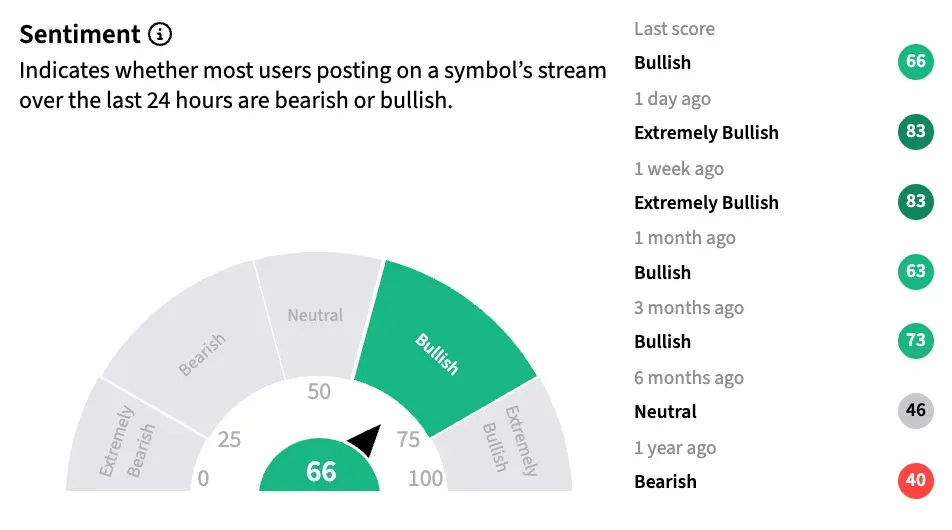
On Stocktwits, retail sentiment around HOLO remained dropped to ‘bullish’ from ‘extremely bullish’ territory, while chatter moved to ‘high’ from ‘extremely high’ levels over the past day.
Advertisement|Remove ads.
Coinbase CEO Pushes Bitcoin Quantum Fix
The initiative comes as the industry focuses on quantum hazards to cryptographic systems.
Coinbase (COIN) CEO Brian Armstrong recently stated that he will lead efforts to make Bitcoin quantum-resistant. Last week, on X, Armstrong said he would “start spending time on this personally,” adding that Bitcoin’s quantum risk “needs to be solved sooner rather than later.”
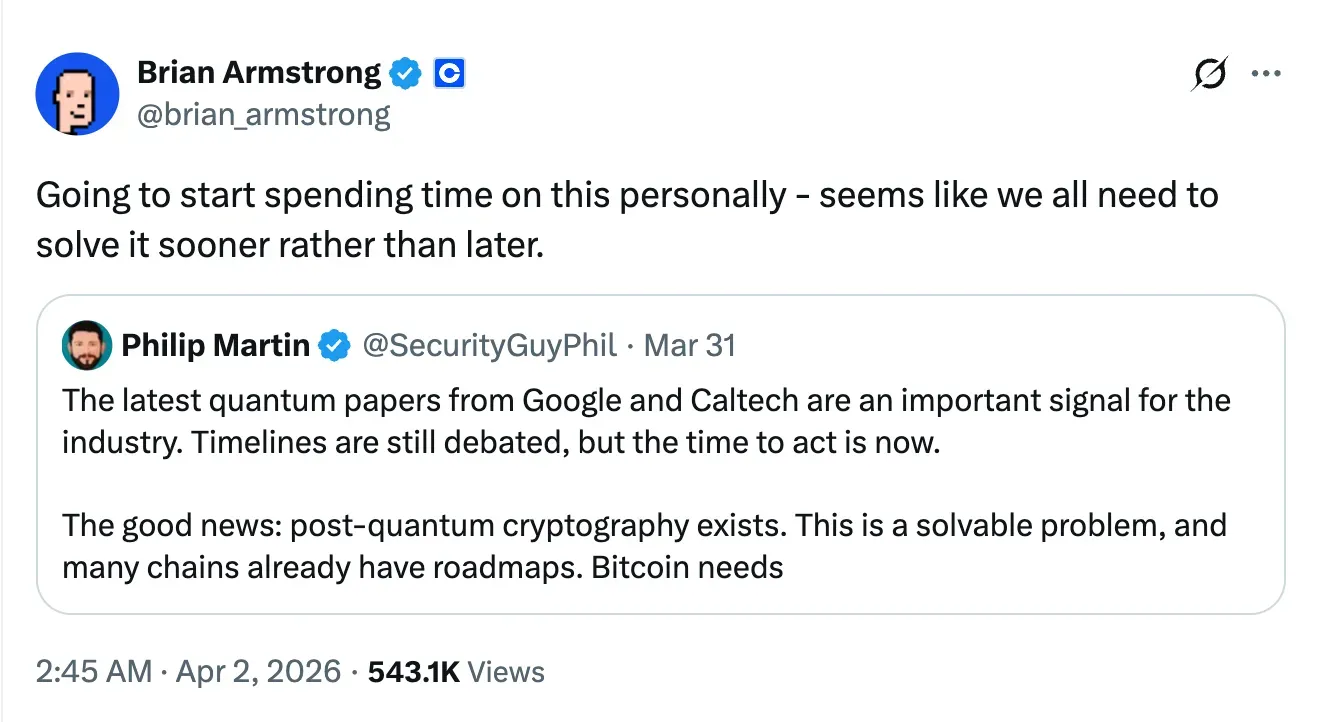
His comments came after Google (GOOGL/ GOOG) Quantum AI published a study presenting a theoretical system capable of breaching Bitcoin's elliptic curve cryptography using Shor's Algorithm.
Advertisement|Remove ads.
The report said that hackers would be able to use new quantum computing techniques to crack open wallets belonging to Bitcoin investor Satoshi Nakamoto in as little as nine minutes.
Read also: Broadridge Rolls Out Tokenized Shareholder Voting On Avalanche – Galaxy To Lead First Use Case
For updates and corrections, email newsroom[at]stocktwits[dot]com.
Comments posted here will also appear on symbol pages.

Latest News
/filters:format(webp)https://news.stocktwits-cdn.com/large_Getty_Images_1140163617_f532763e0e.jpg)
/filters:format(webp)https://news.stocktwits-cdn.com/Anushka_Basu_make_me_smile_in_the_picture_b92832aa_af59_4141_aacc_4180d2241ba8_1_2_png_1086e0ed8c.webp) Anushka Basu·2h ago
Anushka Basu·2h ago/filters:format(webp)https://news.stocktwits-cdn.com/large_Getty_Images_1241727187_186fa8e2c2.jpg) Anushka Basu·3h ago
Anushka Basu·3h ago/filters:format(webp)https://news.stocktwits-cdn.com/large_Grant_Cardone_e02d86f642.webp) Anushka Basu·4h ago
Anushka Basu·4h ago/filters:format(webp)https://news.stocktwits-cdn.com/large_Getty_Images_2291403399_8dbede0ce6.jpg) Anushka Basu·5h ago
Anushka Basu·5h ago/filters:format(webp)https://news.stocktwits-cdn.com/large_us_treasury_yields_jpg_074c6369d6.webp)
/filters:format(webp)https://st-everywhere-cms-prod.s3.us-east-1.amazonaws.com/i_OS_App_Icon_1_8054f2a2fe.png) Stocktwits News Desk·7h ago
Stocktwits News Desk·7h ago/filters:format(webp)https://news.stocktwits-cdn.com/large_Getty_Images_2203983775_jpg_74bdd5dd43.webp) Stocktwits News Desk·7h ago
Stocktwits News Desk·7h ago