


Advertisement|Remove ads.
This Semiconductor ETF Is Set For Its Worst Week In Over 18 Months As Democratic Sweep Raises Data Center Skepticism


- The Philadelphia Stock Exchange Semiconductor Index (SOX) plummeted 9.2%, marking its worst single-day performance since June and heading toward a 12% weekly decline.
- Following Tuesday's midterms, where Democrats secured control of both chambers of Congress, voter opposition to data centers intensified, highlighted by proposed development freezes in states like Texas.
- Heavyweights across the sector—including Nvidia, AMD, Micron, and ARM—faced sharp double-digit corrections amid investor skepticism around the sustainability of the AI trade.
Advertisement|Remove ads.
Semiconductor shares tumbled on Thursday, deepening a multi-week retreat as market participants reassessed the long-term viability of the artificial intelligence boom, especially after a Democratic sweep in the mid-term elections.
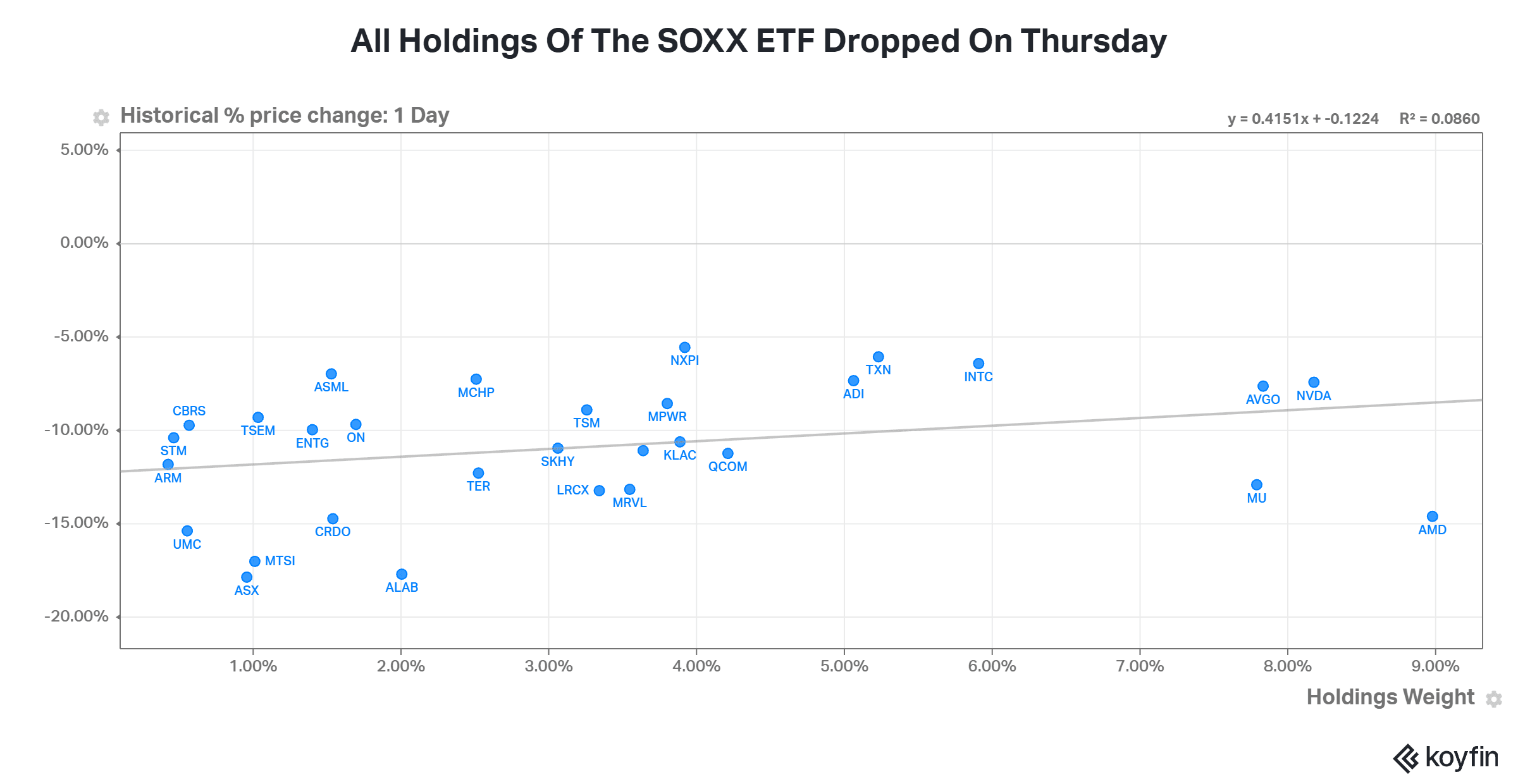
The Philadelphia Stock Exchange Semiconductor Index dropped 9.2%, putting the benchmark on pace for its sharpest daily decline since June. The index has dropped roughly 12% over the week, putting it on track for its worst performance since April 2025 and its fifth consecutive weekly loss. Similarly, the iShares Semiconductor ETF (SOXX) also dropped about 11% on Thursday, with all of its constituents set to close in red.

Advertisement|Remove ads.
Nvidia Corp.(NVDA) slid up to 7.5%, marking its steepest intraday percentage drop since April 2025. Meanwhile, Advanced Micro Devices Inc.(AMD) slumped 15%, Micron Technology Inc. (MU) tumbled 13%, and Intel Corp.(INTC) retreated 9.2% at the time of writing on Thursday.
The correction also rippled far beyond traditional hardware manufacturers; memory storage providers like Western Digital Corp.(WDC) dropped more than 14%, while neocloud platforms CoreWeave Inc.(CRWV) and Nebius Group NV (NBIS) dropped 12% and 17%, respectively.
The Political Backlash Against Data Centers
The sudden acceleration in the tech selloff was heavily catalyzed by the outcome of Tuesday's midterm elections, which saw Democrats capture majorities in both the Senate and the House of Representatives. Electoral campaigns increasingly centered around public pushback against massive data center developments, driven by community anxieties over escalating electricity costs, environmental strains, and grid reliability.
Advertisement|Remove ads.
In Texas, newly elected Governor-elect Gina Hinojosa amplified these regional concerns by advocating for an immediate moratorium on new data center construction. Because data centers serve as the physical backbone for AI infrastructure—packed densely with rows of advanced semiconductors—any regulatory roadblock or deceleration in data center spending threatens to translate into severe long-term headwinds for chipmakers.
The Alternative View
While the immediate market reaction reflects AI panic, an alternative perspective suggests that a political shift toward restraining data center expansion could act as a healthy check on runaway AI capital expenditure (capex).
Proponents of this view argue that a Democratic win could apply brakes to the pace of data center construction, which would in turn help curb cash flow problems most hyperscalers face today.
Advertisement|Remove ads.
Firms like Deutsche Bank have pointed out that relative to software segments, select semiconductor groups retain underlying valuation attractiveness as core technological pillars.
SOXX ETF: Retail View
Retail sentiment on Stocktwits was ‘extremely bullish’ with ‘high’ message volumes.
SOXX ETF has gained about 33% year-to-date.
Advertisement|Remove ads.
For updates and corrections, email newsroom[at]stocktwits[dot]com.
Comments posted here will also appear on symbol pages.

Latest News

 Shashank Nayar·17m ago

 Anan Ashraf·55m ago

 Prabhjote Gill·2h ago
 Shashank Nayar·2h ago
 Anan Ashraf·2h ago

 Arnab Paul·3h ago