


Advertisement|Remove ads.
SPCX Rises Ahead Of Starship's First Orbital Attempt: Industry Insider Sees 16x Cheaper Starlink Capacity By 2028


- Starship is scheduled to deploy 26 new Starlink satellites, circle Earth about six times, and splash down in the Pacific.
- SpaceX’s CFO called it Starship’s first “revenue-generating flight” because the satellites are intended for the Starlink network.
- Mach33 founder Aaron Burnett predicts Starship could cut the cost of launching each unit of satellite network capacity 16-fold by 2028.
Advertisement|Remove ads.
SpaceX (SPCX) shares rose 0.3% in overnight trading heading into Monday, ahead of Starship's first attempt to reach orbit and deploy 26 Starlink satellites. A space-industry researcher projected that the cost of launching each unit of Starlink network capacity could fall 16-fold by 2028.
SPCX stock fell 3% last week, ending a four-week winning streak.
SpaceX Sets Sights On Starship’s First Orbital Flight
The 75-minute launch window opens at 8:15 a.m. ET Monday at Starbase, Texas. The Federal Aviation Administration (FAA) authorized Flight 14’s launch and reentry operations over the weekend after SpaceX completed a full launch rehearsal with the rocket last week. SpaceX had previously targeted Sept.22 for the flight.
Advertisement|Remove ads.
Flight 14 is designed to take Starship into Earth orbit for the first time. Its earlier test flights followed suborbital paths. Ship 41 is set to deploy 26 Starlink V3 satellites at about 275 kilometers, then circle Earth six times before a planned deorbit and splashdown in the Pacific Ocean west of Chile. The mission is expected to last nearly 10 hours. The Super Heavy booster is slated to splash down in the Gulf of Mexico.
The satellite payload gives this test a commercial purpose. SpaceX CFO Bret Johnsen called Flight 14 earlier this month Starship’s first “revenue-generating flight” and called the rocket “core to the rest of our business.” The 26 V3 satellites are intended to add capacity to Starlink’s broadband network if they deploy successfully and are brought into service.
Starlink says the larger V3 satellites have solar arrays designed to generate about twice as much power as those on the V2 satellites SpaceX has launched aboard Falcon 9. Elon Musk has said a fully deployed V3 constellation could ultimately provide more than 100 times the bandwidth of the current Starlink network.
Advertisement|Remove ads.
Mach33 Founder Forecasts Cheaper Starlink Capacity
Aaron Burnett, founder and CEO of space-focused investment and research firm Mach33, estimates that Flight 14’s payload represents about 26 terabits per second (Tbps) of network capacity. Based on his assumed Starship launch cost, he calculates about $9.8 million per Tbps launched on this mission, close to his estimate for Falcon 9. Burnett expects fuller Starship payloads, reuse of the rocket and manufacturing gains to lower that cost per Tbps by 16 times by 2028.
The potential scale of Starship launches has also drawn a more ambitious calculation from ARK Investment Management CEO Cathie Wood. She said earlier this month that the network capacity delivered by a future, larger Starship payload could support about $1 billion in annual Starlink revenue. Applying that estimate to Musk’s goal of 10,000 flights annually by 2030 yields $10 trillion annually, Wood said.
Musk also said on X over the weekend that Starship is “2 to 3 years away from hourly flights.” He has said SpaceX plans to attempt a launch-tower catch of the Starship upper stage after Flight 14 and believes rapid, full reusability is achievable in 2027.
Advertisement|Remove ads.
How Do Retail Traders Feel About SPCX?
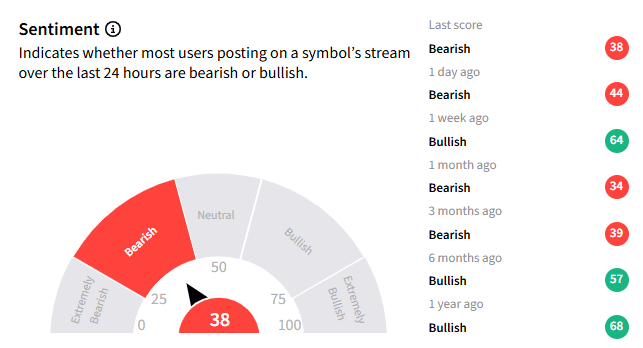
On Stocktwits, retail sentiment for SPCX fell to ‘bearish’ from ‘bullish’ over the past week while 24-hour message volume jumped 74%.
One user said, “$SPCX Successful flight can launch this past 200”
Advertisement|Remove ads.
Another user said, “$SPCX successful launch monday could send us a to rerate with starship on track for datacenter payloads next year. $200.”
SPCX stock has declined 8% year-to-date.
Advertisement|Remove ads.
For updates and corrections, email newsroom[at]stocktwits[dot]com.
Read Next: ASTS Stock Eyes Best Month Since May: New German Filing Puts 344-Satellite BlueBird Plan In Focus
Comments posted here will also appear on symbol pages.

Latest News
/filters:format(webp)https://news.stocktwits-cdn.com/large_Getty_Images_2203983775_jpg_74bdd5dd43.webp)
/filters:format(webp)https://st-everywhere-cms-prod.s3.us-east-1.amazonaws.com/i_OS_App_Icon_1_8054f2a2fe.png) Stocktwits News Desk·42m ago
Stocktwits News Desk·42m ago/filters:format(webp)https://news.stocktwits-cdn.com/large_michael_burry_cropped_b787ce89b4.jpg) Stocktwits News Desk·2h ago
Stocktwits News Desk·2h ago/filters:format(webp)https://news.stocktwits-cdn.com/large_Getty_Images_2183659586_0929f742b5.jpg)
/filters:format(webp)https://news.stocktwits-cdn.com/Anushka_Basu_make_me_smile_in_the_picture_b92832aa_af59_4141_aacc_4180d2241ba8_1_2_png_1086e0ed8c.webp) Anushka Basu·2h ago
Anushka Basu·2h ago/filters:format(webp)https://news.stocktwits-cdn.com/large_Federal_Reserve_a31f9e5606.jpg) Stocktwits News Desk·3h ago
Stocktwits News Desk·3h ago/filters:format(webp)https://news.stocktwits-cdn.com/large_circle_stablecoins_original_jpg_b238d12be8.webp) Anushka Basu·3h ago
Anushka Basu·3h ago/filters:format(webp)https://news.stocktwits-cdn.com/large_mohamed_el_erian_jpg_4608eef11b.webp) Stocktwits News Desk·3h ago
Stocktwits News Desk·3h ago