


Advertisement|Remove ads.
SPCX Stock Set For Index Boost? Elon Musk ‘Highly Confident’ Nvidia AI Computers Will Launch Into Space Next Year



- Musk said he is “highly confident” SpaceX will launch Nvidia Vera Rubin NVL72 AI computers into orbit in 2027.
- SpaceX and Nvidia are adapting the NVL72 platform for orbital weight, radiation and thermal constraints.
- The Starmind satellites would use solar power, radiator cooling and Starlink-derived laser communications.
Advertisement|Remove ads.
Shares of SpaceX (SPCX) could attract billions of dollars in passive-fund buying as its Nasdaq 100 weighting is expected to more than double later this month, while CEO Elon Musk said he is “highly confident” the company will launch Nvidia-powered AI computers into orbit in 2027.
SPCX stock closed 2% higher at $151.21 on Friday, capping its third consecutive weekly gain after rising 2% for the week.
SpaceX Eyes Nasdaq 100 Boost
SpaceX’s Nasdaq 100 weighting is projected to rise to about 2.82% from 1.28%, Bloomberg noted, citing preliminary index data. The final allocation will be determined later this month. The increase could prompt billions of dollars in purchases by funds tracking the benchmark. About $1.7 trillion in assets followed the Nasdaq 100 at the end of the second quarter, including the $481 billion Invesco QQQ Trust (QQQ).
Advertisement|Remove ads.
SpaceX received a relatively small weighting when it joined the index in July because most of its shares remained locked up after its initial public offering. Its free float has since expanded as those restrictions expired.
Concerns that August’s first two lockup expirations would trigger heavy insider selling did not materialize. Further expirations could increase SpaceX’s weighting again.
SpaceX Targets AI Launch Next Year
“I am highly confident that SpaceX will be launching Nvidia VR NVL72 AI computers in space next year,” Musk said on X on Sunday. The hardware is a space-optimized version of Nvidia’s Vera Rubin NVL72 platform, which combines 72 Rubin graphics processing units with 36 Vera central processing units.
Advertisement|Remove ads.
SpaceX’s IPO prospectus said orbital AI satellites could launch “as early as 2028.” Musk subsequently narrowed the window to the fourth quarter of 2027, with “significant scale” expected in 2028.
SpaceX Goes All-In On Nvidia
Musk said SpaceX would build its AI infrastructure exclusively around Nvidia. SpaceX and Nvidia have redesigned the terrestrial NVL72 system for the weight, radiation and thermal constraints of orbit. Musk has called the orbital version “significantly simpler, lower cost, denser and lighter than a traditional rack.”
The first Starmind satellites are expected to carry one rack’s worth of computing power, using solar energy, radiator cooling and laser links derived from Starlink tech. SpaceX President Gwynne Shotwell has said the spacecraft would be “to some extent simpler than the next-gen V3 Starlink satellites.”
Advertisement|Remove ads.
SpaceX Bets On Orbital Data Centers
SpaceX argues that orbital data centers could avoid the land, electricity and water limitations facing computing infrastructure on Earth. Musk has predicted that space will become “by far the cheapest place to put AI” within two to three years. The company has sought regulatory approval for a constellation of up to one million AI satellites, although deployment at that scale remains a long-term goal.
Starship will be crucial to lowering the cost of placing large amounts of computing hardware in orbit. Radiation, cooling, maintenance and launch economics remain significant challenges. SpaceX has already signed compute-rental agreements with Anthropic and Google, while Nvidia held a $21 billion investment in the company as of mid-2026.
How Do Retail Traders Feel About SpaceX?
On Stocktwits, retail sentiment for SpaceX was ‘neutral’ amid a 26% rise in 24-hour message volume.
Advertisement|Remove ads.
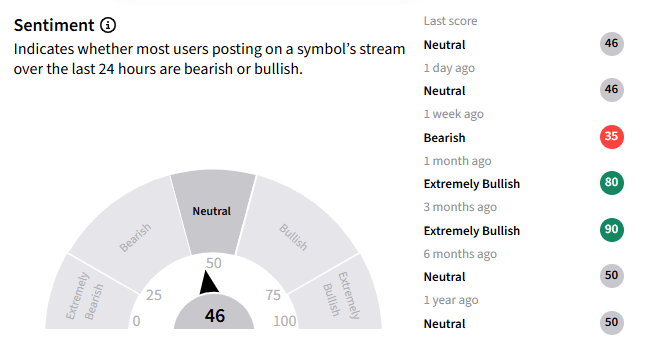
One user said, “Increase in Nasdaq 100 weight factor for $SPCX makes sense to align with their market cap. So they'll become 6th biggest weight factor afterwards.”
Another user said, “$SPCX I think the AI scare will give building on the moon and in Mexico, more of a bullish catalyst”
Advertisement|Remove ads.
SPCX stock has declined 6% over the past three months.
For updates and corrections, email newsroom[at]stocktwits[dot]com.
Advertisement|Remove ads.
Comments posted here will also appear on symbol pages.

Latest News
/filters:format(webp)https://news.stocktwits-cdn.com/Getty_Images_2228900888_jpg_338103de79.webp)
/filters:format(webp)https://news.stocktwits-cdn.com/Anushka_Basu_make_me_smile_in_the_picture_b92832aa_af59_4141_aacc_4180d2241ba8_1_2_png_1086e0ed8c.webp) Anushka Basu·1h ago
Anushka Basu·1h ago/filters:format(webp)https://news.stocktwits-cdn.com/large_Getty_Images_1767602875_jpg_db2e050c08.webp) Anushka Basu·2h ago
Anushka Basu·2h ago/filters:format(webp)https://news.stocktwits-cdn.com/large_new_york_stock_exchange_jpg_e1f85c0d8c.webp)
/filters:format(webp)https://st-everywhere-cms-prod.s3.us-east-1.amazonaws.com/i_OS_App_Icon_1_8054f2a2fe.png) Stocktwits News Desk·2h ago
Stocktwits News Desk·2h ago/filters:format(webp)https://news.stocktwits-cdn.com/large_grayscale_OG_jpg_c35dc5b1a2.webp) Anushka Basu·3h ago
Anushka Basu·3h ago/filters:format(webp)https://news.stocktwits-cdn.com/large_Google_Office_in_New_York_City_2ff844002a.jpg) Stocktwits News Desk·3h ago
Stocktwits News Desk·3h ago/filters:format(webp)https://news.stocktwits-cdn.com/large_mark_rubio_original_jpg_1e75e0c7f2.webp) Stocktwits News Desk·4h ago
Stocktwits News Desk·4h ago